Meet the crystal

Forever SnS Crystal Passport
Ammolite
Pronounced: AM-uh-lite
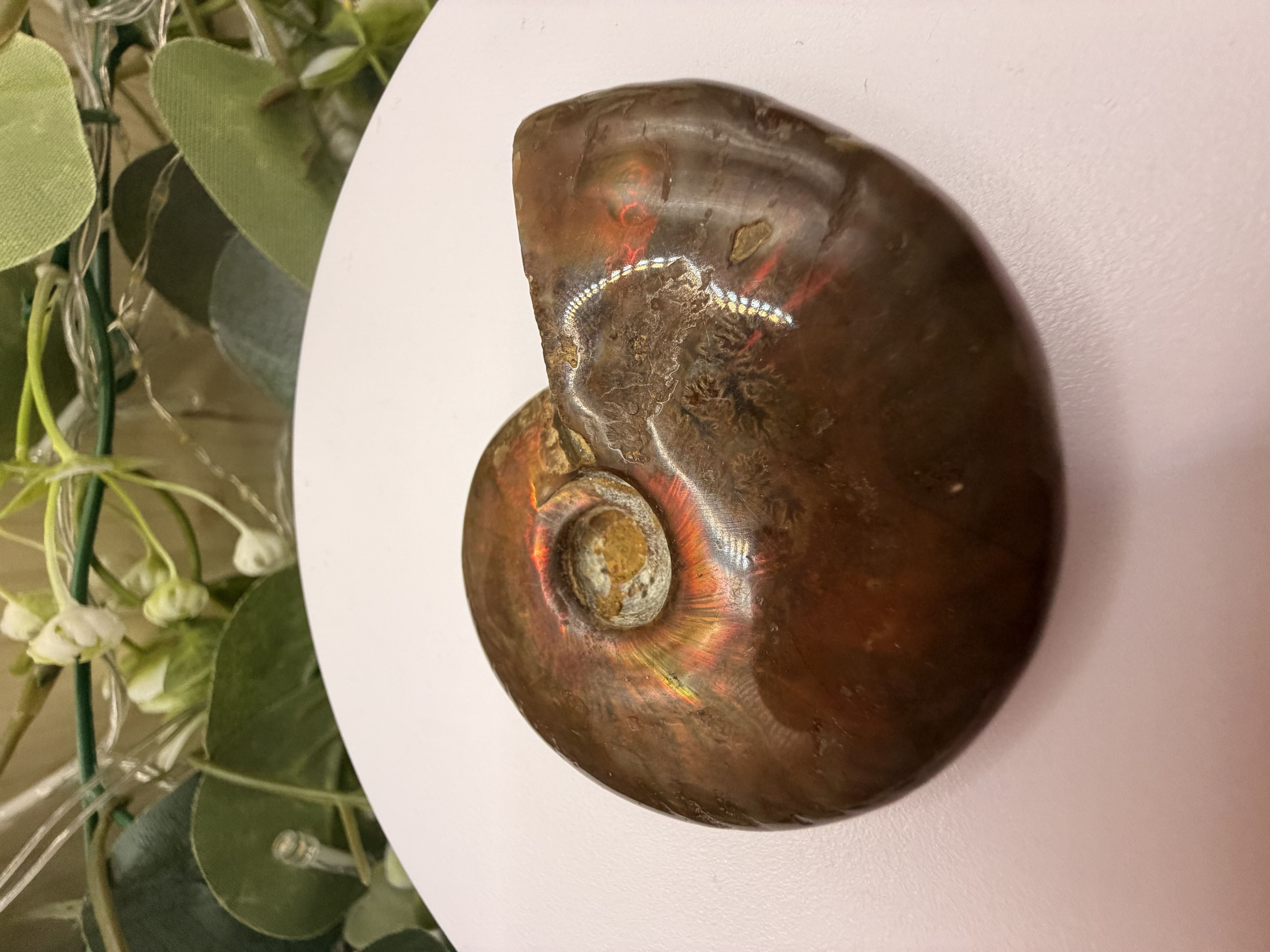
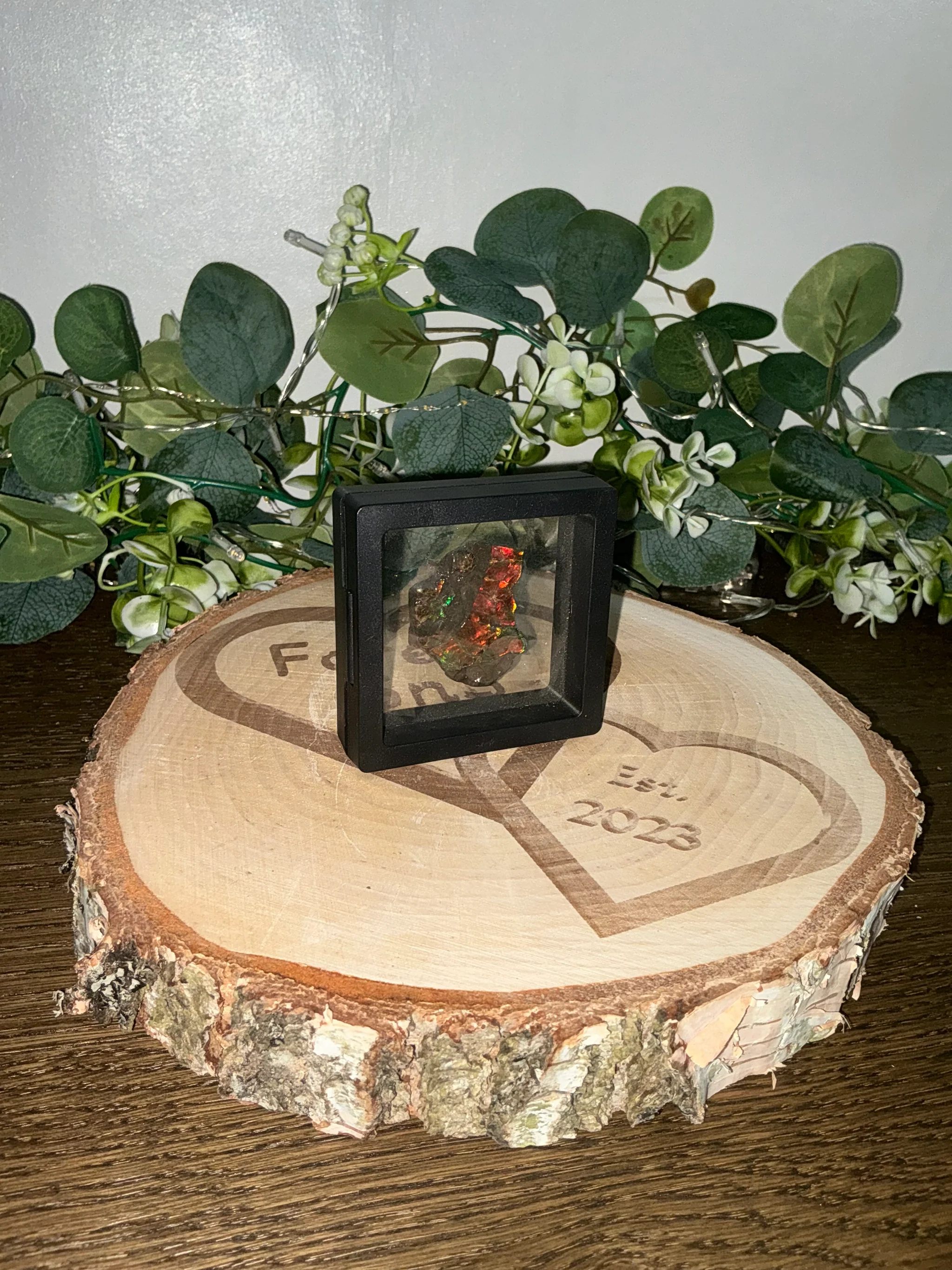
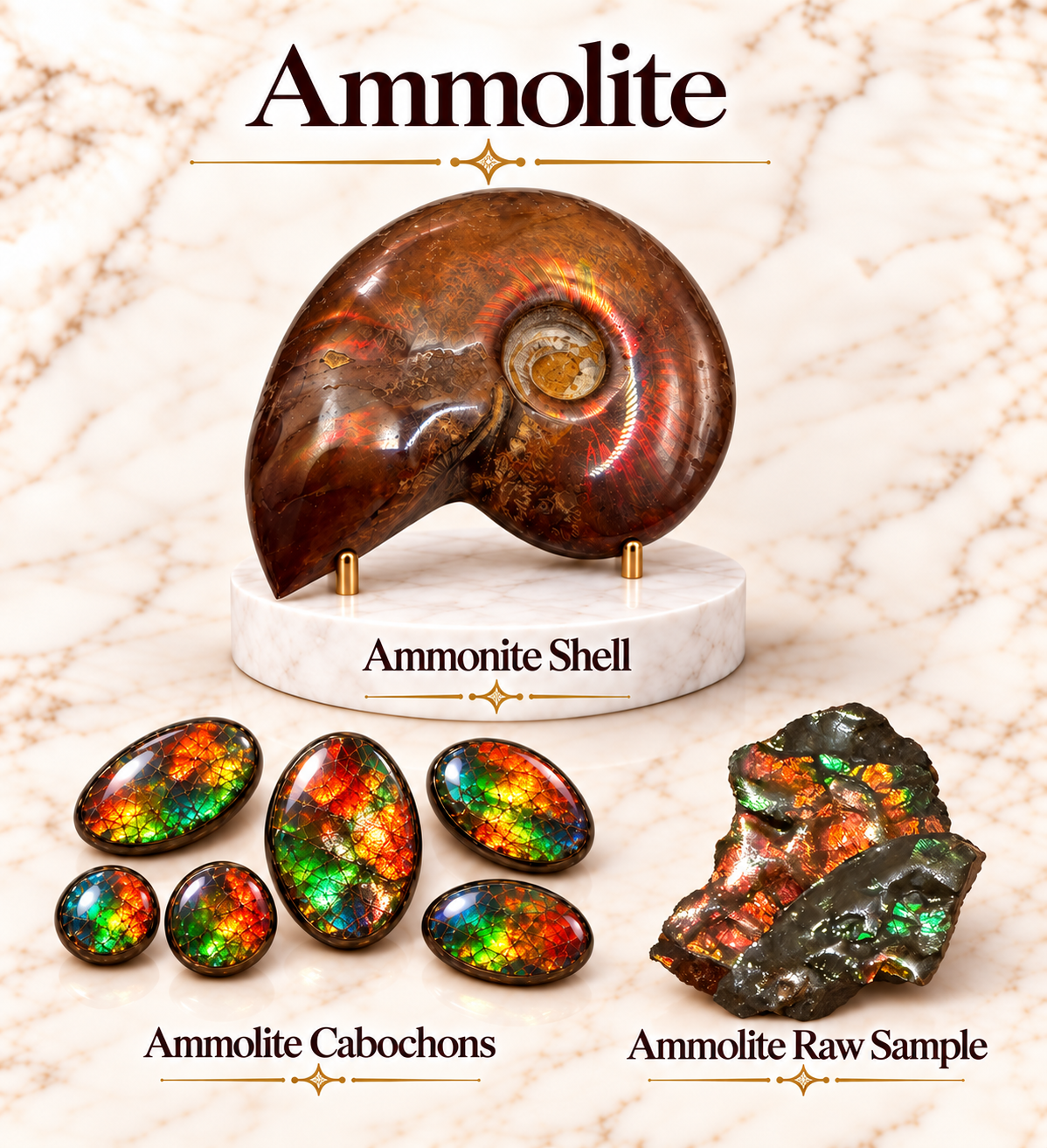
Ammolite is a rare, naturally iridescent gemstone formed from the fossilised shells of ancient ammonites. Famous for brilliant flashes of red, green, gold, blue and violet, the finest gem-quality material is associated with the Late Cretaceous Bearpaw Formation of southern Alberta, Canada.
CWExplore this passport
Showing Science & Formation
Scientific passport
The mineral facts
Observable and measurable properties used to describe and identify this mineral.
- Chemical formula
- Predominantly CaCO₃ — calcium carbonate in the form of aragonite
- Mineral class
- Organic/biogenic gem material — fossil ammonite shell; predominantly carbonate mineral aragonite
- Crystal system
- Orthorhombic — referring to its aragonite component
- Mohs hardness
- Approximately 3.5–4
- Lustre
- Vitreous to resinous, with strong iridescence
- Streak
- White for the aragonite component; streak testing is not recommended for gem Ammolite
- Specific gravity
- Approximately 2.76–2.84 for natural solid Ammolite; values can vary because of shell structure, asso
- Transparency
- Generally opaque; very thin shell layers may be translucent
Common colours
Red, orange, yellow, gold, green, blue and violet, often with several colours visible within the same specimen
Cleavage and fracture
No readily observed true cleavage in gem Ammolite; strong parting can occur along the thin shell layers. The material is brittle and naturally prone to fracturing and delamination. The GIA study of Alberta Ammolite measured specific gravities mostly around 2.76–2.84 and describes the material as predominantly soft aragonite with pronounced sheet-like parting.
From the Earth
How it forms
The geological processes that create this crystal over time.
Formation
Its geological story
Ammolite begins with the shell of an ammonite, an extinct marine cephalopod. During the Late Cretaceous, ammonites lived in the sea that covered what is now southern Alberta. After death, some shells sank into seafloor sediment and became buried within mud that later formed the Bearpaw Formation. Normally, the original shell material of a fossil can dissolve or be replaced by other minerals. Under the unusual burial conditions present in parts of southern Alberta, portions of the original aragonitic shell were preserved. Over millions of years, burial, pressure and mineralisation preserved the extremely fine layered shell structure responsible for Ammolite's colour. When light enters these microscopic aragonite layers, different wavelengths interfere with one another, creating the brilliant iridescence seen at the surface. The Bearpaw Formation itself consists largely of marine shale and siltstone deposited within an ancient inland sea.
A closer look
Scientific notes
Ammolite is unusual because it is simultaneously a fossil-derived material and a gemstone rather than an individual mineral species. Its vivid colours are not primarily caused by coloured pigments. Instead, its iridescence is a structural optical effect. Light interacts with extremely thin layers of aragonite within the fossil shell, causing interference that allows certain wavelengths to be reflected more strongly than others. The thickness and condition of these layers influence the colours observed. Red and green are relatively common, while strong blue and violet can be less common because they require finer preserved structures. Classic Canadian Ammolite comes from certain horizons of the Bearpaw Formation and is associated particularly with Placenticeras meeki and P. intercalare. The original aragonite shell layer can be only a fraction of a millimetre to a few millimetres thick after preparation, explaining why the material often needs reinforcement before use in jewellery.
Passport stamps
Where in the world?
Important countries, regions and mineral localities connected with this crystal.
Canada
Bearpaw Formation, southern Alberta
Alberta
This is the most important Ammolite locality in the world. Gem-quality Ammolite is found almost exclusively in southern Alberta, particularly in the Bearpaw Formation, where unusual geological conditions preserved the iridescent aragonite shell of ammonites.
Canada
St. Mary River area
Alberta
The St. Mary River area is one of the classic regions associated with commercial Ammolite production. It is especially important because many of the best-known Ammolite occurrences and mining operations are linked to this part of southern Alberta.
Canada
Lethbridge area
Alberta
Lethbridge is strongly associated with Ammolite’s public identity and commercial development. The region helped establish Ammolite as an internationally recognised gemstone and lies close to the main productive zones of the Bearpaw Formation.
Canada
Milk River region
Alberta
The Milk River region forms part of southern Alberta’s fossil-bearing landscape and is significant for the wider geological setting of the Bearpaw Formation and related ammonite-bearing deposits.
Canada
Southern Alberta badlands and shale exposures
Alberta
This broader setting matters because Ammolite is not simply tied to one isolated mine. It is part of a wider fossil-rich Cretaceous landscape in southern Alberta, where marine sediments preserved ammonites and, under rare conditions, transformed their shells into iridescent gem material.
Crystal Detective
Look closely. Ask better questions.
Safe observations at home are separated from professional laboratory identification. No single home test can prove every specimen's identity or origin.
Safe checks at home
Move the specimen slowly beneath a strong light and observe how the colours change with viewing angle. Genuine Ammolite typically displays structural iridescence that appears to move or alter as the specimen is tilted. Look carefully at the surface with magnification. Natural Ammolite may show distinctive mosaic-like fracture patterns, fine shell layering and irregular colour boundaries. If the piece is a doublet or triplet, examine it from the side. You may be able to see the thin Ammolite layer attached to a dark backing and, in a triplet, a clear protective cap above it. This construction is normal for Ammolite and does not automatically mean the gemstone is fake. Do not perform scratch, acid or destructive tests. Ammolite is soft, thin and easily damaged. Colour alone cannot establish authenticity, and high-quality assembled material may require professional examination.
Professional methods
Professional gemological testing may include microscopic examination, refractive-index measurements, specific-gravity testing and examination of the characteristic optical behaviour of its aragonite layers. Microscopy can reveal natural shell structure, fracture patterns, backing materials, protective caps and polymer impregnation. Raman spectroscopy and X-ray diffraction can be used to identify aragonite and other minerals present within the fossil material. Spectroscopic and microscopic techniques may also help determine whether polymers, coatings or other treatments have been added. For assembled gems, professional examination can distinguish the natural Ammolite layer from its backing, adhesive and protective cap rather than mistakenly treating the whole piece as a single material.
Imitations and treatments
Ammolite's natural iridescent layer is very thin and fragile, so stabilisation is extremely common and should not automatically be regarded as deceptive treatment. Natural Ammolite may be impregnated with clear polymer or epoxy to strengthen the shell and help prevent flaking. It is also commonly fashioned as a doublet, where a thin Ammolite layer is attached to a durable dark backing such as shale, glass or another material. A triplet adds a transparent protective cap above the Ammolite, commonly quartz or synthetic spinel, giving additional resistance to scratching and impact. Imitations can include iridescent shell such as abalone, coated materials, synthetic iridescent products and composite material designed to resemble natural Ammolite. The treatment or assembled construction should be disclosed accurately when known. GIA specifically documents polymer stabilisation and the widespread use of doublets and triplets because untreated Ammolite is so delicate.
The Mythical Library
Stories carried through time
Folklore can be enjoyed without confusing it with evidence. Where a popular tale is a later retelling, the passport says so.
The Mythical Library
Choose a book to enter the full-screen reader.
Beliefs, traditions and cultural context
What people have believed
Ammolite needs an especially careful distinction between Ammolite the modern gemstone and ammonite fossils themselves, because the two are often incorrectly blended together in modern crystal literature. There is genuinely documented cultural significance associated with ammonite fossils among the Nitsitapii (Blackfoot peoples) of the northern Plains. Fossil ammonites known as Iniskim, often translated as Buffalo Stones, have a longstanding ceremonial tradition. Nitsitapii oral traditions describe Iniskim being associated with calling or attracting buffalo, and archaeological research has found fossil ammonites in contexts connected with ancestral Blackfoot culture. Such objects have also formed part of personal and ceremonial bundles. The Glenbow Museum records the traditional story of Weasel Woman receiving an Iniskim and learning a ceremony associated with calling buffalo. However, we should not simply say that modern gem-quality rainbow Ammolite itself was traditionally regarded as the sacred Buffalo Stone. Research discussing land use in southern Alberta specifically distinguishes commercially valuable iridescent Ammolite from Iniskim, noting that the colourful gemstone layer did not traditionally carry the same significance as the ammonite fossils selected and used ceremonially. That distinction is important for the Forever SnS Passport because it allows us to acknowledge a genuine Indigenous tradition without rewriting it to fit modern gemstone marketing. In contemporary crystal spirituality, Ammolite is sometimes associated with transformation, prosperity, creativity, vitality and adapting to change. Modern Feng Shui-inspired crystal literature may also refer to multicoloured Ammolite as a prosperity or energy stone. These are modern metaphysical interpretations, not scientifically demonstrated effects, and they should not be confused with the documented Nitsitapii traditions surrounding Iniskim.
Handle thoughtfully
Safety notes
Finished Ammolite is generally safe for normal handling. The main risks relate to its fragility. Natural shell layers may chip, flake or separate if struck, flexed or handled roughly, potentially creating sharp fragments. Avoid cutting, grinding or polishing unknown fossil material without suitable eye protection, dust control and appropriate lapidary precautions, because matrix material and associated minerals can vary. Do not expose Ammolite to acids or strong household chemicals. Calcium-carbonate shell material is vulnerable to acidic substances, while adhesives, polymers and protective layers in assembled gems can also be damaged by inappropriate chemicals or heat. Small loose pieces should be kept away from young children and pets because of choking or ingestion risks.
Keep it beautiful
Care and cleaning
Ammolite should be treated as a delicate gemstone. Clean it gently with a soft, damp, non-abrasive cloth. Avoid scrubbing and do not use abrasive cleaners. Do not use ultrasonic cleaners or steam cleaners. Avoid prolonged soaking and keep Ammolite away from acids, perfume, hairspray, household cleaning products and excessive heat. Store pieces separately from harder gemstones that could scratch the surface. Jewellery should ideally be protected from hard knocks and removed before physical work. Doublets and triplets deserve particular care because prolonged soaking or heat may affect adhesives between the layers. GIA specifically recommends a damp, soft, non-abrasive cloth and warns that Ammolite can be damaged by heat, acids, perfume and hairspray.
Follow the evidence
Sources and further reading
We show the references used while researching this passport so visitors can check important claims and continue learning.
- 1
Overview
Ammolite: Iridescent Fossilized Ammonite from Southern Alberta, Canada
K. A. Mychaluk, A. A. Levinson and R. H. Hall · Gems & Gemology / Gemological Institute of America · 2001
Primary reference used for the general overview of Ammolite, including what it is, how it forms from ammonite shell, its association with southern Alberta and the fact that it is a fossil-derived gemstone rather than a standalone mineral species.
Checked 11 Sept 2026
- 2
Science
Ammolite: Iridescent Fossilized Ammonite from Southern Alberta, Canada
K. A. Mychaluk, A. A. Levinson and R. H. Hall · Gems & Gemology / Gemological Institute of America · 2001
Used for Ammolite’s composition, specific gravity, structure, geological occurrence, species association, iridescence and other key gemological and palaeontological facts.
Checked 11 Sept 2026
- 3
Localities
Emblems of Alberta
Government of Alberta · Alberta.ca
Used to support the statement that Ammolite is Alberta’s official gemstone and that it is found almost exclusively in southern Alberta. Useful for the wider location and significance section.
Checked 11 Sept 2026
- 4
Home identification
Ammolite – The Fashionable Fossil
GIA 4Cs Blog · Gemological Institute of America · 2014
Used for consumer-friendly identification information, including natural appearance, colour behaviour, assembled construction and general buying-awareness details.
Checked 11 Sept 2026
- 5
Laboratory identification
Ammolite: Iridescent Fossilized Ammonite from Southern Alberta, Canada (PDF)
K. A. Mychaluk, A. A. Levinson and R. H. Hall · Gems & Gemology / Gemological Institute of America · 2001
Used for the more technical side of the Passport, especially Ammolite’s gemological testing, structural details, physical properties and optical behaviour.
Checked 11 Sept 2026
- 6
Fakes and treatments
Used for consumer-friendly identification information, including natural appearance, colour behaviour, assembled construction and general buying-awareness details.
GIA 4Cs Blog · Gemological Institute of America · 2014
Used for treatment and construction information, especially polymer stabilisation and the widespread use of doublets and triplets. Also supports the need for clear disclosure of assembled material.
Checked 11 Sept 2026
- 7
Myths and folklore
Forever SnS Mythical Library — Original Ammolite Folklore
Forever SnS · Forever SnS Ltd · 2026
The Sea That Learned to Keep the Sunset and The Shell That Carried a Rainbow Through Stone are original contemporary folklore stories created for the Forever SnS Mythical Library. They are inspired by Ammolite’s real fossil origin and iridescent structure but are not presented as genuine ancient legends or traditional cultural stories.
Checked 11 Sept 2026
- 8
Beliefs and traditions
Buffalo Stones: An Indigenous Knowledge and Cultural Interpretation
Academic / cultural reference source
Used to support the cultural significance of ammonite fossils known as Iniskim or Buffalo Stones within Blackfoot/Nitsitapii traditions. This source helps keep the Passport respectful and factual by distinguishing documented cultural traditions from modern gemstone marketing.
Checked 11 Sept 2026
- 9
Beliefs and traditions
The Crystal Bible Volume 1
Judy Hall · Godsfield Press / Hachette UK · 2003
Used only for contemporary crystal-spiritual and metaphysical beliefs associated with Ammolite. It is not used as scientific evidence and should not be treated as proof of medical or historical claims.
Checked 11 Sept 2026
- 10
Beliefs and traditions
Land use, Ammolite and cultural distinction reference
University of Lethbridge
Helpful for supporting the distinction between commercially valuable rainbow Ammolite and the traditional ceremonial significance of Iniskim ammonite fossils. Useful for keeping the cultural section accurate and not overclaiming.
Checked 11 Sept 2026
- 11
Safety and care
Ammolite – The Fashionable Fossil
GIA 4Cs Blog · Gemological Institute of America · 2014
Used for care guidance including gentle cleaning, avoiding acids, heat, perfumes, hairspray, ultrasonic cleaners and rough handling.
Checked 11 Sept 2026
From the Forever SnS collection
Shop products featuring Ammolite
Each listing shows the actual product details, photographs and current availability.
Passport complete