Meet the crystal

Forever SnS Crystal Passport
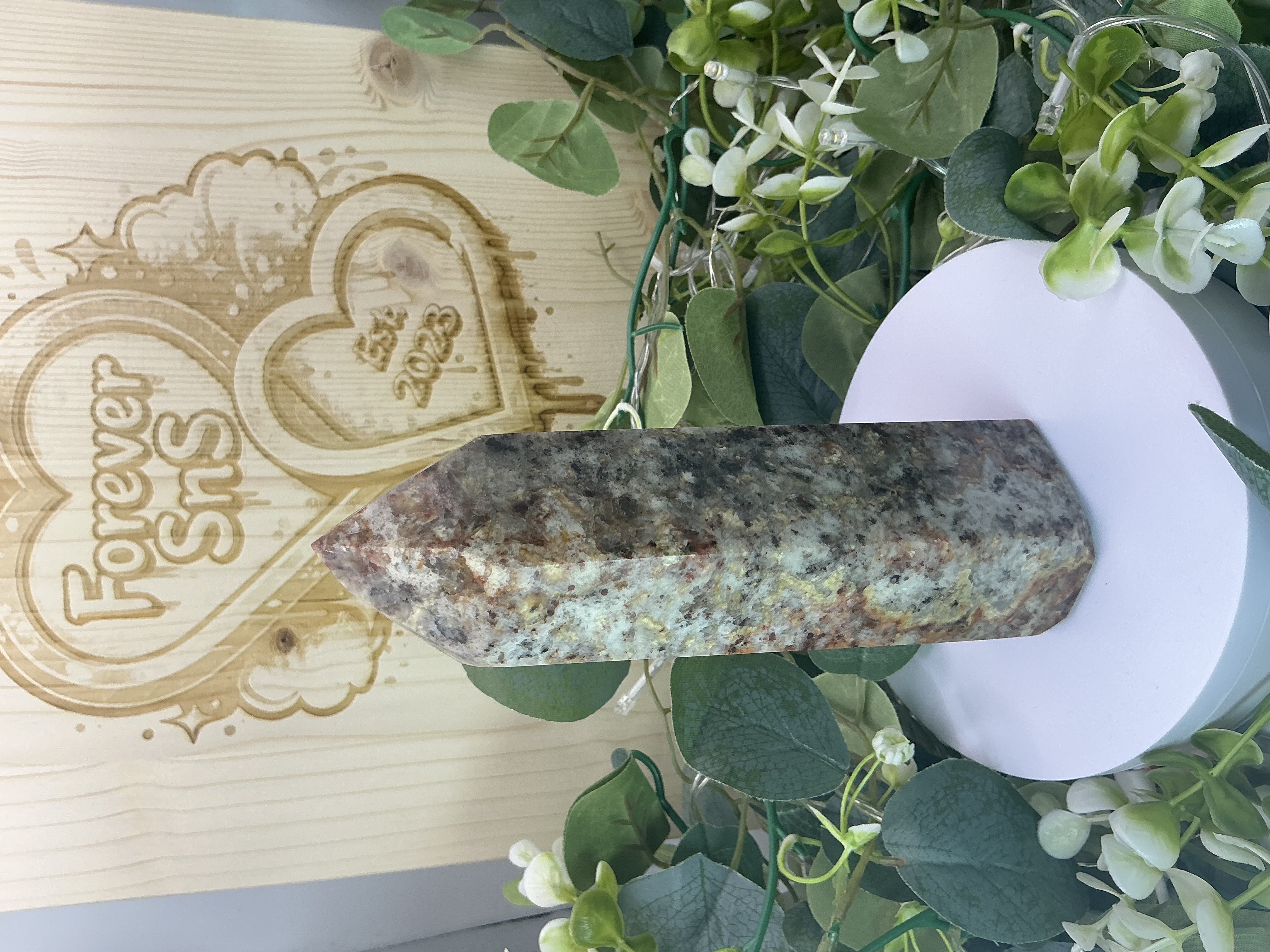
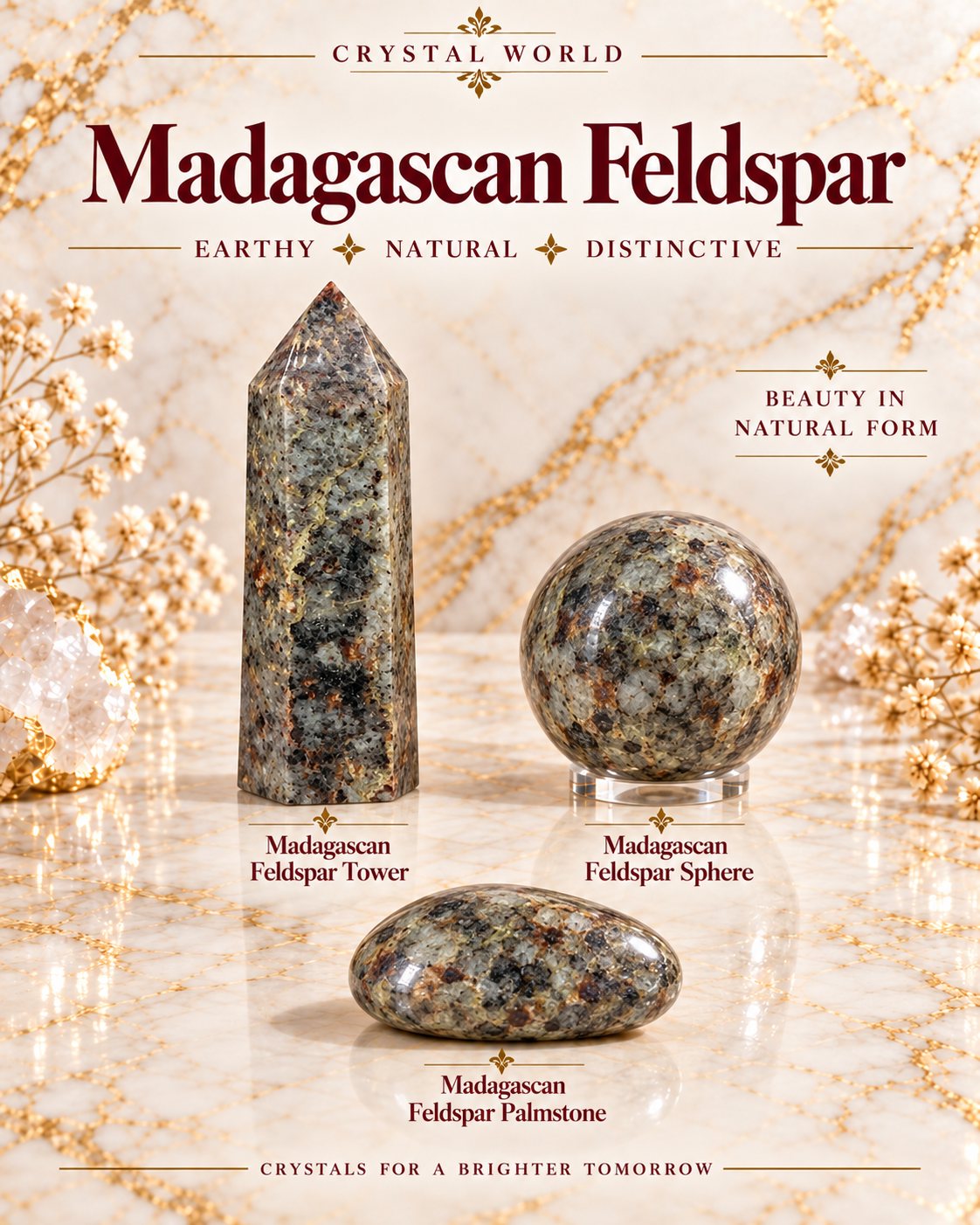
Madagascan Feldspar
Pronounced: MAD-uh-GAS-kan FELD-spar
Madagascan Feldspar is a commercial name used for feldspar-rich material from Madagascar, often sourced from the island’s extensive granitic pegmatites. Depending on the specimen, the feldspar may belong to the potassium-feldspar or plagioclase groups, so exact mineral identification may require laboratory testing.
CWExplore this passport
Showing Science & Formation
Scientific passport
The mineral facts
Observable and measurable properties used to describe and identify this mineral.
- Chemical formula
- Variable — Feldspar Group * Microcline / Orthoclase: KAlSi₃O₈ * Albite: NaAlSi₃O₈ * Anorthite: CaAl₂Si₂O₈
- Mineral class
- Silicate — Tectosilicate — Feldspar Group
- Crystal system
- Variable depending on the feldspar species
- Mohs hardness
- Approximately 6–6.5
- Lustre
- Vitreous to pearly
- Streak
- White
- Specific gravity
- Typically approximately 2.55–2.76, depending on feldspar composition
- Transparency
- Transparent to translucent in some individual crystals; commonly translucent to opaque
Common colours
White, cream, grey, pink, peach, tan, brown, pale yellow and occasionally darker grey or blackish tones
Cleavage and fracture
Feldspars characteristically show two good cleavage directions that meet at or close to right angles. Fracture outside cleavage surfaces may be uneven.
From the Earth
How it forms
The geological processes that create this crystal over time.
Formation
Its geological story
Much of Madagascar’s collectible feldspar forms within granitic pegmatites. Pegmatites develop from the final, volatile-rich stages of granitic magma crystallisation. These residual melts can contain abundant water and unusual concentrations of elements, allowing exceptionally large crystals to grow. As the magma cools, feldspar crystallises alongside minerals such as Quartz, Mica, Tourmaline, Beryl and Spodumene. Madagascar contains numerous documented pegmatite districts. For example, the Ampatsikahitra pegmatites in the Sahatany Valley contain both Microcline and Albite alongside Quartz, Tourmaline and Spodumene.
A closer look
Scientific notes
“Madagascan Feldspar” should be treated as a geographic commercial description, not a mineral species. Madagascar contains several documented Feldspar Group minerals. Microcline occurs at localities such as the Anjahamiary pegmatite in Anosy, where the formula is KAlSi₃O₈. Orthoclase has also been scientifically studied from Madagascar, including material from Itrongay. Madagascan pegmatites can additionally contain Albite and potassium feldspars together in the same deposit. This means two specimens sold commercially as “Madagascan Feldspar” may not necessarily be the exact same feldspar species.
Passport stamps
Where in the world?
Important countries, regions and mineral localities connected with this crystal.
Madagascar
Sahatany Pegmatite Field, Mt Ibity area
Vakinankaratra
The Sahatany Pegmatite Field is one of Madagascar’s most important mineral-producing areas. It contains several documented feldspar minerals, including Microcline, Orthoclase and Albite, alongside Quartz, Tourmaline, Spodumene, Mica and other pegmatite minerals. It is an excellent example of why “Madagascan Feldspar” can legitimately refer to more than one exact feldspar species.
Madagascar
Ampatsikahitra Pegmatites, Sahatany Valley
Vakinankaratra
Ampatsikahitra is a documented pegmatite locality containing Feldspar Group material, Microcline and Amazonite alongside Quartz, Tourmaline, Spodumene and Muscovite. It illustrates the complex mineral assemblages typical of Madagascar’s evolved pegmatites.
Madagascar
Marirana Pegmatites, Sahatany Valley
Vakinankaratra
The Marirana pegmatites contain documented potassium feldspar and Microcline, together with Albite-related mineralisation and other lithium-rich pegmatite minerals. Mineralogical studies of the Sahatany field have used this locality to investigate the remarkable diversity produced during pegmatite crystallisation.
Madagascar
Anjahamiary Pegmatite, Tranomaro
Anosy
Anjahamiary is a famous Madagascan gem pegmatite containing both Microcline and Albite, as well as Amazonite, Quartz, Tourmaline, Beryl and other rare minerals. It provides another clear example of multiple feldspar species occurring within the same broader pegmatite system.
Crystal Detective
Look closely. Ask better questions.
Safe observations at home are separated from professional laboratory identification. No single home test can prove every specimen's identity or origin.
Safe checks at home
Look for the typical feldspar appearance: a relatively hard stone with a glassy to pearly lustre and often blocky-looking internal or external structures. Broken or rough material may show flat cleavage surfaces. Feldspar commonly displays two cleavage directions that meet at approximately right angles. Under a strong directional light, some specimens may show flashes or sheen caused by internal structures within the feldspar. Examine the stone with a magnifying glass. Natural specimens may contain variations in colour, internal veils, mineral inclusions or intergrown material from the original pegmatite. Colour alone cannot reliably identify the feldspar species. Do not scratch-test polished retail pieces because several feldspars have very similar hardness and a scratch test will rarely resolve the exact species.
Professional methods
X-ray diffraction is one of the most useful methods for identifying the exact feldspar species. Raman spectroscopy can distinguish many feldspar minerals based on their crystal structures. Petrographic microscopy can identify twinning and other structural features characteristic of particular feldspars. Electron microprobe or SEM-EDS analysis can determine potassium, sodium, calcium, aluminium and silicon concentrations and help classify the material. Detailed compositional analysis is particularly useful for distinguishing potassium feldspar from members of the plagioclase series.
Imitations and treatments
Madagascan Feldspar may be confused with Moonstone, Labradorite, Larvikite, pale Quartz or other feldspar-rich rocks. Some commercial sellers apply attractive names to feldspar based largely on colour or optical effect rather than mineral species. For example, terms such as “Black Moonstone”, “Peach Moonstone” or other Moonstone trade names may represent particular feldspars displaying adularescence, but not every Madagascan Feldspar specimen should automatically be labelled Moonstone. Dyed material is possible, although feldspar is more commonly polished rather than deliberately treated. Resin may occasionally be used to stabilise fractures in carved or polished commercial material. When provenance is known but exact species is not, Madagascan Feldspar is actually a more transparent label than pretending a laboratory identification has been made.
The Mythical Library
Stories carried through time
Folklore can be enjoyed without confusing it with evidence. Where a popular tale is a later retelling, the passport says so.
The Mythical Library
Choose a book to enter the full-screen reader.
Beliefs, traditions and cultural context
What people have believed
“Madagascan Feldspar” is primarily a modern commercial mineral-trade description rather than the name of a gemstone with a clearly documented ancient spiritual tradition. Feldspar minerals themselves have been used by humans for centuries, particularly in ceramics, glassmaking, construction and ornamental stone. Modern crystal spirituality sometimes associates Madagascan Feldspar with grounding, self-discovery, creativity, intuition and adapting to change. Where material shows a visible flash or sheen, modern interpretations may borrow symbolism from Moonstone or Labradorite, although these associations should not automatically be transferred to every feldspar specimen. Because the term Madagascan Feldspar can encompass more than one mineral species, its spiritual meanings are especially variable between sellers and crystal traditions. These associations belong to contemporary spiritual practice and symbolism and are not scientifically demonstrated physical, psychological or medical effects.
Handle thoughtfully
Safety notes
Finished Feldspar specimens are generally safe for normal handling. Cutting, drilling, grinding or crushing the material produces mineral dust that should not be inhaled. Feldspar material from pegmatites may also contain Quartz, so lapidary work can generate respirable crystalline silica. Use wet-working methods, appropriate dust extraction, respiratory protection and eye protection. Do not ingest powdered mineral material or add loose mineral specimens to drinking water.
Keep it beautiful
Care and cleaning
Madagascan Feldspar is reasonably durable but has pronounced cleavage and can chip if struck. Clean polished pieces with lukewarm water, mild soap and a soft cloth. Avoid hard impacts, especially around thin points, carved edges and natural fractures. Avoid strong acids and aggressive chemical cleaners. Ultrasonic and steam cleaning are best avoided where the specimen contains fractures, mixed minerals or uncertain treatments. Store separately from harder minerals such as Quartz to minimise scratching.
Follow the evidence
Sources and further reading
We show the references used while researching this passport so visitors can check important claims and continue learning.
- 1
Overview
Sahatany Pegmatite Field (Mt Ibity area), Madagascar
Mindat.org contributors · Mindat.org / Hudson Institute of Mineralogy · Continuously updated database
Primary locality reference demonstrating the diversity of feldspar minerals documented in Madagascar’s Sahatany pegmatites, including Microcline, Orthoclase, Albite and Amazonite alongside Quartz, Mica, Tourmaline and Spodumene.
Checked 25 Sept 2026
- 2
Science
Les pegmatites de la Sahatany
W. Rakotoarison · Service Géologique de Madagascar · 1964
Historical geological reference documenting the Sahatany pegmatite field and occurrences of Feldspar Group minerals, Microcline and related pegmatite minerals. Useful for establishing that Madagascar’s feldspar deposits are part of complex, well-studied pegmatite systems.
Checked 25 Sept 2026
- 3
Localities
Ampatsikahitra Pegmatites, Sahatany Valley, Madagascar
Mindat.org contributors · Mindat.org / Hudson Institute of Mineralogy · Continuously updated database
Documents Feldspar Group material, Microcline and Amazonite at Ampatsikahitra alongside Quartz, Tourmaline, Spodumene and Muscovite. Used to support the Vakinankaratra locality entry.
Checked 25 Sept 2026
- 4
Localities
Marirana Pegmatites, Sahatany Valley, Madagascar
Mindat.org contributors; references include Nadine Ranorosoa and Knut Edvard Larsen · Mindat.org / Hudson Institute of Mineralogy · Continuously updated database
Documents potassium feldspar and Microcline from the Marirana pegmatites and supports their inclusion among important feldspar-bearing localities within the Sahatany field.
Checked 25 Sept 2026
- 5
Localities
Anjahamiary Pegmatite, Tranomaro, Madagascar
Mindat.org contributors · Mindat.org / Hudson Institute of Mineralogy · Continuously updated database
Documents both Microcline and Albite at the Anjahamiary pegmatite together with Amazonite, Quartz, Beryl, Tourmaline and other pegmatite minerals. Used to demonstrate multiple feldspar species occurring within one Madagascan deposit.
Checked 25 Sept 2026
- 6
Home identification
Feldspar Group from Itrongay, Madagascar
Mindat.org contributors; referencing Federico Pezzotta · Mindat.org / Hudson Institute of Mineralogy · Continuously updated database
Documents pink to reddish perthitic potassium feldspar and occasional graphic intergrowths with white or smoky Quartz from the Itrongay area. Useful for illustrating the range of appearances possible within commercial Madagascan Feldspar.
Checked 25 Sept 2026
- 7
Laboratory identification
Itrongay (Itrongahy), Mahasoa Est, Betroka District, Madagascar
Mindat.org contributors; citing Simmons, Falster, Ackermann and earlier mineralogical studies · Mindat.org / Hudson Institute of Mineralogy · Continuously updated database
Particularly important for explaining why laboratory identification matters. Yellow feldspar historically described as Orthoclase from the Itrongay area was subsequently examined by X-ray methods and identified as Sanidine. This provides a real-world example of why appearance or old labels alone cannot always establish exact feldspar species.
Checked 25 Sept 2026
- 8
Fakes and treatments
Identity of Orthoclase from Itrongay, Madagascar
Knut Edvard Larsen and Mindat.org mineralogical contributors · Mindat.org · 2009 discussion summarising ea
Used not because Itrongay feldspar is fake, but because it demonstrates a major identification issue: material historically sold and labelled as Orthoclase was later shown through X-ray study to be Sanidine. This supports the Passport’s policy of avoiding overly precise species claims without analytical confirmation.
Checked 25 Sept 2026
- 9
Myths and folklore
Forever SnS Mythical Library — Original Madagascan Feldspar Folklore
Forever SnS · Former SnS Ltd · 2026
The Stone That Could Not Choose a Name and The Island That Collected Colours are original contemporary Forever SnS folklore. They are inspired by Madagascar’s genuine diversity of feldspar minerals and pegmatite deposits but are not presented as traditional Malagasy legends, ancient folklore or documented cultural stories.
Checked 25 Sept 2026
- 10
Beliefs and traditions
Forever SnS — Modern Feldspar Symbolism Context
Forever SnS · Forever SnS Ltd · 2026
Used to document that Madagascan Feldspar does not have one established ancient spiritual tradition under this commercial name. Any associations with grounding, creativity, intuition or change are treated as contemporary crystal symbolism rather than historical fact or scientifically established effects.
Checked 25 Sept 2026
From the Forever SnS collection
Shop products featuring Madagascan Feldspar
Each listing shows the actual product details, photographs and current availability.
Passport complete