Meet the crystal

Forever SnS Crystal Passport
Yooperlite
Pronounced: YOO-per-lite
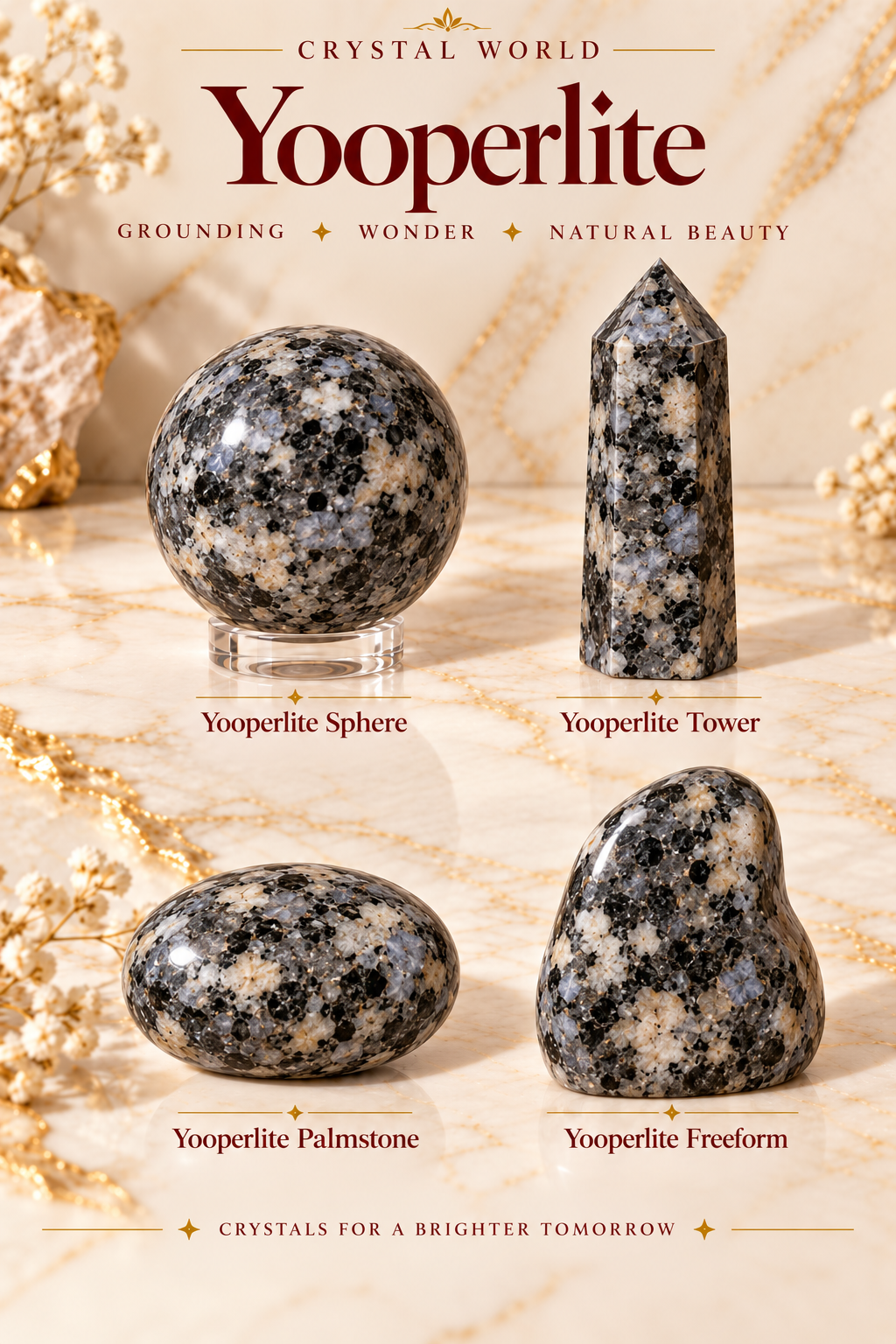
Yooperlite is a trade name for sodalite-bearing syenite that can glow vivid orange or yellow-orange under ultraviolet light due to fluorescent sodalite within the rock.
CWExplore this passport
Showing Science & Formation
Scientific passport
The mineral facts
Observable and measurable properties used to describe and identify this mineral.
- Chemical formula
- No single formula — multi-mineral rock
- Mineral class
- Igneous rock — syenite
- Crystal system
- Not applicable — multi-mineral rock
- Mohs hardness
- Approximately 5.5–6.5
- Lustre
- Dull to vitreous
- Streak
- Usually white to pale
- Specific gravity
- Approximately 2.5–2.8
- Transparency
- Opaque
Common colours
Grey, black, white, cream and pale blue-grey; bright orange under UV
Cleavage and fracture
Variable depending on the minerals present; generally uneven fracture.
From the Earth
How it forms
The geological processes that create this crystal over time.
Formation
Its geological story
Yooperlite begins as syenitic igneous rock formed when alkaline magma cools and crystallises. Sodalite develops within the rock alongside feldspar and other silicate minerals. The Lake Superior material was later transported by glacial ice from its original bedrock source and deposited as glacial erratics. Wave action along the shoreline then rounded and polished many of the loose stones found today.
A closer look
Scientific notes
Yooperlite is a commercial name rather than a recognised mineral species. The material is sodalite-bearing syenite. Its most famous property is bright orange to yellow-orange fluorescence under ultraviolet light. The fluorescence is caused by sodalite containing minor sulphur-related components within its crystal structure. Electron microprobe analysis has confirmed sodalite in Lake Superior Yooperlite material. The Michigan stones are thought to have originated from the Precambrian Coldwell Alkaline Complex in Ontario and were transported into the Lake Superior region by glaciation.
Passport stamps
Where in the world?
Important countries, regions and mineral localities connected with this crystal.
United States
Lake Superior beaches, Chippewa County
Michigan — Upper Peninsula
Chippewa County beaches are among the best-known places where Yooperlite glacial erratics are collected. These rounded shoreline stones contain fluorescent sodalite that glows orange-yellow under longwave ultraviolet light.
United States
Lake Superior shoreline, Luce County
Michigan — Upper Peninsula
Luce County forms part of the famous Lake Superior shoreline where Yooperlite stones are found as glacial erratics. The fluorescent rocks were transported southward by ancient glaciers and later rounded by wave action.
United States
Lake Superior shoreline near Newberry and surrounding beaches
Michigan — Upper Peninsula
This broader shoreline area is historically important because Erik Rintamaki discovered the fluorescent stones in 2017 while searching Lake Superior beaches with a UV light, leading to the Yooperlite name and their rapid rise in popularity.
Canada
Coldwell Alkaline Complex
Ontario
The Coldwell Alkaline Complex is considered the likely original bedrock source of the sodalite-bearing syenite later transported into Michigan by glacial ice. This makes it geologically important even though most commercial Yooperlite is collected as loose beach stone in the United States.
Crystal Detective
Look closely. Ask better questions.
Safe observations at home are separated from professional laboratory identification. No single home test can prove every specimen's identity or origin.
Safe checks at home
In daylight, Yooperlite usually looks like a grey, speckled or pale igneous rock. The easiest non-destructive identification check is ultraviolet light. Under a 365 nm longwave UV torch, sodalite-rich areas can glow bright orange or yellow-orange. The fluorescent patches may appear as spots, veins or irregular areas within the darker matrix. Not every piece will fluoresce equally strongly because the amount of sodalite varies.
Professional methods
Petrographic microscopy can identify the rock texture and individual minerals. Raman spectroscopy can confirm sodalite. X-ray diffraction can identify the main mineral phases within the syenite. Electron microprobe analysis can determine the chemistry of the sodalite and other minerals. UV fluorescence spectroscopy can help investigate the cause and wavelength of the fluorescent response.
Imitations and treatments
Yooperlite may be confused with other fluorescent sodalite-bearing rocks from different locations. Not every rock that fluoresces orange should automatically be called Yooperlite. Artificial fluorescent coatings or paints can also produce bright UV reactions, although these usually look very different from natural mineral fluorescence. Because Yooperlite is a trade name linked strongly with Lake Superior material, locality information is useful when identifying genuine examples.
The Mythical Library
Stories carried through time
Folklore can be enjoyed without confusing it with evidence. Where a popular tale is a later retelling, the passport says so.
The Mythical Library
Choose a book to enter the full-screen reader.
Beliefs, traditions and cultural context
What people have believed
Yooperlite has no ancient spiritual tradition under this modern trade name because the material only became widely recognised and marketed in the 21st century. In contemporary crystal spirituality, it is sometimes associated with hidden potential, self-discovery, confidence and revealing qualities that are not immediately visible. Its dramatic change under ultraviolet light has encouraged symbolic interpretations based around discovering what lies beneath the surface or finding unexpected strengths. These meanings belong to modern crystal spirituality and symbolism and are not scientifically demonstrated medical, psychological or physical effects. Its genuine scientific interest lies in its fluorescent sodalite, igneous origin and glacial transport history.
Handle thoughtfully
Safety notes
Finished Yooperlite is generally safe for normal handling. Cutting, grinding or drilling can create fine silicate and feldspar-rich mineral dust that should not be inhaled. Use wet-working methods, suitable respiratory protection and eye protection during lapidary work. Do not ingest powdered mineral material.
Keep it beautiful
Care and cleaning
Clean Yooperlite with lukewarm water, mild soap and a soft brush or cloth. Avoid harsh acids and strong chemical cleaners. Protect polished pieces from sharp impacts. UV exposure used for viewing is normally brief, but avoid unnecessary prolonged exposure to powerful UV lamps and always protect your eyes and skin when using ultraviolet equipment.
Follow the evidence
Sources and further reading
We show the references used while researching this passport so visitors can check important claims and continue learning.
- 1
Overview
Sodalite-syenite “Yooperlite” glacial erratic
Mindat.org contributors · Mindat.org / Hudson Institute of Mineralogy
Primary geological reference for Yooperlite as sodalite-bearing syenite from Michigan’s Lake Superior shoreline, including its orange fluorescence under 365 nm UV and likely glacial origin from Ontario.
Checked 6 Oct 2026
- 2
Science
Sodalite — Lake Superior beaches, Chippewa County, Michigan
Travis A. Olds / Mindat.org contributors · Mindat.org · 2018
Documents electron-microprobe analysis confirming sodalite in Yooperlite material and notes minor sulphur as a likely cause of the orange fluorescence.
Checked 6 Oct 2026
- 3
Localities
Lake Superior beaches — Yooperlite locality
Mindat.org contributors · Mindat.org
Used for documented fluorescent sodalite-bearing syenite from Chippewa County and the interpretation that the rocks were transported into Michigan by glaciation.
Checked 6 Oct 2026
- 4
Localities
A Guide to Finding Michigan’s Yooperlites
Michigan tourism editorial team · Pure Michigan / Michigan Economic Development Corporation
Provides modern historical context for Yooperlite discovery in Michigan and describes the characteristic grey daylight appearance and vivid orange-yellow response under UV light.
Checked 6 Oct 2026
- 5
Laboratory identification
Sodalite — Lake Superior beaches
Travis A. Olds · Mindat.org · 2018
Used for laboratory confirmation of sodalite chemistry, minor sulphur content and the identification of the fluorescent component in Yooperlite.
Checked 6 Oct 2026
- 6
Myths and folklore
Forever SnS Mythical Library — Original Yooperlite Folklore
Forever SnS · Forever SnS Ltd · 2026
The Stone That Hid Its Fire and The Glacier That Carried the Stars are original contemporary Forever SnS stories inspired by Yooperlite fluorescence and the genuine glacial journey of the Michigan stones. They are not presented as ancient or traditional folklore.
Checked 6 Oct 2026
- 7
Beliefs and traditions
Forever SnS — Modern Yooperlite symbolism context
Forever SnS · Forever SnS Ltd · 2026
Used to separate contemporary crystal symbolism from geological fact. Associations with hidden potential, self-discovery and revealing unseen qualities are presented only as modern beliefs.
Checked 6 Oct 2026
Passport complete
