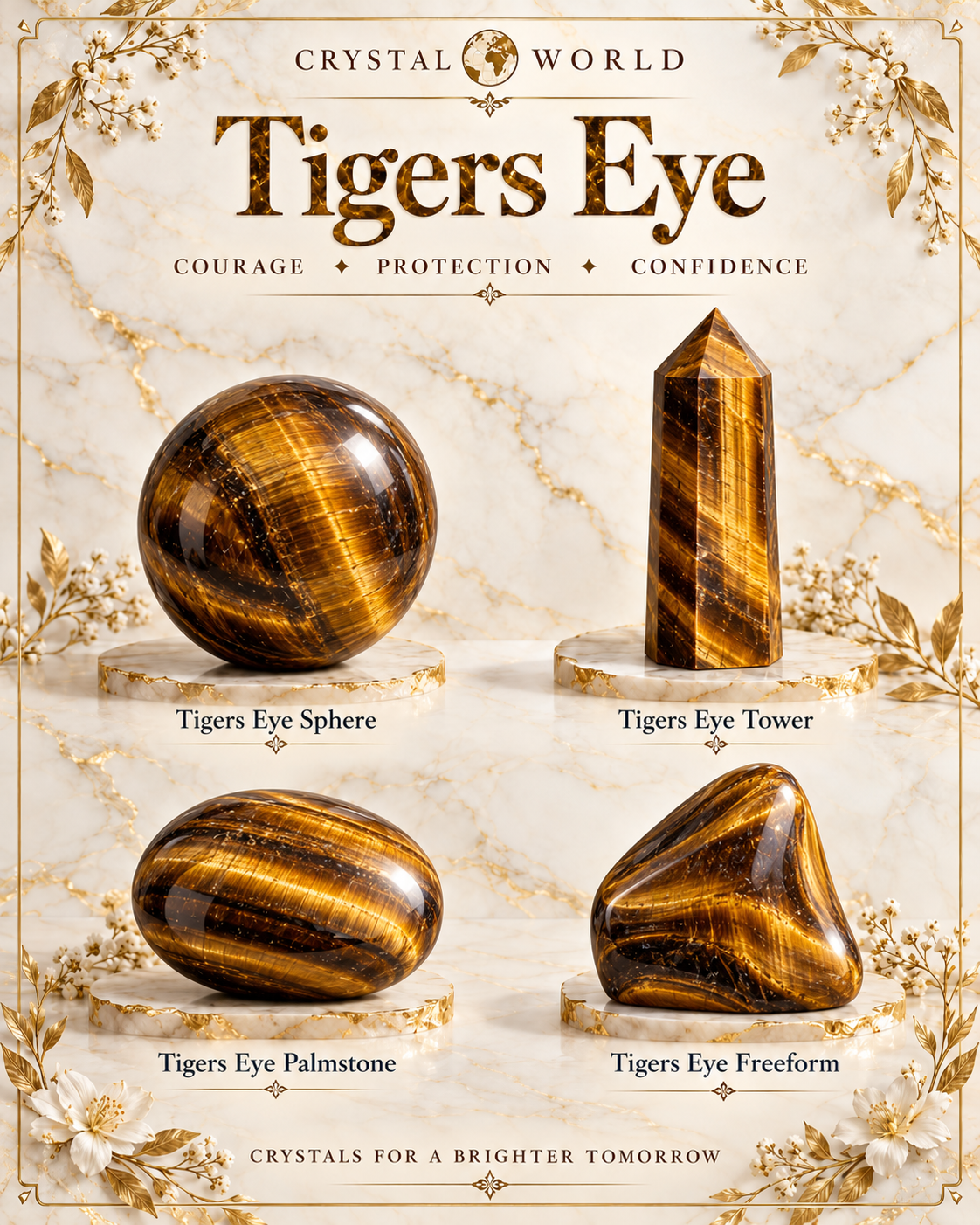
Meet the crystal

Forever SnS Crystal Passport
Tigers Eye
Pronounced: TY-gurz EYE
Tiger’s Eye is a golden-brown chatoyant variety of Quartz known for its silky moving band of light, fibrous internal structure and distinctive striped appearance.
CWExplore this passport
Showing Science & Formation
Scientific passport
The mineral facts
Observable and measurable properties used to describe and identify this mineral.
- Chemical formula
- SiO₂
- Mineral class
- Silicate — Quartz family
- Crystal system
- Trigonal
- Mohs hardness
- 7
- Lustre
- Silky to vitreous
- Streak
- White
- Specific gravity
- Approximately 2.64–2.71
- Transparency
- Opaque to slightly translucent
Common colours
Golden yellow, honey, brown, reddish-brown and dark brown
Cleavage and fracture
No true cleavage; conchoidal to uneven fracture.
From the Earth
How it forms
The geological processes that create this crystal over time.
Formation
Its geological story
Tiger’s Eye forms through the alteration and silicification of fibrous crocidolite-bearing rock. Silica-rich fluids enter the fibrous material and Quartz gradually replaces or surrounds the original fibres while preserving their parallel structure. Iron released during alteration oxidises and contributes golden yellow, brown and reddish colours. The preserved fibrous texture produces the strong chatoyant band of light seen in polished Tiger’s Eye.
A closer look
Scientific notes
Tiger’s Eye is a chatoyant Quartz material rather than a separate mineral species. Its characteristic optical effect is caused by aligned fibrous structures that reflect light in a narrow moving band. The relationship between Quartz and the original crocidolite fibres has historically been described as simple replacement, although detailed studies indicate a more complex process involving crack-seal growth, silicification and preservation of the fibrous texture. Golden Tiger’s Eye is closely related to Hawk’s Eye, which generally retains a blue-grey appearance associated with less oxidised iron-bearing fibrous material. Red Tiger’s Eye may occur naturally, but much commercial red material is produced by heat treatment of golden Tiger’s Eye.
Passport stamps
Where in the world?
Important countries, regions and mineral localities connected with this crystal.
South Africa
Prieska
Northern Cape
Prieska lies within one of South Africa’s classic Tiger’s Eye-producing regions and is closely associated with crocidolite-bearing rocks of the Northern Cape. Material from this wider district helped establish South Africa as one of the world’s best-known sources of golden Tiger’s Eye and related blue Hawk’s Eye material.
South Africa
Griekwastad
Northern Cape
Griekwastad is a documented Tiger’s Eye locality within the historic Griqualand West region. The district is geologically important because studies of South African Tiger’s Eye from this wider area helped improve scientific understanding of how its fibrous and chatoyant structure formed.
South Africa
Balloch Mine, Niekerkshoop
Northern Cape
Balloch Mine is a documented Tiger’s Eye occurrence near Niekerkshoop, an area historically associated with asbestos mining and crocidolite-bearing rocks. It provides another important example of the close geological relationship between Tiger’s Eye and fibrous riebeckite-crocidolite material in the Northern Cape.
Australia
Brockman Tiger Eye Mine, Mount Brockman
Western Australia
The Brockman Tiger Eye Mine is an important Western Australian source of Tiger’s Eye and related Tiger Iron. Material from this locality occurs within iron-rich geological formations and may show chatoyant Tiger’s Eye interlayered with hematite and jasper.
Australia
Wittenoom Gorge Mine
Western Australia
Wittenoom Gorge is a confirmed Western Australian Tiger’s Eye locality associated with crocidolite-bearing rocks. Specimens from the area show the fibrous structure responsible for chatoyancy and provide an important comparison with classic South African Tiger’s Eye.
United States
San Carlos Apache Indian Reservation
Arizona
The San Carlos Apache Indian Reservation is a documented United States occurrence of Tiger’s Eye. Material from this locality has been described in shades including mahogany-brown, yellow and pink, showing that Tiger’s Eye can occur in a wider range of colours than the classic golden-brown South African material.
Crystal Detective
Look closely. Ask better questions.
Safe observations at home are separated from professional laboratory identification. No single home test can prove every specimen's identity or origin.
Safe checks at home
Look for a strong silky band of light that moves across the stone when it is tilted under a single light source. Natural Tiger’s Eye usually shows parallel golden, brown and dark bands rather than perfectly flat printed-looking colour. The chatoyant effect should appear to come from within the polished stone rather than from glitter or a surface coating. Avoid destructive scratch testing on polished pieces.
Professional methods
Microscopy can reveal the parallel fibrous structure responsible for chatoyancy. Raman spectroscopy can identify Quartz and associated iron-bearing phases. X-ray diffraction can confirm crystalline mineral components. Petrographic examination can reveal the relationship between Quartz and preserved fibrous structures. Chemical analysis can identify iron-rich alteration products associated with the golden-brown colour.
Imitations and treatments
Tiger’s Eye may be imitated using fibre-optic glass, coloured glass, resin or synthetic materials designed to produce an artificial cat’s-eye effect. Fibre-optic glass often shows an unnaturally sharp and perfectly uniform light band. Golden Tiger’s Eye is sometimes heat-treated to create reddish Red Tiger’s Eye. Some material may also be dyed to intensify colour. Natural colour variation, irregular banding and mineral texture are usually more complex than those seen in manufactured imitations.
The Mythical Library
Stories carried through time
Folklore can be enjoyed without confusing it with evidence. Where a popular tale is a later retelling, the passport says so.
The Mythical Library
Choose a book to enter the full-screen reader.
Beliefs, traditions and cultural context
What people have believed
Tiger’s Eye has long attracted symbolic associations because its moving band of light resembles the reflective eye of an animal. In modern crystal spirituality it is commonly associated with confidence, courage, focus, grounding, protection and determination. Its golden colouring has also led to contemporary associations with prosperity, motivation and personal strength. Some modern practitioners associate Tiger’s Eye with the Solar Plexus and Root chakras. Claims that Tiger’s Eye was universally worn by ancient Roman soldiers for protection or that it had one single ancient spiritual meaning should be treated cautiously unless supported by a specific historical source. These spiritual associations are cultural or contemporary beliefs and are not scientifically demonstrated medical, psychological or physical effects. Its genuine scientific interest lies in its unusual fibrous structure, Quartz-rich composition and striking chatoyant optical effect.
Handle thoughtfully
Safety notes
Finished polished Tiger’s Eye is generally safe for normal handling. Unworked or freshly cut material requires additional care because Tiger’s Eye forms from material historically associated with fibrous crocidolite, an asbestos mineral. Cutting, grinding, drilling or crushing can generate fine silica and mineral dust that should not be inhaled. Use wet-working methods, suitable respiratory protection, local extraction and eye protection during lapidary work. Do not deliberately create or inhale dust and do not ingest powdered material.
Keep it beautiful
Care and cleaning
Clean Tiger’s Eye with lukewarm water, mild soap and a soft cloth. Avoid harsh chemical cleaners and hydrofluoric acid. Protect from sharp impacts despite its relatively high hardness. Gentle hand cleaning is the safest option for jewellery and polished specimens. Store separately from softer stones to avoid scratching them and away from harder gemstones such as Sapphire and Diamond that may scratch Tiger’s Eye.
Follow the evidence
Sources and further reading
We show the references used while researching this passport so visitors can check important claims and continue learning.
- 1
Overview
Tiger’s Eye
Mindat.org contributors · Mindat.org / Hudson Institute of Mineralogy
Primary mineralogical and locality reference for Tiger’s Eye, including its relationship with Quartz, crocidolite-bearing material and documented occurrences worldwide.
Checked 21 Oct 2026
- 2
Localities
Tiger’s Eye from Northern Cape, South Africa
Mindat.org contributors · Mindat.org / Hudson Institute of Mineralogy
Documents Tiger’s Eye localities throughout the Northern Cape, including Prieska, Griekwastad, Hay, Niekerkshoop and Balloch Mine.
Checked 21 Oct 2026
- 3
Localities
Tiger’s Eye from Griekwastad, Northern Cape, South Africa
Mindat.org contributors · Mindat.org / Hudson Institute of Mineralogy
Documents Tiger’s Eye from Griekwastad and cites published research on Tiger’s Eye resources in the Northern Cape Province.
Checked 21 Oct 2026
- 4
Localities
Tiger’s Eye from Western Australia
Mindat.org contributors · Mindat.org / Hudson Institute of Mineralogy
Documents Western Australian Tiger’s Eye localities including the Brockman Tiger Eye Mine, Mount Brockman and Wittenoom Gorge.
Checked 21 Oct 2026
- 5
Localities
Tiger’s Eye from San Carlos Apache Indian Reservation, Arizona
Mindat.org contributors · Mindat.org / Hudson Institute of Mineralogy
Documents Tiger’s Eye from the San Carlos Apache Indian Reservation and references established published mineralogical works on Arizona minerals.
Checked 21 Oct 2026
- 6
Laboratory identification
New Interpretation of the Origin of Tiger’s-Eye
Peter J. Heaney and Donald M. Fisher · Geology / Geological Society of America · 2003
Peer-reviewed study challenging the traditional explanation that Tiger’s Eye formed purely by Quartz replacing pre-existing crocidolite. The authors proposed synchronous mineral growth through a crack-seal vein-filling process.
Checked 21 Oct 2026
- 7
Myths and folklore
Forever SnS Mythical Library — Original Tiger’s Eye Folklore
Forever SnS · Forever SnS Ltd · 2026
The Eye That Learned to Follow the Light and The Blue Hawk and the Golden Tiger are original contemporary Forever SnS stories inspired by Tiger’s Eye chatoyancy, its fibrous internal structure and its relationship with Hawk’s Eye. They are not presented as ancient or traditional folklore.
Checked 21 Oct 2026
- 8
Beliefs and traditions
Forever SnS — Modern Tiger’s Eye symbolism context
Forever SnS · Forever SnS Ltd · 2026
Used to distinguish contemporary crystal symbolism from mineralogical fact. Associations with confidence, courage, grounding, focus and prosperity are presented only as modern beliefs.
Checked 21 Oct 2026
From the Forever SnS collection
Shop products featuring Tigers Eye
Each listing shows the actual product details, photographs and current availability.
Passport complete