Meet the crystal

Forever SnS Crystal Passport
Spirit Quartz
Pronounced: SPEER-it KWORTS
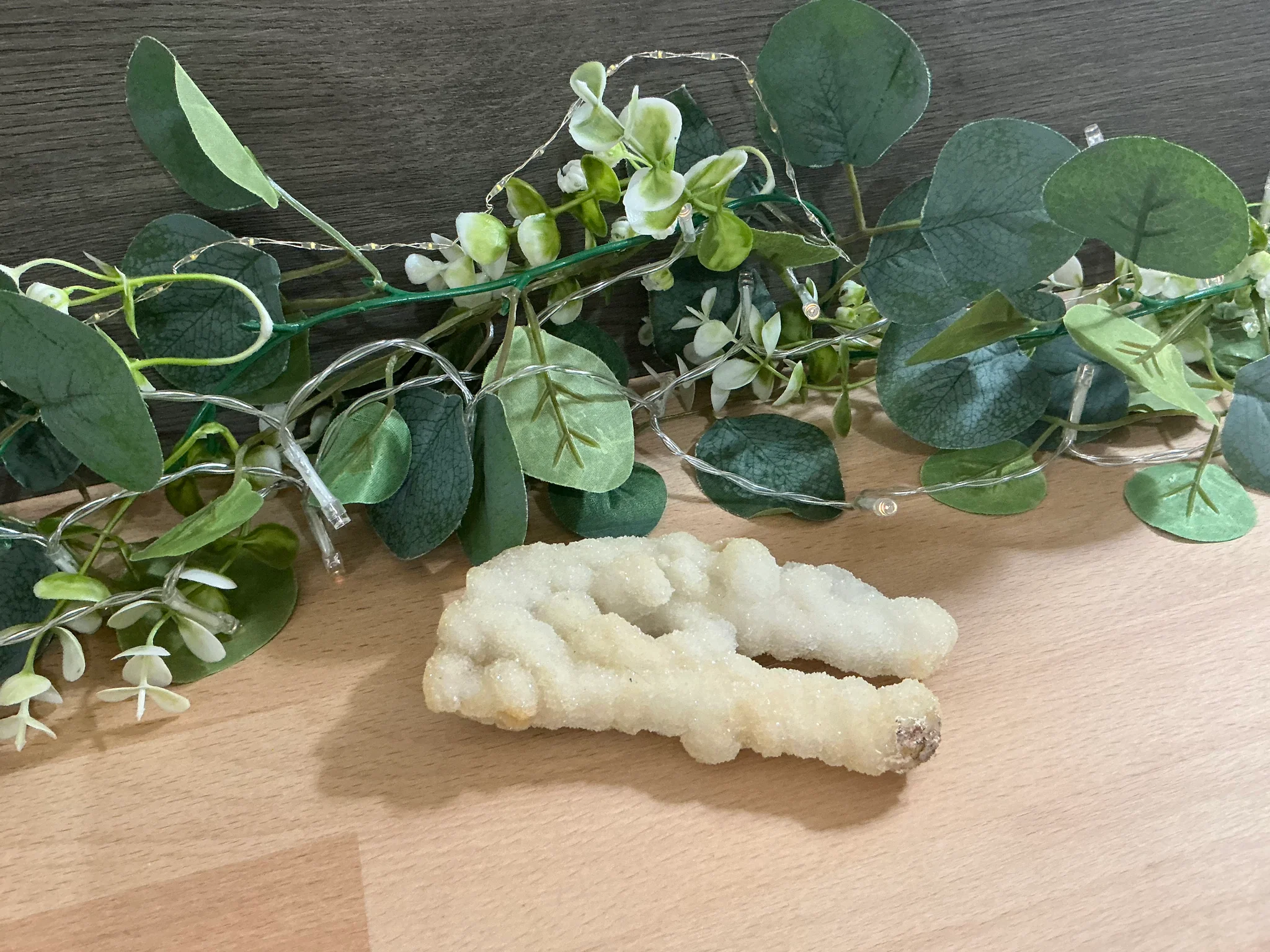
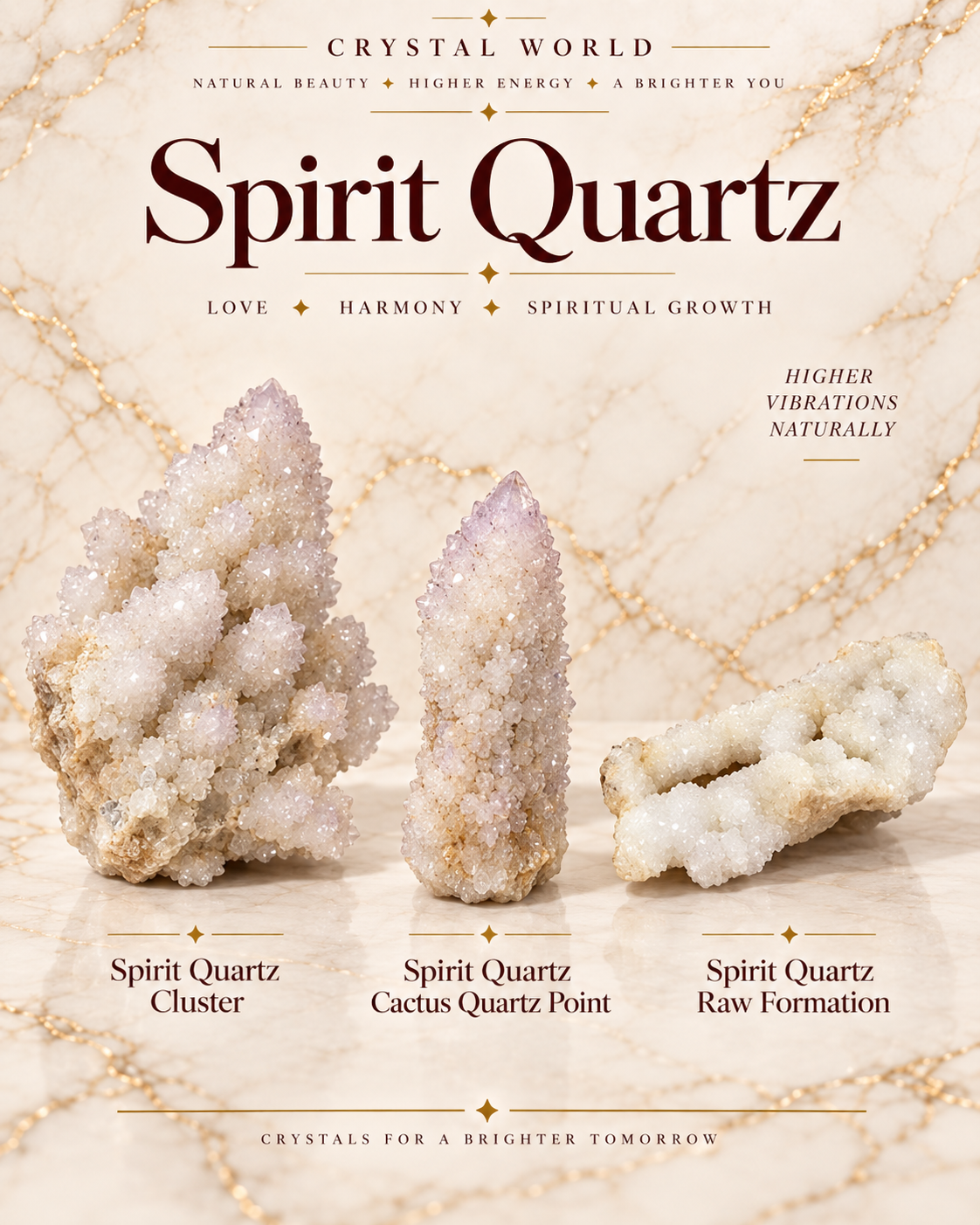
Spirit Quartz is a distinctive South African quartz growth form in which a larger central crystal is covered by hundreds of tiny secondary quartz crystals, giving it its characteristic sparkling, cactus-like appearance.
CWExplore this passport
Showing Science & Formation
Scientific passport
The mineral facts
Observable and measurable properties used to describe and identify this mineral.
- Chemical formula
- SiO₂
- Mineral class
- Oxide — Quartz
- Crystal system
- Trigonal
- Mohs hardness
- 7
- Lustre
- Vitreous
- Streak
- White
- Specific gravity
- Approximately 2.65
- Transparency
- Transparent to translucent; individual specimens may also contain opaque zones or inclusions
Common colours
Colourless, white, pale lilac, purple, smoky grey, brownish, yellowish and mixed purple-yellow tones
Cleavage and fracture
Poor to indistinct cleavage; typically conchoidal fracture
From the Earth
How it forms
The geological processes that create this crystal over time.
Formation
Its geological story
Spirit Quartz forms through at least two distinct episodes of quartz growth. First, a larger quartz crystal develops normally. Later, another generation of silica-rich fluid enters the environment and deposits hundreds or thousands of much smaller quartz crystals across the prism faces of the original crystal. These secondary crystals grow outward rather than aligning with the exact crystallographic orientation of the central quartz crystal. This produces the irregular, sparkling overgrowth responsible for the cactus-like texture. In many specimens, the termination of the first-generation crystal remains relatively uncovered, while its sides become densely coated with smaller crystals.
A closer look
Scientific notes
Spirit Quartz is scientifically best described as a growth habit or variety of Quartz, rather than a separate mineral. Mindat defines Cactus Quartz as quartz crystals encrusted by a second generation of smaller crystals grown on the prism faces. The small secondary crystals point outward and are not crystallographically aligned with the central crystal. The names Spirit Quartz and Pineapple Quartz are listed as alternate commercial names. Mindat Purple examples belong to the amethyst variety of quartz, while colourless material remains ordinary quartz. Yellow, golden or rusty tones can result from iron-bearing inclusions or coatings such as goethite and related iron oxides. Goethite is a documented associated mineral at the classic South African locality.
Passport stamps
Where in the world?
Important countries, regions and mineral localities connected with this crystal.
South Africa
Boekenhouthoek, Mkobola, Thembisile Hani Local Municipality
Mpumalanga
Boekenhouthoek is the classic and most important locality for the material sold as Spirit Quartz or Cactus Quartz. It is here that the distinctive quartz crystals with dense second-generation overgrowths became internationally recognised by mineral collectors. Amethyst is the most common colour variety, although white, grey, mauve, reddish-purple, brown and yellow examples also occur.
South Africa
Mathys Zyn Loop area
Mpumalanga
The wider Boekenhouthoek–Mathys Zyn Loop area contains quartz veins hosted within rocks of the Bushveld Complex and is geologically significant to the formation of the unusual cactus-like quartz growths found in this part of Mpumalanga.
South Africa
Magaliesberg Mountains — historic misattribution
Gauteng
Older labels and early mineral-market descriptions frequently gave the Magaliesberg Mountains as the source of Spirit Quartz. Later investigation showed that this was incorrect and that the famous South African material actually comes from the Boekenhouthoek area in Mpumalanga. I’d include this location specifically because it helps explain why older specimens may still carry a Magaliesberg label.
Spain
La Platera Mine, La Acebeda
Community of Madrid
Cactus-style quartz growth is not unique to South Africa. Quartz showing comparable secondary crystal overgrowths has also been documented at La Platera Mine in Spain. However, the commercial name Spirit Quartz is most strongly associated with the South African material.
United States
Mound House Mining District, Lyon County
Nevada
Cactus Quartz growth has also been recorded in Nevada. This helps show that the crystal-growth habit itself can occur in more than one geological setting, even though South African Boekenhouthoek material remains the classic Spirit Quartz associated with the modern gemstone trade.
Crystal Detective
Look closely. Ask better questions.
Safe observations at home are separated from professional laboratory identification. No single home test can prove every specimen's identity or origin.
Safe checks at home
Look for the defining Spirit Quartz structure: one larger central quartz crystal whose sides are densely coated with many much smaller crystals. The tiny secondary crystals should project outward from the larger crystal and often cover the prism faces while leaving part of the main termination visible. Use a magnifying glass to examine the tiny crystals. Genuine specimens usually show natural variation in crystal size, orientation and coverage rather than perfectly repeated artificial patterns. Purple material should resemble natural amethyst rather than showing dye concentrated in surface cracks. Yellow, brown or orange areas may be associated with iron staining or natural iron minerals rather than indicating citrine. Avoid scratch testing because the delicate small crystal points can be damaged even though quartz itself has a Mohs hardness of 7.
Professional methods
Professional identification may include refractive-index testing, specific-gravity measurement and polarised-light microscopy to confirm quartz. Raman spectroscopy and X-ray diffraction can confirm the SiO₂ mineral phase. Microscopy is particularly useful for examining the two generations of crystal growth and distinguishing genuine natural overgrowth from artificial surface coatings or adhered particles. SEM imaging can show the relationship between the larger central crystal and smaller secondary quartz crystals in great detail. Elemental techniques such as XRF or SEM-EDS can help identify iron-rich coatings or associated minerals such as goethite.
Imitations and treatments
Spirit Quartz can occasionally be imitated by artificially attaching small crystals or granular material to larger quartz pieces, although natural material is widely available. Some specimens may also be dyed to intensify purple, pink or other colours. Dye may accumulate inside fractures or between tiny crystals and can produce unnaturally uniform colour. Quartz specimens may also be coated with metals to create artificial iridescent “Aura” effects. These should be disclosed as treated or coated quartz rather than natural Spirit Quartz colour. Purple Spirit Quartz is often naturally amethystine, while yellow or orange colouring does not automatically mean natural citrine. Iron staining, goethite or limonite-like material can produce warm colours. Because the commercial names used for Spirit Quartz are descriptive rather than formal mineral species names, provenance and accurate mineral identification are useful when buying unusual specimens.
The Mythical Library
Stories carried through time
Folklore can be enjoyed without confusing it with evidence. Where a popular tale is a later retelling, the passport says so.
The Mythical Library
Choose a book to enter the full-screen reader.
Beliefs, traditions and cultural context
What people have believed
Spirit Quartz as a specifically named crystal variety is largely a modern mineral-trade and crystal-spiritual term, rather than a stone with a well-documented ancient cultural tradition. The distinctive South African material entered modern mineral collections under names including Cactus Quartz and Spirit Quartz, and its unusual appearance later became incorporated into contemporary crystal spirituality. In modern metaphysical traditions, Spirit Quartz is commonly associated with cooperation, harmony, community, spiritual growth and collective energy. The many small crystals growing around a larger central crystal are often interpreted symbolically as individuals surrounding and supporting a shared centre. Purple Spirit Quartz may additionally inherit modern associations traditionally given to Amethyst, such as meditation, intuition and spiritual awareness. Colourless specimens may be interpreted through beliefs commonly associated with Clear Quartz, while yellowish examples are sometimes marketed with meanings borrowed from Citrine. These interpretations belong to contemporary crystal spirituality and symbolism. They are not scientifically demonstrated physical, psychological or medical effects, and they should remain clearly separate from the mineralogical information in the Passport.
Handle thoughtfully
Safety notes
Finished Spirit Quartz specimens are generally safe to handle normally. However, the hundreds of small crystal points can be sharp and are relatively easy to chip or break. Handle specimens carefully and avoid squeezing or gripping the crystal-covered surfaces. As with all quartz, cutting, grinding, drilling or crushing Spirit Quartz can generate respirable crystalline silica dust. This dust should not be inhaled. Use wet-working methods, proper extraction, eye protection and suitable respiratory protection during lapidary or specimen preparation. Keep small broken fragments away from children and pets.
Keep it beautiful
Care and cleaning
Spirit Quartz should be cleaned more carefully than a smooth quartz specimen because of its many delicate secondary crystals. Remove loose dust using a very soft brush or gentle air flow. If necessary, rinse gently with lukewarm water and mild soap, avoiding aggressive scrubbing between the tiny crystals. Do not use abrasive cleaners. Avoid strong impacts and store the specimen where other minerals cannot strike its crystal-covered surface. Ultrasonic and steam cleaning are best avoided for collectible specimens because vibration or heat may damage delicate crystal points, natural fractures or mineral inclusions.
Follow the evidence
Sources and further reading
We show the references used while researching this passport so visitors can check important claims and continue learning.
- 1
Overview
Cactus Quartz: Mineral information, data and localities
Mindat.org contributors · Mindat.org / Hudson Institute of Mineralogy
Primary mineralogical reference for Spirit Quartz/Cactus Quartz. Used to confirm that Cactus Quartz is a quartz growth variety rather than a separate mineral species and that Spirit Quartz and Pineapple Quartz are commercial names for the same distinctive growth habit.
Checked 13 Sept 2026
- 2
Science
Cactus Quartz — Boekenhouthoek, Mpumalanga Province, South Africa
Bruce Cairncross · Rocks & Minerals / Taylor & Francis · 2023
Major modern reference on South African Cactus Quartz. Used for the geology, occurrence, locality history and mineralogical context of the Boekenhouthoek material.
Checked 13 Sept 2026
- 3
Localities
Boekenhouthoek, Mkobola, Mpumalanga, South Africa
Mindat.org contributors · Mindat.org / Hudson Institute of Mineralogy
Used for the classic Spirit Quartz locality. Confirms Boekenhouthoek as the source of the famous South African Cactus/Spirit Quartz material and records its range of colours and geological setting.
- 4
Localities
Magaliesberg Mountains, Pretoria, Gauteng, South Africa
Mindat.org contributors · Mindat.org / Hudson Institute of Mineralogy
Used specifically to document the historic locality error. Mindat notes that Magaliesberg was commonly but incorrectly given as the source of Spirit/Cactus Quartz and identifies Boekenhouthoek in Mpumalanga as the actual locality.
Checked 13 Sept 2026
- 5
Home identification
Quartz (Var: Cactus Quartz), Goethite — Boekenhouthoek specimen
Mindat.org contributors / TRG Collection · Mindat.org · 2021 specimen record
Useful visual and mineralogical example showing the characteristic larger quartz terminations covered by a second generation of smaller crystals. It also documents naturally occurring yellow goethite-associated material.
Checked 13 Sept 2026
- 6
Laboratory identification
Cactus Quartz — Boekenhouthoek, Mpumalanga Province, South Africa
Bruce Cairncross · Rocks & Minerals / Taylor & Francis · 2023
Used for the detailed scientific and geological treatment of Cactus Quartz, including the growth habit, host rocks and mineral associations found at Boekenhouthoek.
Checked 13 Sept 2026
- 7
Fakes and treatments
Cactus Quartz: Mineral information, data and localities
Mindat.org contributors · Mindat.org / Hudson Institute of Mineralogy
Used as the mineralogical baseline for distinguishing natural Cactus Quartz growth from altered, dyed, coated or artificially assembled quartz specimens.
Checked 13 Sept 2026
- 8
Myths and folklore
Forever SnS Mythical Library — Original Spirit Quartz Folklore
Forever SnS · Forever SnS Ltd · 2026
The Crystal That Would Not Grow Alone and The Thousand Little Stars are original contemporary folklore created for the Forever SnS Mythical Library. They are inspired by Spirit Quartz’s genuine two-stage crystal growth and sparkling appearance but are not presented as ancient South African legends or documented traditional folklore.
Checked 13 Sept 2026
- 9
Beliefs and traditions
The Crystal Bible Volume 1
Judy Hall · Godsfield Press / Hachette UK · 2003
Used only for modern crystal-spiritual traditions and contemporary metaphysical interpretations. Any spiritual associations are documented as beliefs rather than presented as scientifically proven effects.
Checked 13 Sept 2026
- 10
Safety and care
Quartz — mineral information and physical properties
Mindat.org contributors · Mindat.org / Hudson Institute of Mineralogy
Used for the underlying quartz physical properties relevant to Spirit Quartz, including hardness, brittleness, fracture and general mineral characteristics. The delicate secondary crystals mean Spirit Quartz requires gentler handling than a smooth quartz specimen.
Checked 13 Sept 2026
From the Forever SnS collection
Shop products featuring Spirit Quartz
Each listing shows the actual product details, photographs and current availability.
Passport complete