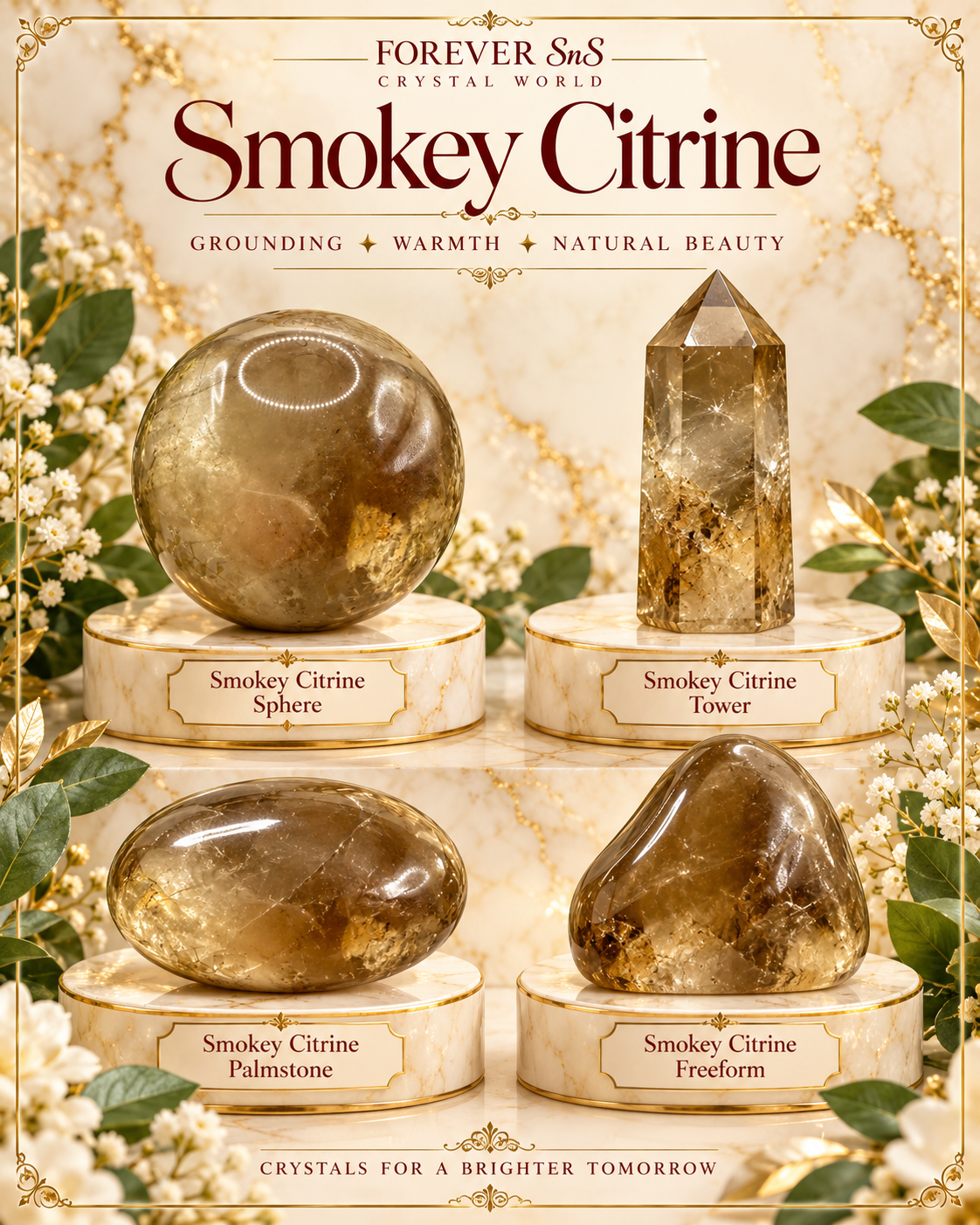
Meet the crystal

Forever SnS Crystal Passport
Smoky Citrine
Pronounced: SMOH-kee SIT-reen
Smoky Citrine is a commercial name used for Quartz showing a mixture of golden-yellow Citrine colour and smoky brown colouration, sometimes as distinct zones within the same crystal.
CWExplore this passport
Showing Science & Formation
Scientific passport
The mineral facts
Observable and measurable properties used to describe and identify this mineral.
- Chemical formula
- SiO₂
- Mineral class
- Silicate — Quartz
- Crystal system
- Trigonal
- Mohs hardness
- 7
- Lustre
- Vitreous
- Streak
- White
- Specific gravity
- Approximately 2.65
- Transparency
- Transparent to translucent
Common colours
Golden yellow, honey, brownish yellow, smoky brown and grey-brown
Cleavage and fracture
No true cleavage; conchoidal fracture.
From the Earth
How it forms
The geological processes that create this crystal over time.
Formation
Its geological story
Smoky Citrine forms when Quartz develops both yellow to golden and smoky colour centres during natural crystal growth and later geological processes. Citrine colour is associated with iron-related colour mechanisms within Quartz, while smoky colour is commonly linked to aluminium-related defects affected by natural irradiation. Where these colour-producing conditions overlap, the same crystal may develop both golden Citrine and smoky brown zones.
A closer look
Scientific notes
Smoky Citrine is a trade name rather than a recognised separate mineral species. Mineralogically, the material is Quartz. Mindat lists Smoky Citrine as a synonym of Smoky Quartz, but documented specimens also exist in which Citrine and Smoky Quartz occur together naturally within one crystal. Because Citrine and Smoky Quartz are both colour varieties of Quartz, boundaries between them can sometimes be subjective when yellow, brown and smoky tones overlap. Natural colour cannot be confirmed reliably from appearance alone, because heat treatment and irradiation can alter Quartz colour.
Passport stamps
Where in the world?
Important countries, regions and mineral localities connected with this crystal.
Madagascar
Sakavalana Mine, Ambatovita, Mandrosonoro
Amoron'i Mania
Sakavalana is especially important because both Citrine and Smoky Quartz are documented from the same pegmatite locality. This makes it an excellent geological example of why yellow, brown and smoky Quartz varieties can occur within the same broader mineral environment.
Madagascar
Citrine occurrence, Mandrosonoro
Amoron'i Mania
Mandrosonoro is a documented source of natural Citrine. A significant find was reported from the area in 2019, helping establish central Madagascar as an important source of naturally yellow Quartz rather than only heat-treated commercial material.
Madagascar
Sahatany Pegmatite Field, Mt Ibity area
Vakinankaratra
The Sahatany Pegmatite Field is a major Madagascan Quartz locality with documented Smoky Quartz. It forms part of the central Madagascan pegmatite regions where a wide variety of Quartz colours and habits occur.
Madagascar
Andilamena Quartz Quarries, Andranotokana Massif
Alaotra-Mangoro
The Andilamena Quartz Quarries are another documented Madagascan source of Smoky Quartz. They help demonstrate the widespread occurrence of smoky-coloured Quartz across Madagascar.
Crystal Detective
Look closely. Ask better questions.
Safe observations at home are separated from professional laboratory identification. No single home test can prove every specimen's identity or origin.
Safe checks at home
Look for a combination of golden-yellow, honey or brownish-yellow colour with smoky brown or grey-brown areas. Natural zoning may appear as gradual transitions, smoky tips, smoky rims, phantoms or internal colour bands. Quartz should feel relatively hard and glassy and should not be scratched easily by ordinary steel. Avoid scratch testing polished or valuable pieces. Appearance alone cannot reliably confirm whether the colour is natural or treated.
Professional methods
Gemological microscopy can examine natural inclusions and internal growth zoning. UV-Vis spectroscopy can help study the colour-causing centres within the Quartz. FTIR spectroscopy and trace-element analysis may help distinguish natural from synthetic or treated material. Raman spectroscopy can confirm the Quartz structure. Laboratory testing may be required to determine whether unusual colour zoning is natural or artificially produced.
Imitations and treatments
Smoky Citrine may be confused with Smoky Quartz, Citrine, heat-treated Amethyst, irradiated Quartz or other brownish-yellow Quartz varieties. Some Smoky Quartz can be heated to produce yellow or greenish-yellow colour. Much commercial Citrine is produced by heating Amethyst. Artificial irradiation can also produce smoky colour in Quartz. Because both natural and treated material can show attractive yellow and brown tones, treatment history should not be assumed from appearance alone.
Beliefs, traditions and cultural context
What people have believed
Smoky Citrine does not have a clearly documented ancient spiritual tradition under this modern commercial name. In contemporary crystal spirituality, it is often associated with combining the optimism, confidence and abundance symbolism linked with Citrine with the grounding and stabilising symbolism commonly attributed to Smoky Quartz. Some practitioners therefore use Smoky Citrine symbolically for staying grounded while pursuing goals, balancing enthusiasm with practicality and maintaining confidence during change. These associations belong to modern crystal spirituality and are not scientifically demonstrated medical, psychological or physical effects. Its scientifically established significance lies in being Quartz displaying overlapping or associated yellow and smoky colouration.
Handle thoughtfully
Safety notes
Finished Smoky Citrine is generally safe for normal handling. Cutting, grinding or drilling Quartz can create respirable crystalline silica dust, which should not be inhaled. Use wet-working methods, eye protection and suitable respiratory protection during lapidary work. Do not ingest powdered Quartz or place loose mineral material in drinking water.
Keep it beautiful
Care and cleaning
Clean with lukewarm water, mild soap and a soft cloth or brush. Avoid harsh chemicals and sudden extreme temperature changes. Prolonged strong heat may alter Quartz colour. Extended intense sunlight may affect some colour centres, so display valuable specimens away from strong continuous UV exposure. Store separately from softer minerals because Quartz can scratch them.
Passport complete
