Meet the crystal

Forever SnS Crystal Passport
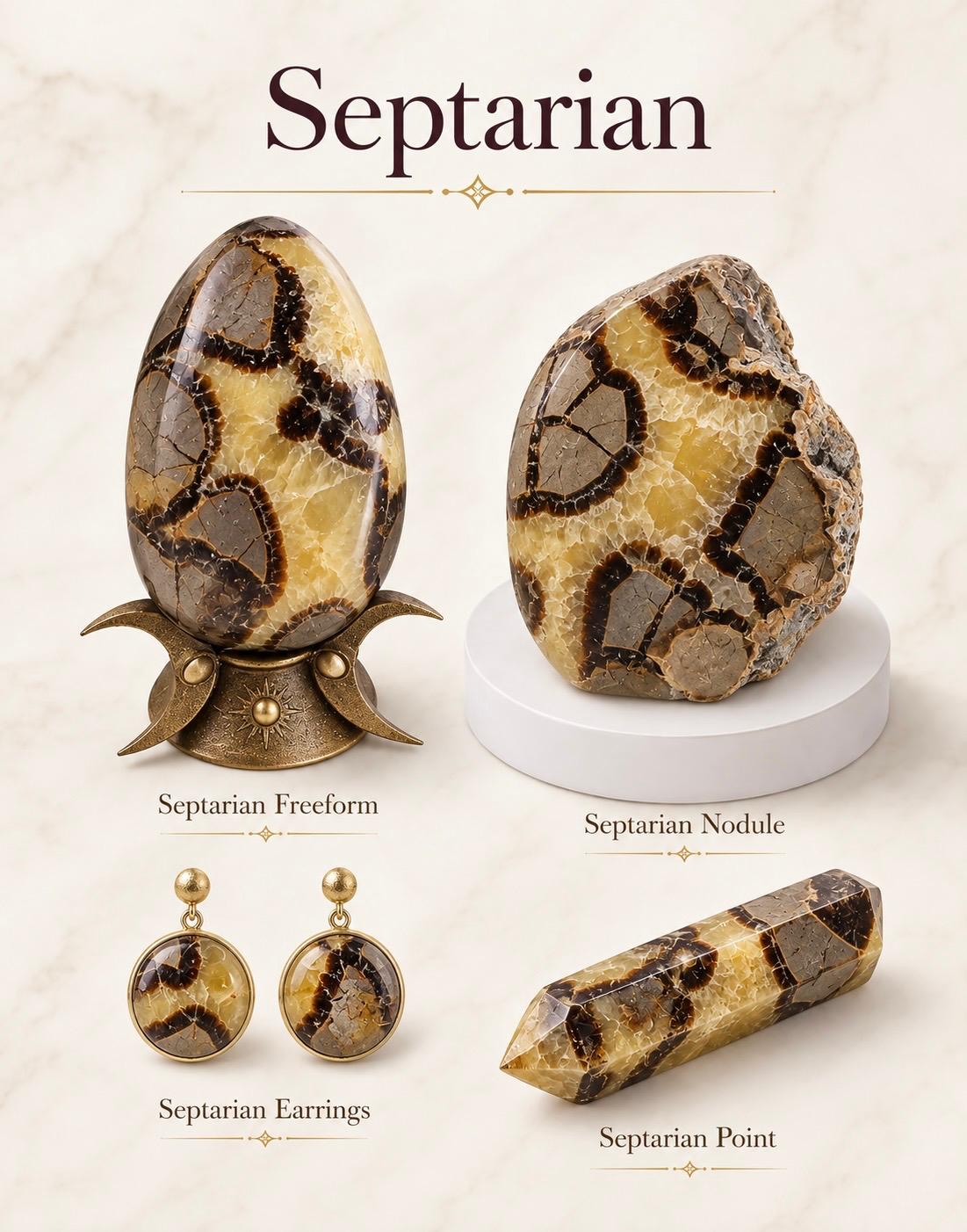
Septarian
Pronounced: sep-TAIR-ee-un
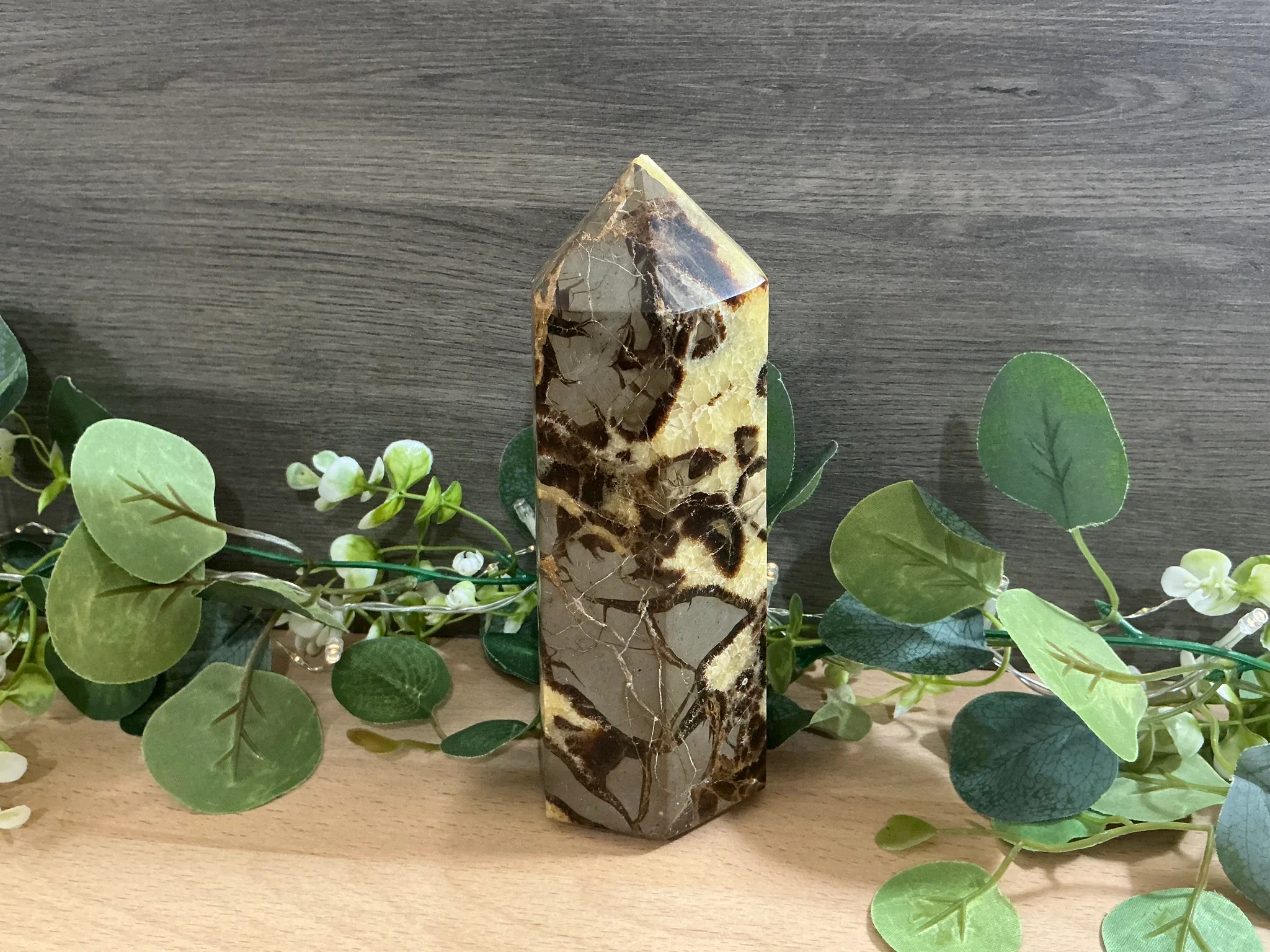
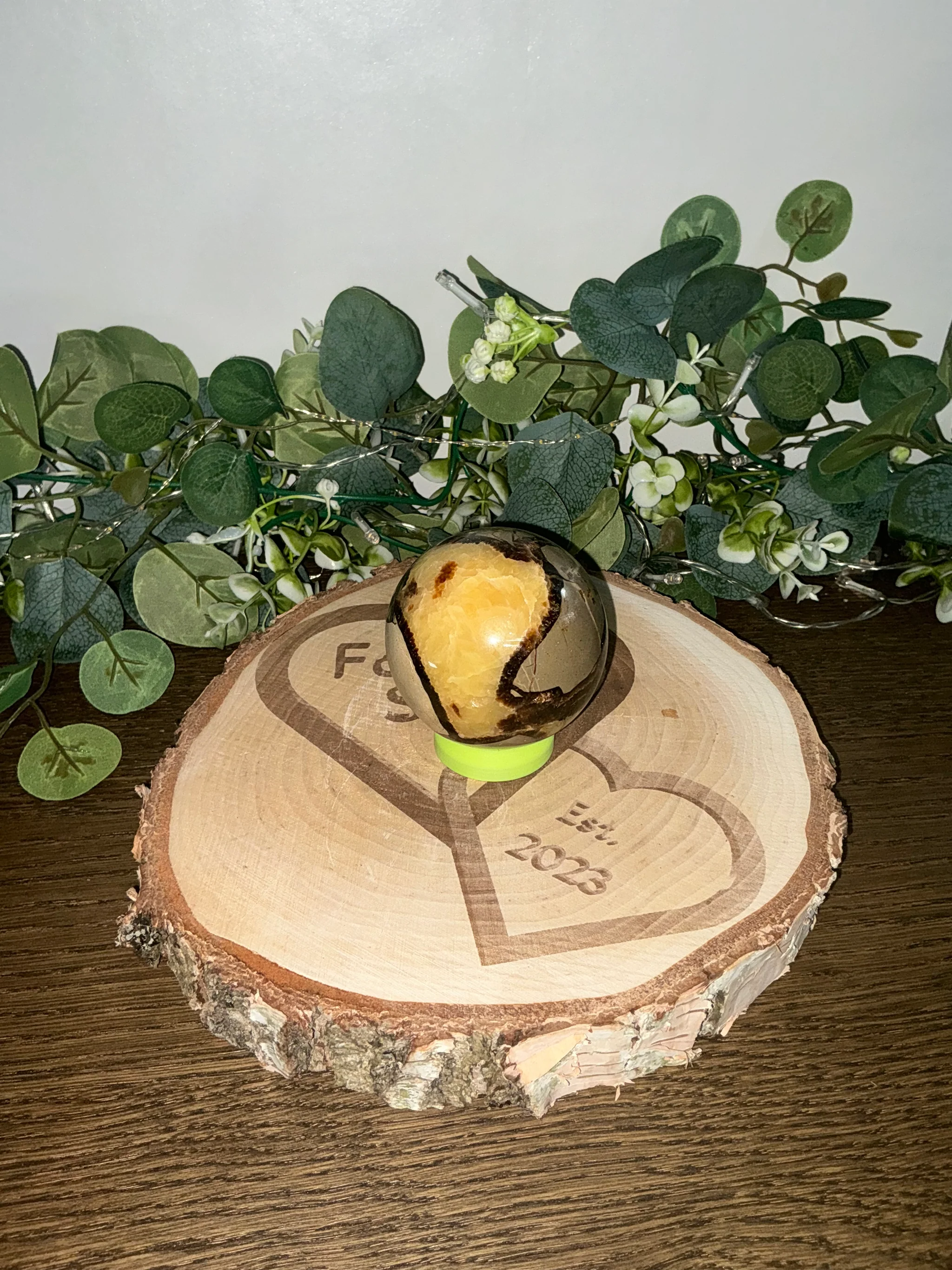
A striking natural stone formed from ancient mineral-rich concretions, famous for its cracked, dragon-scale patterns of golden calcite, brown aragonite and surrounding limestone or mudstone.
CWExplore this passport
Showing Science & Formation
Scientific passport
The mineral facts
Observable and measurable properties used to describe and identify this mineral.
- Chemical formula
- Mixed
- Mineral class
- Carbonate-rich sedimentary concretion / mixed mineral aggregate
- Crystal system
- Mixed; calcite is trigonal, aragonite is orthorhombi
- Mohs hardness
- 3-4
- Lustre
- Dull to earthy on the host rock; vitreous to pearly on calcite/aragonite fillings
- Streak
- Usually white
- Specific gravity
- Variable, commonly around 2.5–2.8
- Transparency
- Usually opaque, with some calcite areas translucent
Common colours
Golden yellow, cream, brown, grey, black, white
Cleavage and fracture
The properties vary because Septarian is a mixed-material concretion. Calcite shows perfect rhombohedral cleavage, while aragonite has distinct cleavage. The surrounding sedimentary material is generally irregular to uneven in fracture. Polished specimens can therefore contain areas with noticeably different breakage behaviour.
From the Earth
How it forms
The geological processes that create this crystal over time.
Formation
Its geological story
Septarian forms as sedimentary concretions, usually in marine muds or other fine-grained sediments. As the concretion develops and the interior loses water or contracts, internal cracks form. These cracks are later filled by mineral-rich fluids, commonly depositing calcite and sometimes aragonite or other minerals. The result is the distinctive network of contrasting veins that gives Septarian its cracked or “dragon-skin” appearance.
A closer look
Scientific notes
Septarian is not a single mineral species but a geological structure made from several minerals and sedimentary material. Its exact composition varies between deposits. The pale yellow or honey-coloured veins are commonly calcite, while darker brown regions may contain aragonite and the outer matrix is typically limestone, mudstone or similar sedimentary rock. The characteristic crack network is known as septaria, which is where the name Septarian comes from. Because it is a mixed aggregate, properties such as hardness, specific gravity, cleavage and lustre can vary across a single specimen.
Passport stamps
Where in the world?
Important countries, regions and mineral localities connected with this crystal.
United States
Muddy Creek / Orderville
Utah — Kane County
One of the best-known commercial sources of septarian. Utah material is especially recognised for its strong contrast and honey-yellow calcite-filled fractures, and polished pieces from the Orderville area are widely sold to collectors.
Madagascar
Tsaramandroso area
Northern Madagascar
Madagascar is one of the principal commercial sources of polished septarian. Material from this area is typically Jurassic in age and often shows darker brown or black sections with contrasting calcite and other mineral fillings.
Morocco
Merzouga / Adrar septaria occurrence
Drâa-Tafilalet Region — Errachidia Province
Morocco produces attractive septarian concretions containing minerals such as calcite, aragonite, quartz, pyrite and siderite. Documented occurrences are known around the Merzouga and Tafilalet area.
New Zealand
Moeraki Boulders
Otago — South Island
The famous Moeraki Boulders are enormous septarian concretions formed within ancient marine sediments. They are among the world’s most striking natural examples of septarian structure, although they are primarily a geological landmark rather than a commercial crystal source.
New Zealand
Koutu Boulders, Hokianga Harbour
Northland — North Island
Large septarian-style concretions occur along the coast between Koutu and Kauwhare Points. Like the Moeraki Boulders, they demonstrate how exceptionally large septarian concretions can form naturally in marine sedimentary rocks.
United Kingdom
Kimmeridge / Jurassic Coast
Dorset, England
Septarian concretions occur within Jurassic sedimentary rocks along parts of southern England, including the Dorset coast. These localities are important geological examples of septarian formation in Britain.
United Kingdom
Totland / London Clay exposures
Isle of Wight, England
Septarian nodules occur in the local clay formations, where erosion can expose concretions containing characteristic internal calcite-filled cracks.
Crystal Detective
Look closely. Ask better questions.
Safe observations at home are separated from professional laboratory identification. No single home test can prove every specimen's identity or origin.
Safe checks at home
Look for the distinctive network of natural cracks or polygon-shaped sections filled with contrasting mineral veins, commonly yellow, cream, brown or white calcite within a darker limestone/mudstone matrix. Under magnification, the veins should appear to pass naturally through the host rock rather than looking painted or surface-applied. Septarian can vary noticeably in weight, texture and hardness because it contains several different minerals. A UV torch may cause some calcite areas to fluoresce, although this varies and absence of fluorescence does not indicate a fake.
Professional methods
Professional identification may use optical microscopy, Raman spectroscopy or X-ray diffraction (XRD) to identify the individual minerals within the nodule. Calcite-rich sections can also be confirmed using refractive-index, hardness and chemical testing where appropriate. Because septarian is a rock containing several minerals rather than one single crystal species, measurements such as hardness, density and refractive index can vary across the specimen. Microscopic examination can also distinguish natural mineral-filled fractures from resin, glue or artificial colouring.
Imitations and treatments
Septarian is sometimes confused with patterned jasper, calcite-rich limestone, concretions or other naturally fractured rocks. Lower-quality material may occasionally be enhanced with dye, resin, polish or fracture filling to improve colour and contrast. Artificial pieces may also be produced by joining fragments or filling cracks with coloured resin. Warning signs include unnaturally vivid colour concentrated inside cracks, bubbles within transparent filling, colour collecting around surface pits, or seams that appear glued rather than naturally mineralised.
The Mythical Library
Stories carried through time
Folklore can be enjoyed without confusing it with evidence. Where a popular tale is a later retelling, the passport says so.
The Mythical Library
Septarian
Choose a book to enter the full-screen reader.
Beliefs, traditions and cultural context
What people have believed
Septarian is often associated in modern crystal traditions with grounding, confidence, patience and a sense of connection to the Earth. Its cracked, naturally segmented appearance has led to symbolic interpretations around bringing separate parts together, stability and personal growth. These ideas are mainly part of contemporary crystal-healing and spiritual practice rather than established historical or scientific use, so they should be presented as beliefs rather than proven effects.
Handle thoughtfully
Safety notes
Finished septarian specimens are generally safe to handle normally. However, cutting, drilling, sanding or grinding can create fine mineral and silica-containing rock dust, so suitable respiratory protection and dust extraction should be used when working the material. Avoid deliberately ingesting the stone or using it to prepare crystal-infused drinking water. Some of its minerals, particularly calcite, are also sensitive to acids and harsh chemicals.
Keep it beautiful
Care and cleaning
Clean gently using a soft cloth or soft brush with lukewarm water and, if necessary, a small amount of mild soap. Dry thoroughly afterwards. Avoid acidic cleaners, vinegar, bleach and other strong chemicals because calcite within the veins can be attacked or dulled. Ultrasonic and steam cleaners are best avoided, particularly where natural fractures are present. Avoid prolonged soaking, especially on more porous or unpolished specimens, and protect polished pieces from hard knocks that could chip the softer mineral-filled areas.
Follow the evidence
Sources and further reading
We show the references used while researching this passport so visitors can check important claims and continue learning.
- 1
Science
Septarian concretions from the Oxford Clay (Jurassic, England, UK): involvement of original marine and multiple external pore fluids
J. D. Hudson, M. L. Coleman, B. A. Barreiro, N. T. J. Hollingworth · Sedimentology — Wiley · 2001
Peer-reviewed geological research into septarian concretions from the Jurassic Oxford Clay. Supports information about their sedimentary origin, internal cracking, calcite and pyrite precipitation and multiple generations of mineral-rich pore fluids.
Checked 7 Sept 2026
- 2
Science
The diagenetic history of some septarian concretions from the Kimmeridge Clay, England
T. R. Astin, I. C. Scotchman · Sedimentology — Wiley · 1988
Peer-reviewed research documenting large septarian concretions, their calcite-rich interiors and several generations of calcite filling septarian veins and cavities. Supports the formation and internal-fracture information in the passport.
Checked 7 Sept 2026
- 3
Science
Jurassic septarian concretions from NW Scotland record interdependent bacterial, physical and chemical processes of marine mudrock diagenesis
J. P. Hendry, M. J. Pearson, N. H. Trewin, A. E. Fallick · Sedimentology — Wiley · 2006
Peer-reviewed research into Jurassic septarian concretions from marine mudrocks. Useful supporting evidence for the geological processes involved in concretion formation and septarian cracking.
Checked 7 Sept 2026
- 4
Localities
Muddy Creek, Orderville, Kane County, Utah, USA
Mindat.org contributors · Mindat.org / Hudson Institute of Mineralogy
Documents the well-known Septarian nodule locality at Muddy Creek near Orderville, Utah. The locality records calcite and aragonite as components of the Septarian nodules and also records anhydrite, baryte, gypsum and quartz.
Checked 7 Sept 2026
- 5
Localities
Tsaramandroso, Ambato-Boeni, Boeny, Madagascar
Mindat.org contributors · Mindat.org / Hudson Institute of Mineralogy
Documents Tsaramandroso as an area producing Septarian nodules, including specimens containing calcite and gypsum. Also records that Septarian from the area is polished into decorative forms.
Checked 7 Sept 2026
- 6
Localities
Adrar septaria occurrence, Merzouga, Errachidia Province, Morocco
Mindat.org contributors; field observations by Alain Guillet · Mindat.org / Hudson Institute of Mineralogy · 2025
Documents a Septarian occurrence west of Merzouga. Recorded minerals include aragonite, calcite, gypsum, pyrite, quartz and siderite. Coordinates are approximate, so this is used as a regional locality rather than an exact mine location.
Checked 7 Sept 2026
- 7
Localities
Ringstead Bay, Osmington, West Dorset, Dorset, England, UK
Mindat.org contributors · Mindat.org / Hudson Institute of Mineralogy
Documents large septarian nodules originating from the Oxford and Kimmeridge clays at Ringstead Bay. Broken examples characteristically contain calcite and aragonite, with some material displaying fluorescence.
Checked 7 Sept 2026
- 8
Localities
Alum Bay, Middle Barton Beds, Totland, Isle of Wight, England, UK
Mindat.org / Paleobiology Database contributors · Mindat.org
Geological locality record describing dark brown sandy clay containing layers of septaria within the Middle Barton Beds at Alum Bay.
Checked 7 Sept 2026
- 9
Localities
Moeraki Boulders
Alexander Russell Mutch · An Encyclopaedia of New Zealand / Te Ara — The Encyclopedia of New Zealand · 1966
Describes the Moeraki Boulders as large grey septarian concretions eroded from marine mudstone, with yellow calcite filling internal cracks. This is an older encyclopedia entry and is retained primarily as a geological and historical reference.
Checked 7 Sept 2026
- 10
Localities
The Moeraki Boulders — Anatomy of Some Septarian Concretions
J. R. Boles, C. A. Landis, P. Dale · Journal of Sedimentary Petrology / Society for Sedimentary Geology · 1985
Scientific study specifically examining the Moeraki Boulders. Describes them as large calcite concretions containing septarian veins of calcite, with rare later quartz and ferrous dolomite, enclosed within marine mudstones.
Checked 7 Sept 2026
- 11
Home identification
Calcite gemstone information
Gemdat.org; property information citing recognised gemmological references · Gemdat.org
Provides identification properties for calcite, including Mohs hardness, specific gravity, refractive index, cleavage and fluorescence. Relevant because calcite commonly forms prominent mineral-filled veins in Septarian.
Checked 7 Sept 2026
- 12
Laboratory identification
Septarian concretions from the Oxford Clay (Jurassic, England, UK): involvement of original marine and multiple external pore fluids
J. D. Hudson, M. L. Coleman, B. A. Barreiro, N. T. J. Hollingworth · Sedimentology — Wiley · 2001
Scientific analytical study using mineralogical and isotopic evidence to investigate Septarian concretions and successive generations of mineralisation. Supports the passport’s explanation that laboratory investigation can reveal mineral composition and formation history.
Checked 7 Sept 2026
- 13
Fakes and treatments
Calcite gemstone information
Gemdat.org; citing Henn & Milisenda, Lazzarelli and other gemmological references · Gemdat.org
Documents known treatments of massive calcite, including dyeing and impregnation with wax or plastic. Relevant when examining treated or enhanced Septarian because calcite is commonly a significant exposed component.
Checked 7 Sept 2026
- 14
Myths and folklore
The Moeraki boulders — Ngāi Tahu
Te Maire Tau · Te Ara — The Encyclopedia of New Zealand · 2009; updated 2017
Documents the tradition that Ārai-te-uru was wrecked at Shag Point in Otago and that food baskets aboard were washed ashore, where they remain as the Moeraki Boulders. Used as a cultural source for the fifth Septarian Mythical Library story.
Checked 7 Sept 2026
- 15
Myths and folklore
Moeraki Boulders — Māori shipwreck stories
Gerard Hutching · Te Ara — The Encyclopedia of New Zealand · 2009
Records the Māori tradition of the Ārai-te-uru canoe wreck at Matakaea (Shag Point) and states that its cargo of kūmara, gourds and eel pots became the Moeraki Boulders.
Checked 7 Sept 2026
- 16
Myths and folklore
The Moeraki Boulders / Kaihinaki
Rāwiri Taonui · Te Ara — The Encyclopedia of New Zealand · 2009
Records Te Waipounamu traditions in which kūmara carried aboard the Ārai-te-uru waka washed overboard and became petrified on the beach. Provides an additional cultural reference for the fifth Mythical Library story.
Checked 7 Sept 2026
- 17
Beliefs and traditions
Septarian meaning — grounding, confidence, ancestral healing
Darren Kong / Sacred Gems · Sacred Gems Australia
Example of contemporary crystal-spirituality beliefs associating Septarian with grounding, confidence, communication and stability. Included to document modern beliefs only; it does not provide scientific evidence that Septarian produces these effects.
Checked 7 Sept 2026
- 18
Safety and care
Control of exposure to silica dust — A guide for employees
Health and Safety Executive · UK Health and Safety Executive (HSE) · 2024
UK government safety guidance explaining that silica occurs naturally in many rocks, sands and clays and that cutting, sanding and carving can generate respirable crystalline silica dust. Supports precautions when cutting, drilling, sanding or grinding mineral specimens.
Checked 7 Sept 2026
- 19
Safety and care
Calcite gemstone information
Gemdat.org; citing recognised gemmological references · Gemdat.org
Records calcite at Mohs hardness 3 with perfect cleavage. These properties support gentle handling of calcite-rich portions of Septarian and protection from scratching and physical impact.
Checked 7 Sept 2026
From the Forever SnS collection
Shop products featuring Septarian
Each listing shows the actual product details, photographs and current availability.
Passport complete