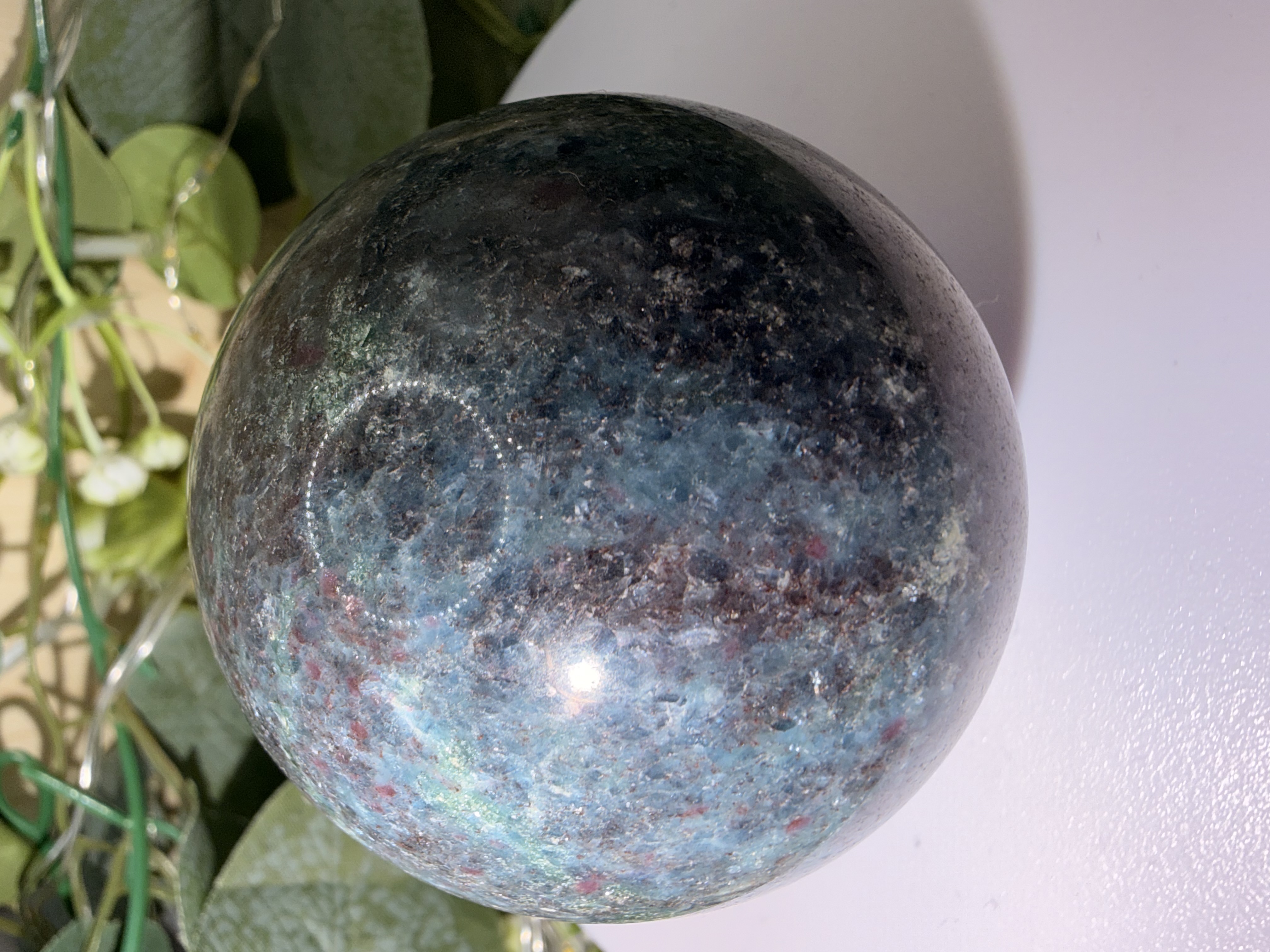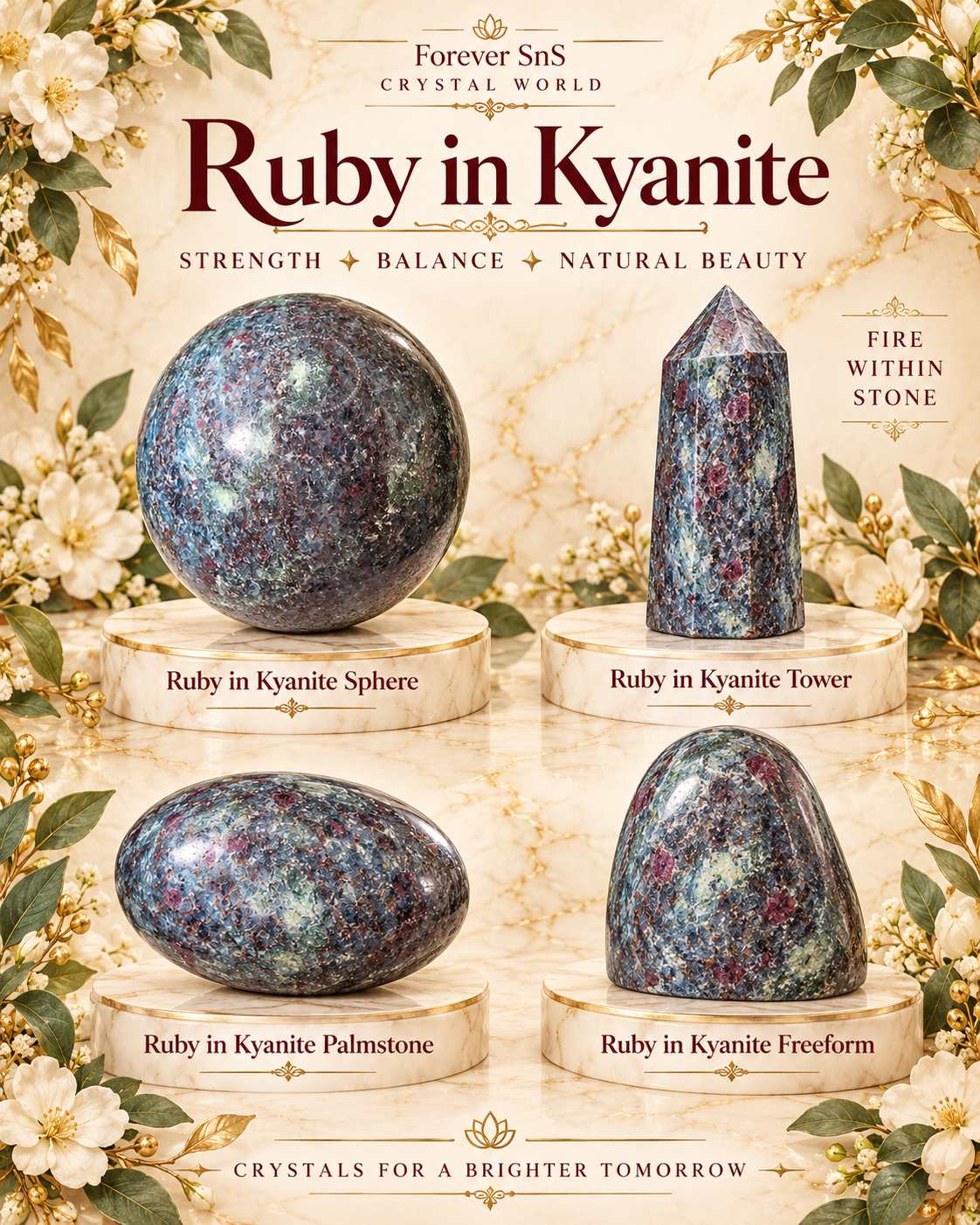
Meet the crystal

Forever SnS Crystal Passport
Ruby in Kyanite
Pronounced: ROO-bee in KYE-uh-nite
Ruby in Kyanite is a striking multi-mineral stone made up of red Ruby crystals within a blue Kyanite-rich matrix. It is a trade name rather than a single mineral species and is valued for its vivid colour contrast and metamorphic origin.
CWExplore this passport
Showing Science & Formation
Scientific passport
The mineral facts
Observable and measurable properties used to describe and identify this mineral.
- Chemical formula
- Al₂O₃ + Al₂SiO₅
- Mineral class
- Oxide + Silicate
- Crystal system
- Trigonal + Triclinic
- Mohs hardness
- Approximately 4.5–9
- Lustre
- Vitreous to dull
- Streak
- White
- Specific gravity
- Approximately 3.4–4.0
- Transparency
- Opaque to translucent
Common colours
Blue, red, grey, white, black and sometimes greenish tones
Cleavage and fracture
Kyanite has good cleavage; Ruby has no true cleavage and shows uneven to conchoidal fracture.
From the Earth
How it forms
The geological processes that create this crystal over time.
Formation
Its geological story
Ruby in Kyanite is a descriptive trade name for a natural multi-mineral material rather than a single mineral species. Ruby is the red gem variety of Corundum and has a hardness of 9, while Kyanite is much softer and has variable hardness depending on crystal direction. Because the two minerals have very different physical properties, the finished stone can show mixed behaviour in hardness, texture and wear. The material may also include other matrix minerals, so two pieces sold as Ruby in Kyanite may not be compositionally identical.
A closer look
Scientific notes
Ruby in Kyanite is a descriptive trade name for a natural multi-mineral material rather than a single mineral species. Ruby is the red gem variety of Corundum and has a hardness of 9, while Kyanite is much softer and has variable hardness depending on crystal direction. Because the two minerals have very different physical properties, the finished stone can show mixed behaviour in hardness, texture and wear. The material may also include other matrix minerals, so two pieces sold as Ruby in Kyanite may not be compositionally identical.
Passport stamps
Where in the world?
Important countries, regions and mineral localities connected with this crystal.
Tanzania
Winza, Mpwapwa District
Dodoma Region
Winza is a well-known Tanzanian gem locality where Ruby and Kyanite occur together in high-grade metamorphic material. The association is especially notable because red Corundum crystals can occur directly alongside blue Kyanite.
India
Ruby-Kyanite-Fuchsite rock mine, Madikeri, Kodagu District
Karnataka
Madikeri is a documented locality for rock containing Ruby, Kyanite and Fuchsite together. It is especially useful for understanding why some commercial Ruby in Kyanite pieces may also contain green mica or other metamorphic minerals.
Greece
Ruby occurrence, Paranesti, Drama
Eastern Macedonia and Thrace
The Paranesti occurrence documents Ruby and Kyanite within the same metamorphic area. Some specimens show the two minerals directly associated, making it a useful example of how this combination can occur naturally.
Tanzania
Kisumba Mine, Nkasi District
Rukwa Region
Kisumba Mine is another Tanzanian locality where Ruby and Kyanite are documented together. The Kyanite here may occur in colours other than blue, showing that the Ruby-Kyanite association is broader than the familiar polished blue-and-red trade material.
United States
Propst Farm, Lincoln County
North Carolina
Propst Farm is a documented occurrence where Ruby, Sapphire and Kyanite are all recorded. It helps demonstrate that Corundum and Kyanite can occur together in more than one metamorphic region worldwide.
Crystal Detective
Look closely. Ask better questions.
Safe observations at home are separated from professional laboratory identification. No single home test can prove every specimen's identity or origin.
Safe checks at home
Look for red to pink Ruby areas set within a blue, blue-grey or mixed-colour matrix. The Ruby usually appears as patches, grains or crystal areas rather than perfectly even colour. The Kyanite-rich matrix may show a fibrous, bladed or slightly streaky appearance depending on the polish and structure. Because the material is mixed, it may polish unevenly in places. Avoid destructive scratch testing because the Ruby and Kyanite parts have very different hardness.
Professional methods
Microscopic examination can help identify Ruby and Kyanite within the stone. Raman spectroscopy and X-ray diffraction can confirm the mineral components. Petrographic microscopy can examine the texture and mineral relationships in the matrix. Chemical analysis can be used to confirm Corundum and Kyanite and identify any additional minerals present.
Imitations and treatments
Ruby in Kyanite may be confused with Ruby in Fuchsite, Ruby in Zoisite or other Ruby-in-matrix stones. Some dyed or resin-stabilised decorative stones may imitate the strong colour contrast. Incorrect naming is more common than outright fakery, especially where different Ruby-bearing matrix stones are sold under similar names.
The Mythical Library
Stories carried through time
Folklore can be enjoyed without confusing it with evidence. Where a popular tale is a later retelling, the passport says so.
The Mythical Library
Choose a book to enter the full-screen reader.
Beliefs, traditions and cultural context
What people have believed
Ruby in Kyanite does not have a clearly documented ancient tradition under this modern trade name. In contemporary crystal spirituality, it is often associated with passion balanced by calm, motivation balanced by clarity and emotional strength combined with communication. Ruby is often symbolically linked with vitality, courage and drive, while Kyanite is commonly associated in modern crystal traditions with calm, alignment and clear expression. These associations are modern spiritual beliefs and are not scientifically demonstrated medical, psychological or physical effects.
Handle thoughtfully
Safety notes
Finished Ruby in Kyanite is generally safe for normal handling. Cutting, grinding or drilling can create fine mineral dust that should not be inhaled. Use wet-working methods, suitable respiratory protection and eye protection during lapidary work. Do not ingest powdered mineral material.
Keep it beautiful
Care and cleaning
Clean gently using lukewarm water, mild soap and a soft cloth. Avoid harsh chemicals and prolonged soaking. Because the stone contains minerals of different hardness and cleavage, avoid sharp impacts and dropping. Ultrasonic and steam cleaning are best avoided unless the stability of the specific specimen is known.
Follow the evidence
Sources and further reading
We show the references used while researching this passport so visitors can check important claims and continue learning.
- 1
Overview
Corundum (Var: Ruby), Kyanite — Winza, Tanzania
Mindat.org contributors · Mindat.org / Hudson Institute of Mineralogy
Documents a natural association of Ruby and Kyanite from Winza, Tanzania and provides mineral formulas and locality information.
Checked 4 Oct 2026
- 2
Science
Ruby + Kyanite — Mineral Association Discussion
Mindat.org contributors and mineral experts · Mindat.org · 2007
Provides expert discussion of the natural association between Corundum and Kyanite and records examples from several metamorphic regions.
Checked 4 Oct 2026
- 3
Localities
Kodagu District, Karnataka, India
Mindat.org contributors · Mindat.org / Hudson Institute of Mineralogy
Documents Ruby and Kyanite from the Ruby-Kyanite-Fuchsite rock mine at Madikeri, Karnataka, India.
Checked 4 Oct 2026
- 4
Localities
Kyanite from Ruby occurrence, Paranesti, Greece
Mindat.org contributors · Mindat.org / Hudson Institute of Mineralogy
Documents Kyanite associated with Corundum var. Ruby at the Paranesti Ruby occurrence in Greece.
Checked 4 Oct 2026
- 5
Laboratory identification
Kyanite with Ruby from India
Mindat.org contributors and mineral experts · Mindat.org · 2010
Discusses the mineralogical relationship between Ruby, silica and Kyanite and how Kyanite may form around or partially replace Corundum under suitable metamorphic conditions.
Checked 4 Oct 2026
- 6
Myths and folklore
Forever SnS Mythical Library — Original Ruby in Kyanite Folklore
Forever SnS · Forever SnS Ltd · 2026
The Fire That Learned the Language of Stone and The Red Heart in the Blue Mountain are original contemporary Forever SnS stories inspired by the genuine Ruby-Kyanite mineral association. They are not presented as ancient or traditional cultural folklore.
Checked 4 Oct 2026
- 7
Beliefs and traditions
Forever SnS — Modern Ruby in Kyanite symbolism context
Forever SnS · Forever SnS Ltd · 2026
Used to separate modern spiritual symbolism from geological fact. Associations with balance, strength, communication and emotional contrast are presented only as contemporary beliefs.
Checked 4 Oct 2026
From the Forever SnS collection
Shop products featuring Ruby in Kyanite
Each listing shows the actual product details, photographs and current availability.
Passport complete