Meet the crystal

Forever SnS Crystal Passport
Rhodonite
Pronounced: ROH-duh-nite
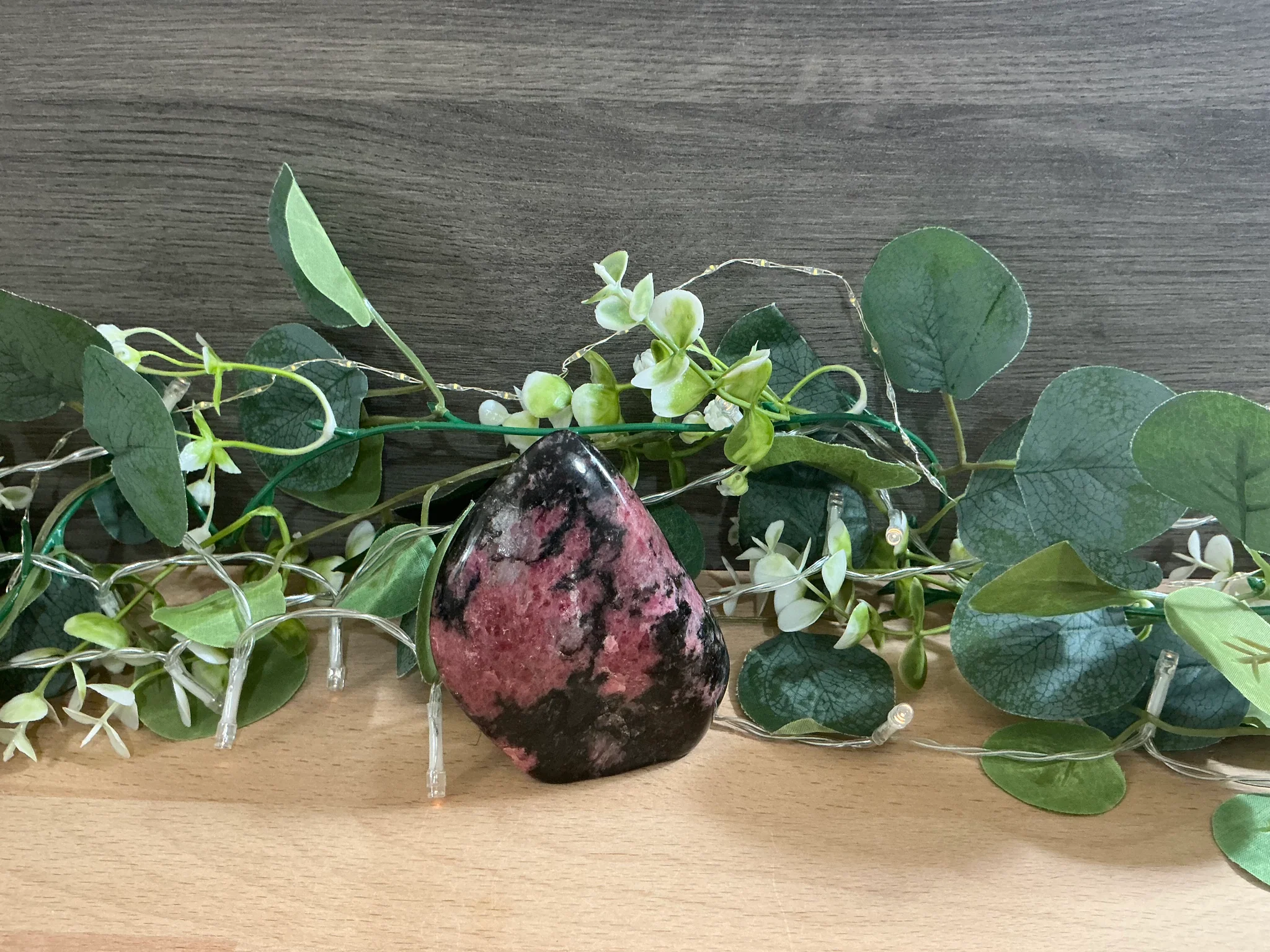
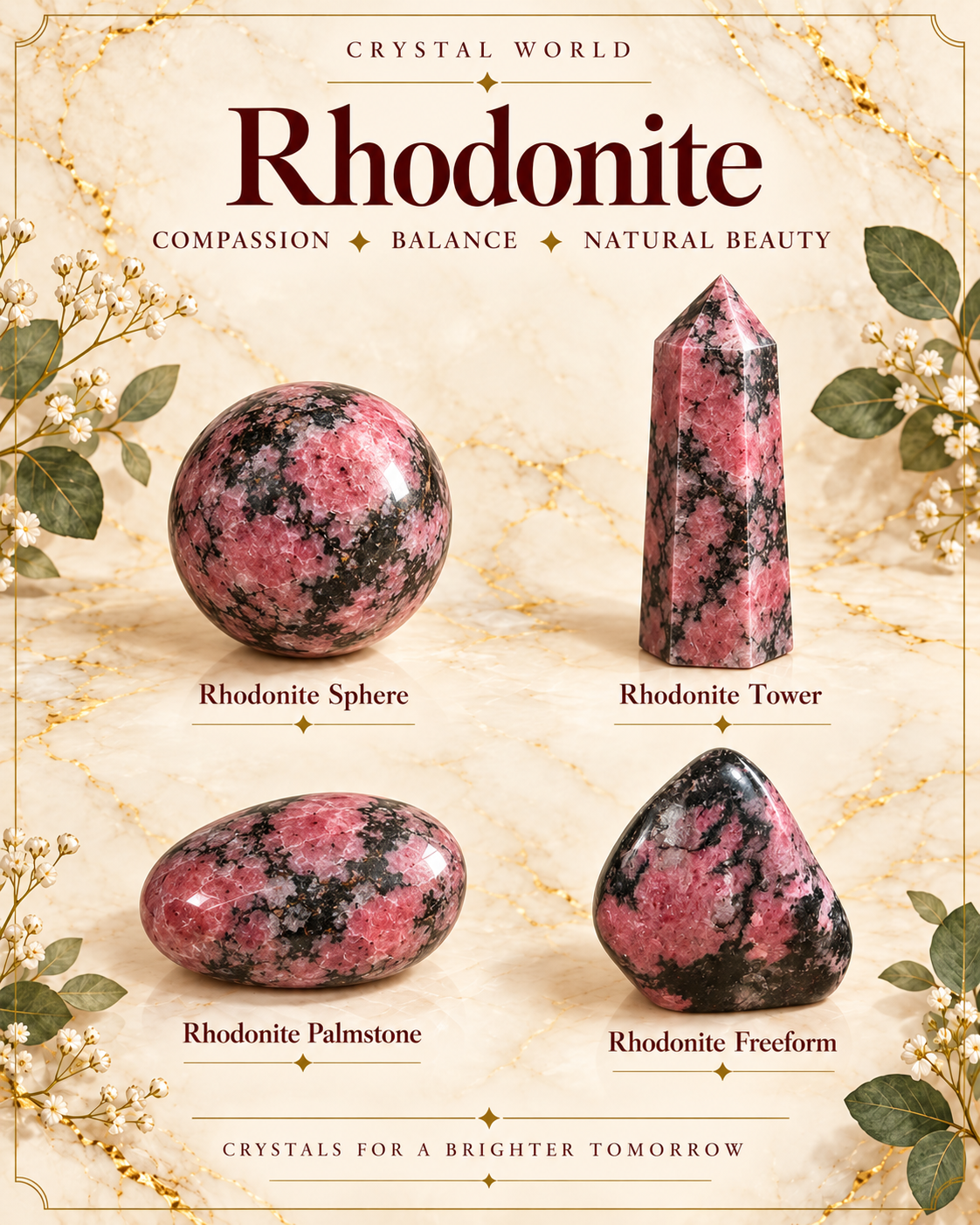
Rhodonite is a pink to red manganese-rich silicate mineral, often recognised by contrasting black manganese-oxide veining and valued as both a collector mineral and ornamental stone.
CWExplore this passport
Showing Science & Formation
Scientific passport
The mineral facts
Observable and measurable properties used to describe and identify this mineral.
- Chemical formula
- CaMn₄Si₅O₁₅
- Mineral class
- Silicate — Rhodonite Group
- Crystal system
- Triclinic
- Mohs hardness
- 5.5–6.5
- Lustre
- Vitreous to pearly
- Streak
- White
- Specific gravity
- Approximately 3.57–3.76
- Transparency
- Transparent to opaque
Common colours
Pink, rose-red, red, brownish-red and grey
Cleavage and fracture
Perfect cleavage in two directions; uneven to conchoidal fracture.
From the Earth
How it forms
The geological processes that create this crystal over time.
Formation
Its geological story
Rhodonite typically forms in manganese-rich metamorphic deposits. Heat, pressure and chemical reactions alter manganese-bearing sediments or ores, allowing Rhodonite to crystallise with other manganese minerals. It may occur with minerals such as Rhodochrosite, Spessartine, Bustamite and manganese oxides. Later weathering can oxidise manganese near the surface, producing the familiar black coatings, veins and patches seen in many Rhodonite specimens.
A closer look
Scientific notes
Rhodonite is a recognised mineral species and member of the Rhodonite Group. Its chemistry is manganese-rich but can contain calcium, iron, magnesium and zinc. Older references often give the simplified formula MnSiO₃, but modern mineralogical work shows that natural Rhodonite has a more complex composition. Some material historically labelled Rhodonite may actually belong to closely related species such as Ferrorhodonite, Vittinkiite or Pyroxmangite, and laboratory analysis may be needed for an exact identification.
Passport stamps
Where in the world?
Important countries, regions and mineral localities connected with this crystal.
Russia
Malosedel'nikovskoe deposit, Sedel'nikovo
Sverdlovsk Oblast, Ural Mountains
Malosedel'nikovskoe is one of the most historically important Rhodonite localities in the world. Large quantities of richly coloured material from this area were used for Russian ornamental stonework and objects associated with the Imperial period.
Australia
Broken Hill district
New South Wales
Broken Hill is a world-famous Rhodonite locality and has produced exceptionally fine red crystals, including well-formed specimens associated with Galena, Spessartine, Calcite and other manganese-rich minerals.
United States
Franklin Mine, Sussex County
New Jersey
Franklin Mine is one of the classic manganese-rich mineral localities of the United States and has produced notable Rhodonite crystals associated with minerals such as Franklinite, Willemite and Calcite.
United States
Sterling Mine, Sterling Hill, Ogdensburg
New Jersey
Sterling Hill is another major manganese-rich locality closely associated with Franklin. Rhodonite occurs here with Calcite, Willemite and other characteristic minerals from the famous Franklin–Sterling Hill district.
Switzerland
Tanatz Alp
Graubünden
Tanatz Alp is an important alpine Rhodonite locality known for jewellery and ornamental-quality material. Scientific study of the deposit has also helped clarify the relationship between Rhodonite and closely related manganese silicates such as Pyroxmangite.
Crystal Detective
Look closely. Ask better questions.
Safe observations at home are separated from professional laboratory identification. No single home test can prove every specimen's identity or origin.
Safe checks at home
Look for pink to rose-red material, often crossed by black or dark brown manganese-oxide veins. Rhodonite commonly has a more solid pink appearance than Rhodochrosite, which frequently shows pale banding. Fresh surfaces may have a glassy lustre, while cleavage surfaces can appear slightly pearly. Avoid destructive scratch testing on polished or valuable pieces.
Professional methods
X-ray diffraction can confirm Rhodonite and distinguish it from related manganese silicates. Raman spectroscopy can identify the mineral structure. Refractive index and optical testing can be used on transparent gem material. Chemical analysis can measure manganese, calcium, iron and magnesium and help distinguish Rhodonite from closely related Rhodonite Group minerals.
Imitations and treatments
Rhodonite may be confused with Rhodochrosite, Thulite, pink Feldspar and other pink ornamental stones. Rhodochrosite is generally softer and often displays distinctive white or cream banding. Some low-grade material may be stabilised with resin to improve durability. Dyed stones can imitate stronger pink or red colours, so unusually intense colour concentrated in fractures should be treated with caution.
The Mythical Library
Stories carried through time
Folklore can be enjoyed without confusing it with evidence. Where a popular tale is a later retelling, the passport says so.
The Mythical Library
Choose a book to enter the full-screen reader.
Beliefs, traditions and cultural context
What people have believed
Rhodonite has a documented history as an ornamental stone, particularly in Russia, where large pieces were used for decorative objects and works associated with the Imperial period. In contemporary crystal spirituality, Rhodonite is commonly associated with compassion, emotional balance, forgiveness, relationships and self-worth. Its pink colouring has encouraged modern associations with love and the Heart chakra, while the contrasting black manganese-oxide markings are sometimes interpreted symbolically as grounding or protection. These spiritual associations are contemporary beliefs and are not scientifically demonstrated medical, psychological or physical effects. Its established scientific and historical importance lies in its manganese-rich mineralogy, distinctive colour and long-standing use as an ornamental and gemstone material.
Handle thoughtfully
Safety notes
Finished Rhodonite is generally safe for normal handling. Cutting, grinding or drilling can create fine mineral dust containing manganese and silica-bearing material that should not be inhaled. Use wet-working methods, suitable respiratory protection and eye protection during lapidary work. Do not ingest powdered mineral material.
Keep it beautiful
Care and cleaning
Clean Rhodonite gently with lukewarm water, mild soap and a soft cloth. Avoid harsh acids and strong chemical cleaners. Avoid ultrasonic and steam cleaning, particularly where the stone contains fractures or extensive manganese-oxide veining. Protect from sharp impacts because Rhodonite has perfect cleavage. Store separately from harder gemstones such as Quartz, Sapphire and Diamond to reduce scratching.
Follow the evidence
Sources and further reading
We show the references used while researching this passport so visitors can check important claims and continue learning.
- 1
Overview
Rhodonite
Mindat.org contributors · Mindat.org / Hudson Institute of Mineralogy
Primary mineralogical reference for Rhodonite, including classification, chemistry, crystal system, physical properties and recognised localities.
Checked 9 Oct 2026
- 2
Localities
Rhodonite from Ural Mountains, Russia
Mindat.org contributors · Mindat.org / Hudson Institute of Mineralogy
Documents Rhodonite localities throughout the Ural Mountains, including Malosedel'nikovskoe and Kurganovskoe deposits.
Checked 9 Oct 2026
- 3
Localities
Rhodonite from Broken Hill, New South Wales, Australia
Mindat.org contributors · Mindat.org / Hudson Institute of Mineralogy
Documents Broken Hill as a world-class Rhodonite locality and lists major mines and associated minerals from the district.
Checked 9 Oct 2026
- 4
Localities
Rhodonite from New Jersey, USA
Mindat.org contributors · Mindat.org / Hudson Institute of Mineralogy
Documents Rhodonite from the Franklin Mining District and related New Jersey occurrences.
Checked 9 Oct 2026
- 5
Laboratory identification
Rhodonite-Pyroxmangite from Tanatz Alp, Switzerland
Gems & Gemology research contributors · Gemological Institute of America · 2020
Detailed gemological and mineralogical study of Rhodonite and closely related Pyroxmangite from Tanatz Alp, including chemistry, structure and gem use.
Checked 9 Oct 2026
- 6
Myths and folklore
Forever SnS Mythical Library — Original Rhodonite Folklore
Forever SnS · Forever SnS Ltd
The Rose That Grew in Stone and The Stone That Refused to Stay Perfect are original contemporary Forever SnS stories inspired by Rhodonite’s rose-pink colour, manganese-rich geology and characteristic dark manganese-oxide markings. They are not presented as ancient or traditional folklore.
Checked 9 Oct 2026
- 7
Beliefs and traditions
Forever SnS — Modern Rhodonite symbolism context
Forever SnS · Forever SnS Ltd
Used to separate contemporary crystal symbolism from mineralogical and historical fact. Associations with compassion, relationships, emotional balance and self-worth are presented only as modern beliefs.
Checked 9 Oct 2026
From the Forever SnS collection
Shop products featuring Rhodonite
Each listing shows the actual product details, photographs and current availability.
Passport complete