Meet the crystal

Forever SnS Crystal Passport
Red Hematoid Quartz
Pronounced: RED hee-MAT-oyd KWORTS
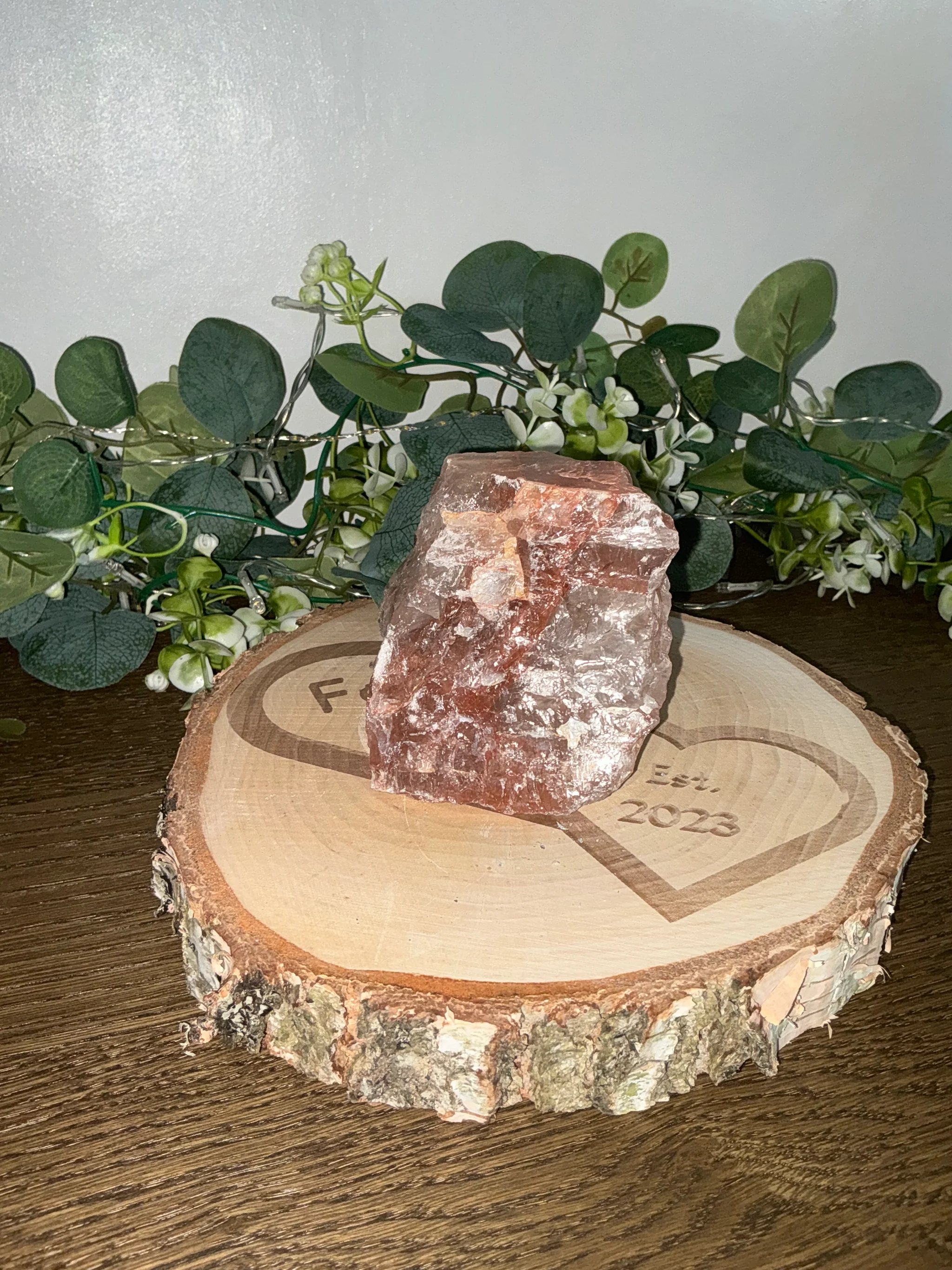
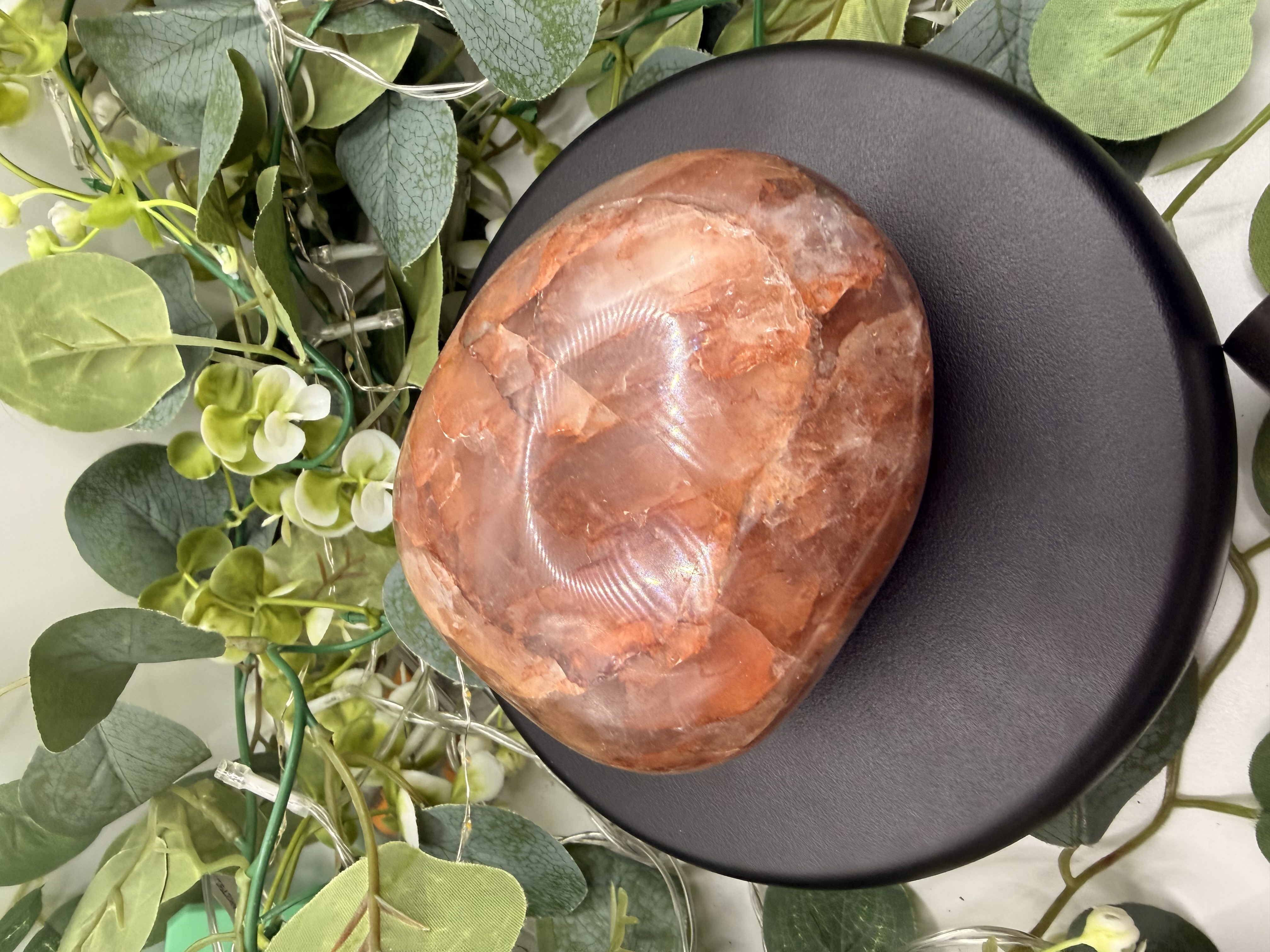
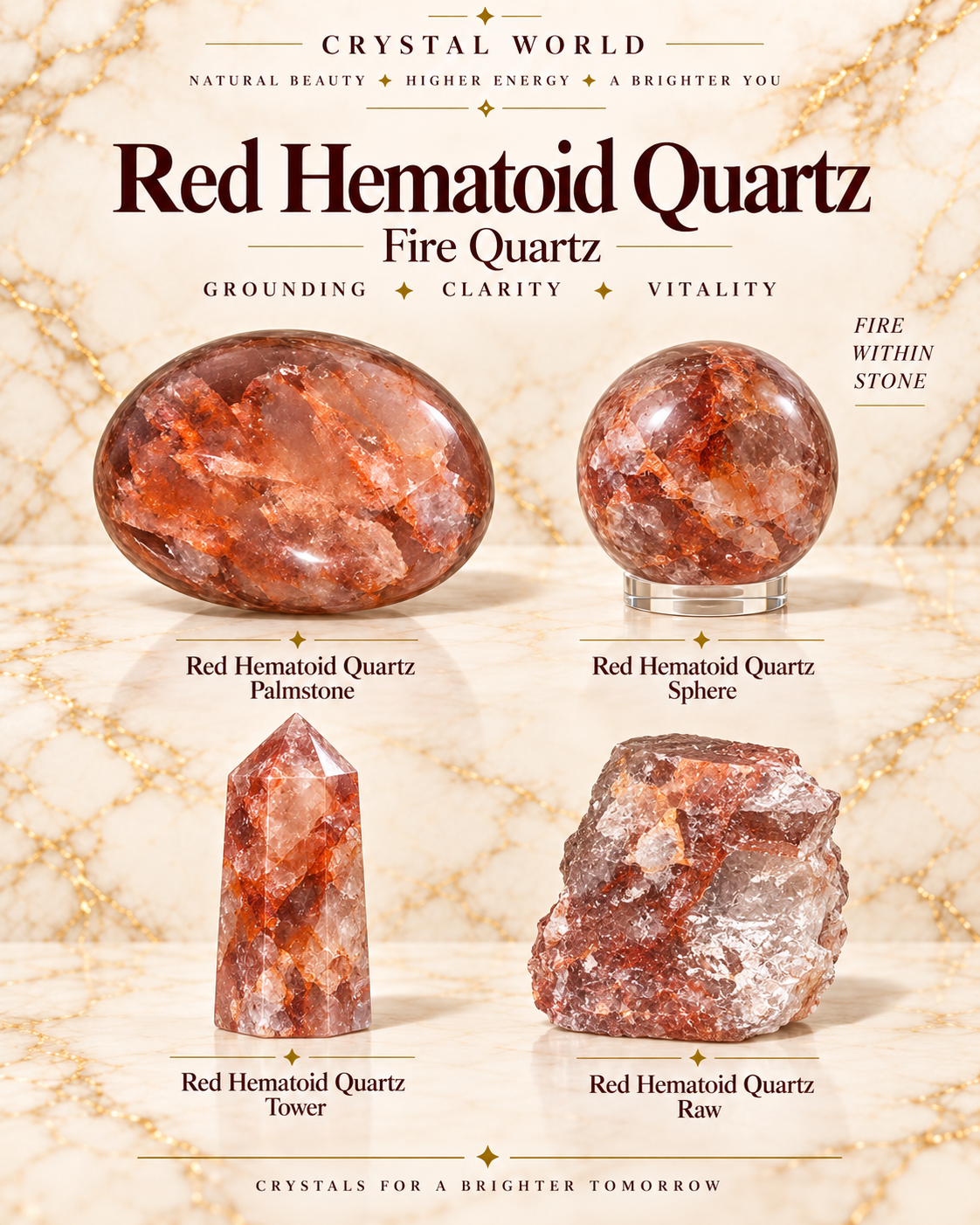
Red Hematoid Quartz, often sold as Fire Quartz, is quartz coloured by natural iron-oxide inclusions, especially hematite. Its fiery red, rust, orange and crimson markings may form clouds, streaks, phantoms or dense internal zones within otherwise clear, milky or smoky quartz.
CWExplore this passport
Showing Science & Formation
Scientific passport
The mineral facts
Observable and measurable properties used to describe and identify this mineral.
- Chemical formula
- Quartz: SiO₂ Common inclusion: Hematite Fe₂O₃
- Mineral class
- Oxide — Quartz with iron-oxide inclusions
- Crystal system
- Trigonal
- Mohs hardness
- 7
- Lustre
- Vitreous; iron-rich coatings or inclusions may appear earthy to metallic
- Streak
- Quartz: white Hematite: typically reddish brown
- Specific gravity
- Approximately 2.65 for quartz; heavily included specimens may be slightly higher
- Transparency
- Transparent to translucent, sometimes nearly opaque where iron-oxide inclusions are dense
Common colours
Colourless, white, smoky or pale quartz with red, orange, rust, brown, crimson or brick-red inclusions and zoning
Cleavage and fracture
Poor to indistinct cleavage; typically conchoidal fracture
From the Earth
How it forms
The geological processes that create this crystal over time.
Formation
Its geological story
Red Hematoid Quartz forms when quartz crystallises in an environment containing iron-rich fluids or minerals. Quartz may begin growing normally from silica-rich hydrothermal fluids. If iron becomes available during growth, hematite or other iron oxides can crystallise within the quartz, coat an existing growth surface or settle along microscopic zones. If quartz growth later resumes, these iron-rich layers can become enclosed inside the crystal. This produces internal clouds, streaks, platelets or clearly defined phantom structures. In other specimens, iron oxides may be introduced later along fractures or external surfaces. This is why not every red-coloured quartz specimen has exactly the same internal structure. Mindat specifically distinguishes true hematite-included quartz from quartz merely stained by later hematite deposition.
A closer look
Scientific notes
Red Hematoid Quartz is not a formally recognised mineral species. It is quartz whose red appearance comes from iron-rich material, especially hematite and sometimes goethite. The appearance can vary dramatically depending on when the iron minerals formed. Hematite may occur as microscopic particles, thin plates, coatings or dense masses. Some specimens from the Orange River region preserve repeated stages of quartz growth as vivid red hematite phantoms. Each phantom can record an interruption in quartz growth, deposition of hematite and later renewed quartz growth. Mindat Mindat also documents intensely red Ferruginous Quartz from Tinejdad, Morocco, in which the quartz is coloured almost completely by iron-oxide inclusions.
Passport stamps
Where in the world?
Important countries, regions and mineral localities connected with this crystal.
Morocco
Tinejdad, Errachidia Province
Drâa-Tafilalet
Tinejdad is a well-known modern locality for intensely red Ferruginous or Hematoid Quartz. Specimens can be coloured almost completely red by iron-oxide inclusions, especially hematite or goethite, and are frequently sold under names including Hematoid Quartz, Red Quartz and Eisenkiesel.
South Africa / Namibia region
Orange River, southern Africa
Orange River region
The Orange River region is famous for transparent quartz containing vivid red to crimson hematite phantoms and inclusions. These specimens can preserve multiple stages of quartz growth and are among the most visually dramatic examples of hematite-included quartz
India
Karur District
Tamil Nadu
Karur has produced exceptionally clear quartz crystals with striking red hematite phantom inclusions. Some specimens preserve complex multi-terminated phantom structures, making the locality especially interesting for collectors studying repeated growth stages inside quartz.
United Kingdom
Florence Mine, Egremont
Cumbria, England
Florence Mine is a classic British iron-mining locality famous for hematite and quartz associations. Specimens include vivid brick-red hematite-included quartz alongside metallic hematite crystals, making it an important historic example of ferruginous quartz.
United Kingdom
Calton Hill Quarry, Blackwell in the Peak
Derbyshire, England
This locality has produced ferruginous quartz containing hematite that gives the quartz an overall red colour. Mindat records specimens explicitly described as Hematite-included or Ferruginous Quartz from the quarry.
Crystal Detective
Look closely. Ask better questions.
Safe observations at home are separated from professional laboratory identification. No single home test can prove every specimen's identity or origin.
Safe checks at home
Examine the stone under strong light and rotate it slowly. Natural Red Hematoid Quartz often shows irregular internal clouds, streaks, flakes, phantoms or patchy zones rather than perfectly uniform red colouring. Use a magnifying glass to look for iron-rich material inside the quartz. Genuine inclusions may appear red, rusty orange, brown or dark metallic. If the red colour is concentrated only in surface cracks, it may represent staining or dye rather than true included hematite. Clear sections should retain the typical glass-like lustre of quartz. Avoid scratch testing polished or valuable specimens.
Professional methods
Professional testing may include refractive-index measurement, specific-gravity testing and polarised-light microscopy to confirm quartz. Raman spectroscopy can identify both quartz and hematite non-destructively. GIA has used Raman analysis to confirm hematite inclusions inside quartz specimens. gia X-ray diffraction can also identify quartz and associated iron-oxide phases. Microscopy is particularly useful for distinguishing hematite that formed during crystal growth from later surface staining or fracture coatings. SEM-EDS or electron microprobe analysis may be used to investigate the chemistry of iron-rich inclusions.
Imitations and treatments
Red Hematoid Quartz may be confused with dyed quartz, dyed crackle quartz, iron-stained quartz, glass, resin or other red-included quartz varieties. Dyed material may show strong colour collecting in fractures or porous areas, especially where the colour looks unnaturally vivid or uniform. Artificially cracked quartz may be dyed red or orange and marketed using names similar to Fire Quartz. Natural iron staining can also colour quartz externally without true inclusions being present. This is still natural quartz, but it is not necessarily the same as genuine hematite-included quartz. Because “Fire Quartz” is a commercial name rather than a tightly defined mineralogical category, accurate descriptions should ideally say whether the material contains visible hematite inclusions, surface coatings or general ferruginous staining.
The Mythical Library
Stories carried through time
Folklore can be enjoyed without confusing it with evidence. Where a popular tale is a later retelling, the passport says so.
The Mythical Library
Red Hematoid Quartz
Choose a book to enter the full-screen reader.
Beliefs, traditions and cultural context
What people have believed
Red Hematoid Quartz and Fire Quartz are mainly modern trade and crystal-spiritual names, so claims about ancient cultures specifically using “Fire Quartz” should be treated cautiously. Quartz and hematite themselves both have long histories of human use, but the modern combined gemstone category does not have one clearly documented ancient tradition under this name. In contemporary crystal spirituality, Red Hematoid Quartz is commonly associated with grounding, confidence, motivation, focus and combining the symbolic qualities attributed to Quartz and Hematite. Modern practitioners may connect it with the Root and Sacral chakras and sometimes use its fiery red appearance as a symbol of energy, determination or turning ideas into action. These interpretations belong to modern crystal spirituality and symbolism rather than scientifically demonstrated medical or psychological effects.
Handle thoughtfully
Safety notes
Finished Red Hematoid Quartz is generally safe for normal handling. As with all quartz, cutting, grinding, drilling or crushing can create respirable crystalline silica dust, which should not be inhaled. Use wet-working methods, proper dust extraction, respiratory protection and eye protection during lapidary work. Broken quartz can develop sharp edges. Do not ingest mineral powders or use powdered material in drinks or homemade “elixirs”.
Keep it beautiful
Care and cleaning
Red Hematoid Quartz is relatively durable because quartz has a Mohs hardness of 7. Clean polished specimens with lukewarm water, mild soap and a soft cloth or brush. Avoid harsh chemicals and sudden temperature changes. For specimens with delicate external hematite coatings or crystal points, use a soft brush and avoid aggressive scrubbing. Ultrasonic and steam cleaning are best avoided where the specimen is heavily fractured, has fragile inclusions or contains delicate external iron-oxide coatings.
Follow the evidence
Sources and further reading
We show the references used while researching this passport so visitors can check important claims and continue learning.
- 1
Overview
Quartz (Var: Ferruginous Quartz) — Tinejdad, Morocco
Mindat.org contributors · Mindat.org / Hudson Institute of Mineralogy
Used to support the terminology surrounding Red Hematoid Quartz. Mindat records Ferruginous Quartz, Red Quartz, Hematoid Quartz, Hematite Quartz and Eisenkiesel as names used for quartz coloured strongly red by iron-oxide inclusions such as hematite or goethite.
Checked 13 Sept 2026
- 2
Science
Quartz
John W. Anthony, Richard A. Bideaux, Kenneth W. Bladh and Monte C. Nichols · Handbook of Mineralogy / Mineral Data Publishing · 2001
Primary mineralogical reference for the quartz host, including SiO₂ composition, crystal system, hardness, density, lustre, streak, transparency, fracture and geological occurrence.
Checked 13 Sept 2026
- 3
Localities
Ferruginous Quartz — Tinejdad, Morocco
Mindat.org contributors · Mindat.org
Supports Tinejdad as a significant modern locality for strongly red Hematoid/Ferruginous Quartz coloured by iron-oxide inclusions.
Checked 13 Sept 2026
- 4
Localities
Quartz and Hematite — Orange River, Southern Africa
Mindat.org contributors · Mindat.org · 2026 specimen record
Supports the Orange River locality and documents vivid red hematite phantoms preserved inside transparent quartz.
Checked 13 Sept 2026
- 5
Localities
Quartz and Hematite — Karur District, Tamil Nadu, India
Mindat.org contributors · Mindat.org · 2024 specimen record
Supports the Karur locality and documents exceptionally clear quartz containing red hematite phantom growths.
Checked 13 Sept 2026
- 6
Localities
Quartz and Hematite — Florence Mine, Cumbria
Mindat.org contributors · Mindat.org
Supports Florence Mine as a classic British locality producing vivid brick-red hematite-included quartz associated with metallic hematite.
Checked 13 Sept 2026
- 7
Home identification
Quartz and Hematite — Orange River, Southern Africa
Mindat.org contributors · Mindat.org · 2026 specimen record
Used as a clear example of transparent quartz containing vivid red hematite phantom inclusions and repeated internal growth zones.
Checked 13 Sept 2026
- 8
Laboratory identification
“Rose” Quartz
John Koivula, Nathan Renfro and Maxwell Hain · Gems & Gemology / Gemological Institute of America · 2024
Used as a laboratory example of hematite inclusions identified inside quartz. GIA used Raman spectroscopy to confirm that opaque platy inclusions within the quartz were hematite, demonstrating the analytical methods used to identify iron-oxide inclusions.
Checked 13 Sept 2026
- 9
Fakes and treatments
Identity Help — Hematoid or Ferruginous Quartz
Mindat.org community contributors · Mindat.org · 2024
Useful for the distinction between true hematite included during quartz growth and later hematite staining or deposition along fractures. This supports the Passport's warning that a red quartz specimen is not automatically internally included Hematoid Quartz.
Checked 13 Sept 2026
- 10
Myths and folklore
Forever SnS Mythical Library — Original Red Hematoid Quartz Folklore
Forever SnS · Forever SnS Ltd · 2026
The Fire That the Mountain Refused to Lose and The Ember Inside the Crystal are original contemporary folklore created for the Forever SnS Mythical Library. They are inspired by genuine hematite inclusions, red iron-oxide colouring and phantom growth within quartz but are not presented as historical legends or documented ancient traditions.
Checked 13 Sept 2026
- 11
Beliefs and traditions
The Crystal Bible Volume 1
Judy Hall · Godsfield Press / Hachette UK · 2003
Used solely to document contemporary crystal-spiritual beliefs relating to quartz, hematite and modern crystal practices. These interpretations are presented as beliefs rather than scientific or medical evidence.
Checked 13 Sept 2026
- 12
Safety and care
Quartz — Mineral Properties
Handbook of Mineralogy contributors · Mineral Data Publishing · 2001
Used for quartz hardness, brittleness and physical properties relevant to routine handling and care. Standard crystalline-silica precautions apply when cutting or grinding quartz.
Checked 13 Sept 2026
From the Forever SnS collection
Shop products featuring Red Hematoid Quartz
Each listing shows the actual product details, photographs and current availability.
Passport complete