Meet the crystal

Forever SnS Crystal Passport
Que Sera Stone
Pronounced: KAY seh-RAH
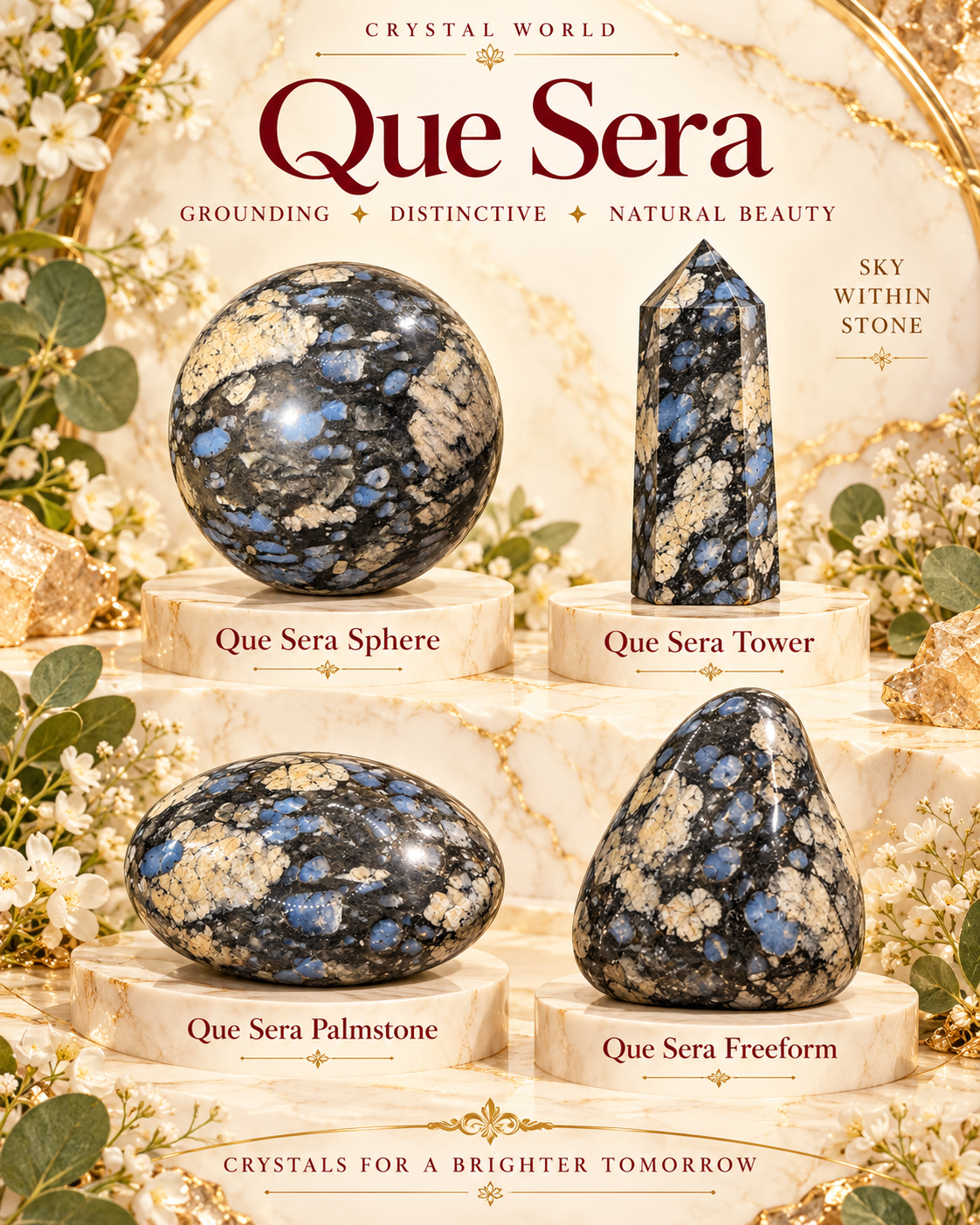
Que Sera Stone is a modern trade name for a colourful multi-mineral rock, commonly sold from Brazil, containing quartz, feldspar and other accessory minerals. It is recognised for its blue-grey patches, cream, pink, brown and black markings.
CWExplore this passport
Showing Science & Formation
Scientific passport
The mineral facts
Observable and measurable properties used to describe and identify this mineral.
- Chemical formula
- No single formula — multi-mineral rock
- Mineral class
- Silicate-rich multi-mineral rock
- Crystal system
- Not applicable — multi-mineral rock
- Mohs hardness
- Approximately 6–7
- Lustre
- Vitreous to dull
- Streak
- Usually white to pale
- Specific gravity
- Approximately 2.6–2.8
- Transparency
- Opaque
Common colours
Blue-grey, cream, pink, brown, black, grey and white
Cleavage and fracture
Variable depending on the minerals present; generally uneven fracture.
From the Earth
How it forms
The geological processes that create this crystal over time.
Formation
Its geological story
Que Sera Stone is generally associated with silica-rich igneous rock in which Quartz, Feldspar and accessory minerals crystallised together as magma cooled. Different minerals formed at different stages, producing the mottled, spotted and contrasting appearance seen in polished pieces. Because Que Sera is a trade name rather than a formal geological classification, the precise formation history may differ between deposits.
A closer look
Scientific notes
Que Sera Stone is a commercial name rather than a formally recognised mineral species. It is generally described as a Quartz- and Feldspar-rich rock, often resembling rhyolite or another silica-rich igneous material. The exact mineral composition is not standardised and may vary between specimens. It is often marketed as Llanite, but true Llanite is specifically a blue-Quartz rhyolite from Llano County, Texas. Brazilian Que Sera material should therefore not automatically be identified as Llanite without supporting geological or laboratory evidence.
Passport stamps
Where in the world?
Important countries, regions and mineral localities connected with this crystal.
Brazil
Commercial Brazilian Que Sera Stone source
Exact region not reliably documented
Brazil is the country most commonly associated with material sold commercially as Que Sera Stone. However, because Que Sera is a trade name rather than a formally defined geological material, a single verified mine or geological locality has not been reliably established in widely available mineralogical references.
Brazil
Exact commercial extraction locality unknown
Unrecorded
This entry is included to make the uncertainty clear. Many Que Sera specimens reach the crystal trade labelled only as Brazilian material, without enough geological provenance to identify the original quarry or mine confidently.
United States
Llanite rhyolite occurrence
Texas — Llano County
This is a comparison locality rather than a confirmed source of Brazilian Que Sera Stone. True Llanite is a blue-Quartz-bearing rhyolite from Llano County, Texas. Because Que Sera is frequently marketed as Llanite or Llanite-like material, this locality is important for explaining the difference between the documented geological rock Llanite and the broader Que Sera trade name.
Crystal Detective
Look closely. Ask better questions.
Safe observations at home are separated from professional laboratory identification. No single home test can prove every specimen's identity or origin.
Safe checks at home
Look for a mottled mixture of blue-grey, cream, pink, brown, black and pale mineral patches. The material usually appears granular or speckled rather than evenly coloured. Blue-grey Quartz-rich areas may contrast strongly with the darker Feldspar-rich matrix. Because it contains several minerals, hardness and surface texture may vary slightly across the same specimen. Avoid destructive scratch testing on polished pieces.
Professional methods
X-ray diffraction can identify the mineral phases present within the rock. Raman spectroscopy can confirm Quartz, Feldspar and other individual minerals. Petrographic microscopy can examine the rock texture and identify its mineral relationships. SEM-EDS or electron microprobe analysis can determine the chemistry of individual mineral grains. Laboratory testing is the best way to distinguish Que Sera material from similar-looking rhyolites or true Llanite.
Imitations and treatments
Que Sera Stone may be confused with Llanite, other rhyolites, granite-like rocks and artificially dyed decorative stone. The names Llanite, Galaxy Rhyolite and Blue Liberite are sometimes used interchangeably in the crystal trade, even though they do not necessarily describe exactly the same geological material. Very intense or unnatural colour concentrated inside fractures may indicate dye treatment. Because the trade name is not standardised, incorrect or exaggerated mineral identifications are more common than deliberate imitation.
The Mythical Library
Stories carried through time
Folklore can be enjoyed without confusing it with evidence. Where a popular tale is a later retelling, the passport says so.
The Mythical Library
Choose a book to enter the full-screen reader.
Beliefs, traditions and cultural context
What people have believed
Que Sera Stone does not have a documented ancient spiritual tradition under this modern commercial name. In contemporary crystal spirituality, it is commonly associated with acceptance, confidence, personal power, emotional balance and the idea of allowing events to unfold without excessive resistance. Its name is often interpreted through the phrase “Que sera, sera” or “Whatever will be, will be”, which has encouraged modern associations with acceptance and trust in change. Some practitioners associate the blue portions with communication and intuition and the darker or earthy portions with grounding and stability. These ideas belong to modern crystal spirituality and symbolism and are not scientifically demonstrated medical, psychological or physical effects.
Handle thoughtfully
Safety notes
Finished Que Sera Stone is generally safe for normal handling. Because it commonly contains Quartz and other silicate minerals, cutting, drilling or grinding can create fine silica-bearing dust. Do not inhale mineral dust. Use wet-working methods, suitable respiratory protection and eye protection during lapidary work. Do not ingest powdered material or place loose specimens in drinking water.
Keep it beautiful
Care and cleaning
Clean gently with lukewarm water, mild soap and a soft cloth. Avoid strong acids, bleach and harsh chemical cleaners. Avoid prolonged soaking if the specimen contains softer or porous mineral areas. Do not use ultrasonic or steam cleaners unless the exact mineral composition is known. Protect polished pieces from sharp impacts and store away from materials that may scratch softer portions of the rock.
Follow the evidence
Sources and further reading
We show the references used while researching this passport so visitors can check important claims and continue learning.
- 1
Overview
Que Sera Stone Meaning, Composition, Identification & Uses
Gems Lore editorial team · Gems Lore · 2026
Used for the modern commercial definition of Que Sera Stone and the important clarification that Que Sera is an unstandardised trade name rather than a formally recognised mineral species.
Checked 28 Sept 2026
- 2
Science
Llanite rhyolite occurrence, Llano County, Texas
Mindat.org contributors · Mindat.org / Hudson Institute of Mineralogy
Used to distinguish true Llanite from Que Sera Stone. The documented Llanite occurrence in Llano County, Texas contains blue Quartz and potassium Feldspar within rhyolite.
Checked 28 Sept 2026
- 3
Localities
Llano County, Texas, USA
Mindat.org contributors · Mindat.org / Hudson Institute of Mineralogy
Provides locality records for Llano County and documents blue Quartz and Feldspar associated with the true Llanite rhyolite occurrence. Used as a geological comparison rather than as the claimed source of commercial Brazilian Que Sera Stone.
Checked 28 Sept 2026
- 4
Home identification
Que Sera Stone — Trade Name and Identification Guide
Crystals.eu editorial team · Crystals.eu
Used as a secondary commercial reference explaining that Que Sera has no universal geological definition, commonly contains Quartz and Feldspar and should not automatically be identified as true Llanite.
Checked 28 Sept 2026
- 5
Laboratory identification
Origin and significance of blue coloration in quartz from Llano rhyolite (llanite), north-central Llano County, Texas
Michael E. Zolensky, Paul J. Sylvester and James B. Paces · American Mineralogist · 1988
Scientific reference for blue Quartz from true Texas Llanite. Included as comparison evidence rather than evidence that Brazilian Que Sera Stone is Llanite.
Checked 28 Sept 2026
- 6
Myths and folklore
Forever SnS Mythical Library — Original Que Sera Stone Folklore
Forever SnS · Forever SnS Ltd · 2026
The Stone That Said Whatever Will Be and The Rock That Wanted One Name are original contemporary stories created for the Forever SnS Mythical Library. They are inspired by the Que Sera trade name and its complicated geological identity and are not presented as traditional Brazilian, Texan or ancient folklore.
Checked 28 Sept 2026
- 7
Beliefs and traditions
Forever SnS — Modern Que Sera Stone symbolism context
Forever SnS · Forever SnS Ltd · 2026
Used to separate contemporary crystal symbolism from geological fact. Associations with acceptance, confidence, communication and allowing change are presented only as modern spiritual beliefs.
Checked 28 Sept 2026
Passport complete
