Meet the crystal

Forever SnS Crystal Passport
Prehnite
Pronounced: PREY-nite
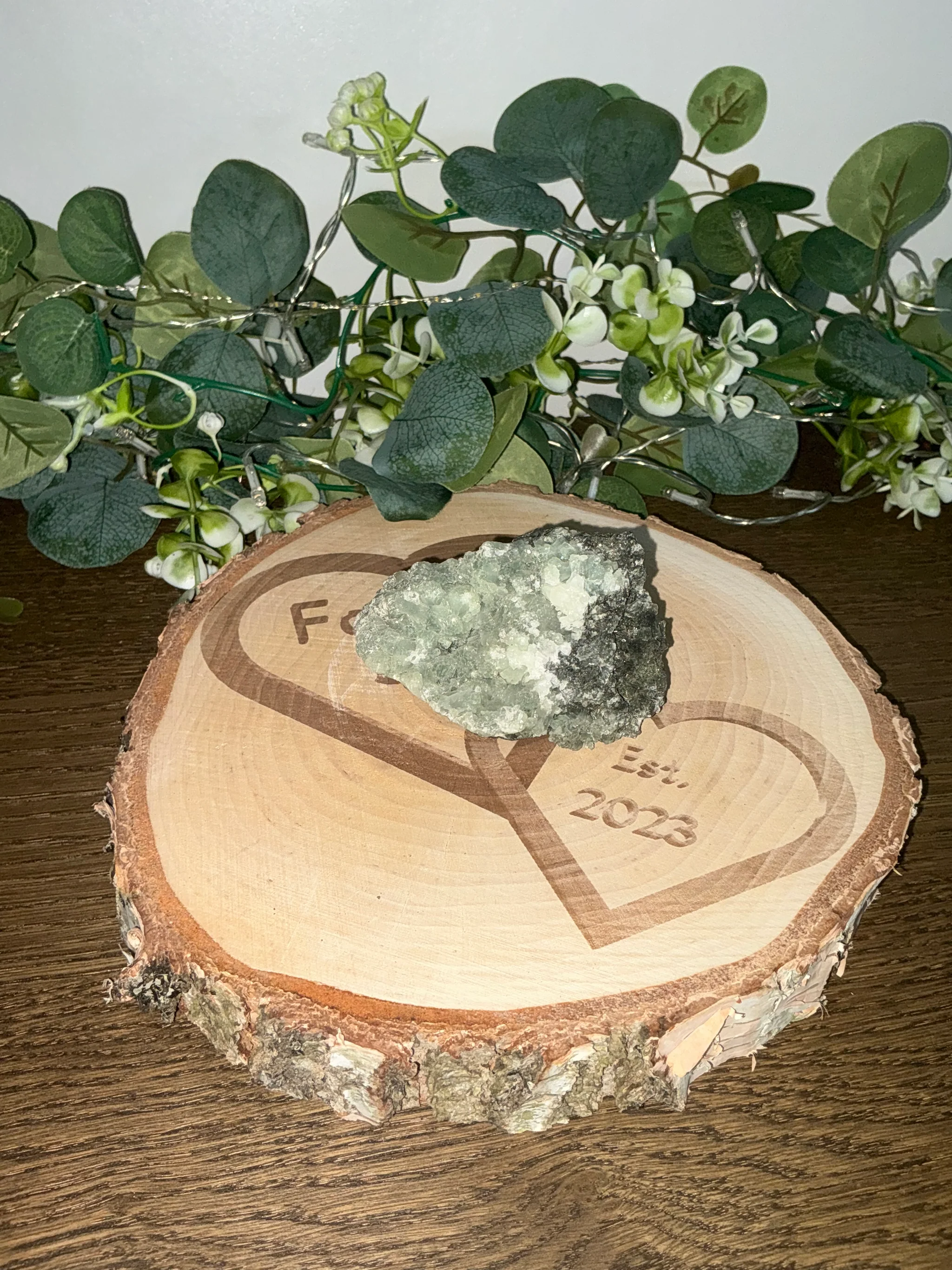
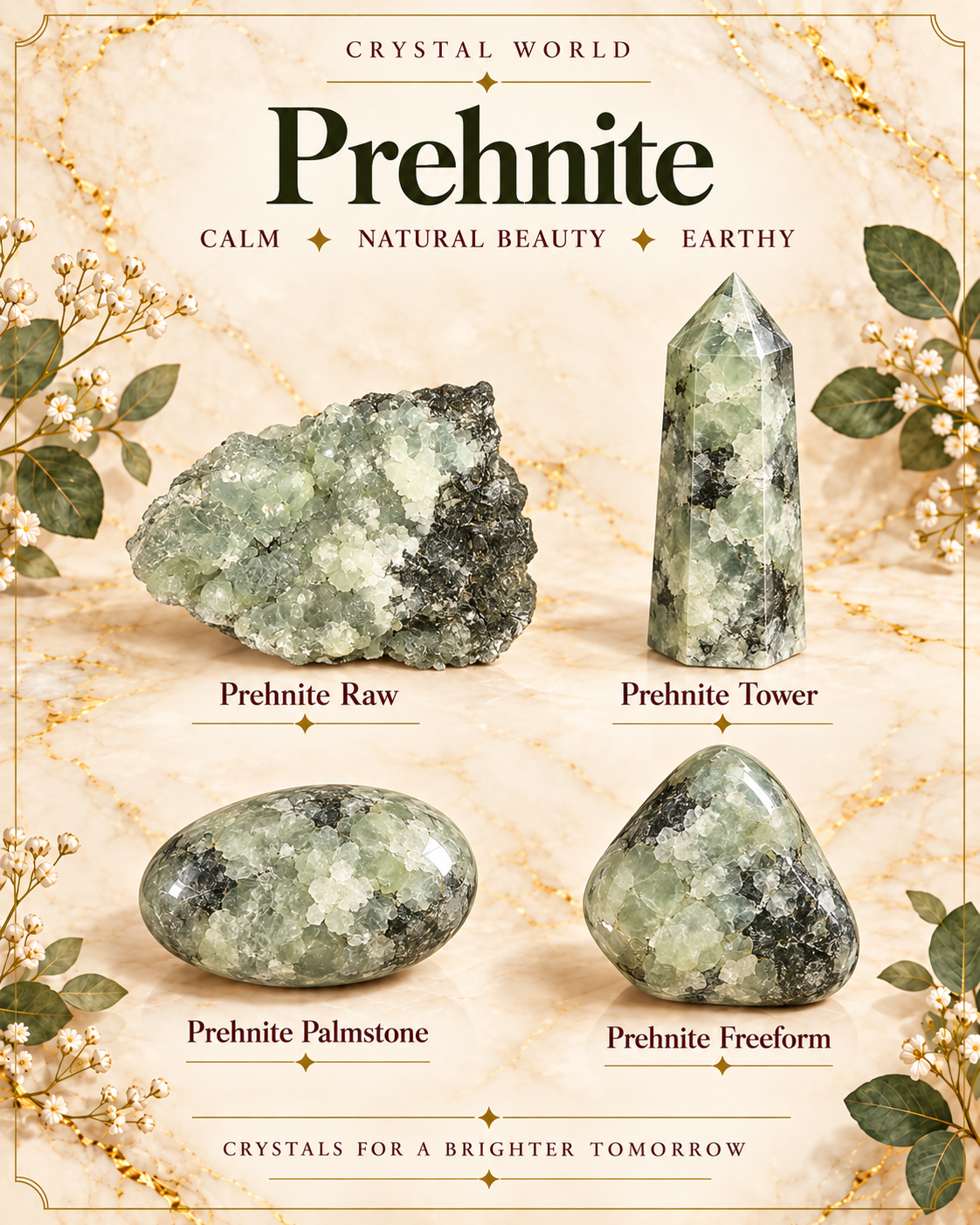
Prehnite is a pale green to yellow-green calcium aluminium silicate mineral known for its soft translucent glow, rounded crystal aggregates and formation in low-temperature hydrothermal environments.
CWExplore this passport
Showing Science & Formation
Scientific passport
The mineral facts
Observable and measurable properties used to describe and identify this mineral.
- Chemical formula
- Ca₂Al₂Si₃O₁₀(OH)₂
- Mineral class
- Silicate — Prehnite Group
- Crystal system
- Orthorhombic
- Mohs hardness
- 6–6.5
- Lustre
- Vitreous to pearly
- Streak
- White
- Specific gravity
- Approximately 2.8–2.95
- Transparency
- Transparent to translucent
Common colours
Pale green, yellow-green, colourless, white, grey and pale yellow
Cleavage and fracture
Distinct cleavage; uneven to slightly conchoidal fracture.
From the Earth
How it forms
The geological processes that create this crystal over time.
Formation
Its geological story
Prehnite commonly forms from low-temperature hydrothermal fluids moving through fractures, cavities and vesicles in volcanic rocks. It is especially common in altered basalt and related igneous rocks, where calcium- and aluminium-rich fluids react with the host rock. It may also form during low-grade metamorphism. Prehnite often grows with minerals such as Calcite, Epidote, Zeolites, Quartz and Native Copper.
A closer look
Scientific notes
Prehnite is a valid mineral species and member of the Prehnite Group. It commonly forms rounded, botryoidal, reniform, fan-like and stalactitic aggregates. Individual crystals are less common and may be blocky or tabular. Its soft green colour is often caused by small amounts of iron replacing aluminium within the mineral structure. Prehnite is an important indicator mineral in low-grade metamorphic rocks and is associated with the prehnite-pumpellyite metamorphic facies.
Passport stamps
Where in the world?
Important countries, regions and mineral localities connected with this crystal.
South Africa
Karoo dolerites, Cradock
Eastern Cape
The Karoo dolerites near Cradock form the recognised type locality for Prehnite. Material from the Cape region was used in the original scientific description of the mineral in the late 18th century, making this one of the most historically important Prehnite localities in the world.
India
Malad Quarry, Salsette Island, Mumbai
Maharashtra
Malad Quarry is a famous Deccan volcanic locality where pale green Prehnite occurs in basalt cavities with minerals such as Gyrolite, Apophyllite, Okenite, Calcite and Quartz. The locality is particularly well known for attractive botryoidal growths and Prehnite pseudomorphs after earlier minerals.
India
Dahisar Quarry, Salsette Island, Mumbai
Maharashtra
Dahisar Quarry is another important locality within the Deccan Volcanic Province and has produced attractive Prehnite specimens from basalt cavities. It forms part of the wider Mumbai–Salsette mineral district famous for secondary minerals formed by hydrothermal alteration of volcanic rock.
Canada
Jeffrey Mine, Val-des-Sources
Québec
Jeffrey Mine is regarded as a world-class locality for Prehnite. It has produced colourless, white, pale yellow, green and even purple material in blocky, steeply pyramidal and curved crystal aggregates, often associated with Grossular, Diopside, Pectolite and Vesuvianite.
United States
McKiernan & Bergin Quarry, Paterson
New Jersey
Paterson and the surrounding New Jersey basalt quarries are classic North American localities for Prehnite and related secondary minerals. They demonstrate the mineral’s strong association with fractures and cavities in altered basaltic rocks.
Australia
Emu Quarry, Prospect Hill
New South Wales
Prospect Hill has produced attractive translucent sea-green Prehnite, including unusually distinct crystals. It is an important Australian example of Prehnite occurring within altered volcanic rocks.
Crystal Detective
Look closely. Ask better questions.
Safe observations at home are separated from professional laboratory identification. No single home test can prove every specimen's identity or origin.
Safe checks at home
Look for pale green to yellow-green colour with a soft translucent appearance. Prehnite commonly forms rounded, botryoidal or grape-like surfaces rather than sharp crystal points. Polished material may show cloudy or glowing internal areas. Its hardness is greater than Calcite but lower than Quartz. Avoid destructive scratch testing on polished or valuable specimens.
Professional methods
X-ray diffraction can confirm Prehnite and distinguish it from similar silicate minerals. Raman spectroscopy can identify the Prehnite structure. Refractive index and specific gravity testing can assist with gemstone identification. Petrographic microscopy can help identify Prehnite within altered volcanic or metamorphic rocks. Chemical analysis can measure calcium, aluminium, silicon and trace iron.
Imitations and treatments
Prehnite may be confused with Chrysoprase, Peridot, Serpentine, Jade, green Chalcedony or pale green glass. Dyed material may show unusually intense or uneven colour concentrated in cracks. Some low-grade stones may be resin-stabilised. Natural Prehnite commonly has a softer, cloudy or glowing appearance rather than perfectly uniform colour.
The Mythical Library
Stories carried through time
Folklore can be enjoyed without confusing it with evidence. Where a popular tale is a later retelling, the passport says so.
The Mythical Library
Choose a book to enter the full-screen reader.
Beliefs, traditions and cultural context
What people have believed
Prehnite does not have a clearly documented ancient spiritual tradition under its modern mineral name. In contemporary crystal spirituality, Prehnite is often associated with calm, intuition, reflection, emotional balance and connection with nature. Its pale green colour has led many modern practitioners to associate it with the Heart chakra and ideas of growth, harmony and renewal. Some modern crystal traditions also connect Prehnite with meditation, dreams and personal insight. These interpretations belong to contemporary crystal spirituality and symbolism and are not scientifically demonstrated medical, psychological or physical effects. Its established scientific importance lies in its low-temperature hydrothermal formation, characteristic mineral chemistry and role as an indicator of low-grade metamorphic conditions.
Handle thoughtfully
Safety notes
Finished Prehnite is generally safe for normal handling. Cutting, grinding or drilling can create fine silicate dust that should not be inhaled. Use wet-working methods, suitable respiratory protection and eye protection during lapidary work. Do not ingest powdered mineral material.
Keep it beautiful
Care and cleaning
Clean Prehnite gently with lukewarm water, mild soap and a soft cloth. Avoid strong acids and harsh chemical cleaners. Avoid steam cleaning and prolonged ultrasonic cleaning, particularly if the stone contains fractures. Protect from sharp knocks and sudden temperature changes. Store separately from harder gemstones such as Quartz, Sapphire and Diamond to reduce scratching.
Follow the evidence
Sources and further reading
We show the references used while researching this passport so visitors can check important claims and continue learning.
- 1
Overview
Prehnite
Mindat.org contributors · Mindat.org / Hudson Institute of Mineralogy
Primary mineralogical reference for Prehnite, including its formula, crystal system, physical properties, geological setting and recognised type locality.
Checked 9 Oct 2026
- 2
Localities
Prehnite from the Karoo dolerites, Cradock, South Africa
Mindat.org contributors · Mindat.org / Hudson Institute of Mineralogy
Documents the recognised type locality for Prehnite in the Karoo dolerites near Cradock, Eastern Cape, South Africa.
Checked 9 Oct 2026
- 3
Localities
Prehnite from Salsette Island, Maharashtra, India
Mindat.org contributors · Mindat.org / Hudson Institute of Mineralogy
Documents extensive Prehnite occurrences at Salsette Island, including Malad, Dahisar and other classic Mumbai quarries in the Deccan Volcanic Province.
Checked 9 Oct 2026
- 4
Localities
Prehnite from Jeffrey Mine, Québec, Canada
Mindat.org contributors · Mindat.org / Hudson Institute of Mineralogy
Documents Jeffrey Mine as a world-class Prehnite locality producing colourless, white, pale yellow, green and purple specimens in several crystal habits.
Checked 9 Oct 2026
- 5
Home identification
Prehnite from McKiernan & Bergin Quarry, Paterson, New Jersey
Mindat.org contributors · Mindat.org / Hudson Institute of Mineralogy
Provides a documented North American Prehnite occurrence associated with the classic basaltic mineral localities around Paterson, New Jersey.
Checked 9 Oct 2026
- 6
Laboratory identification
The Secondary Minerals from the Pillow Basalt of Salsette-Mumbai, Deccan Volcanic Province, India
Berthold Ottens, Ralf Schuster and Zsolt Benkó · Minerals · 2022
Scientific study of secondary mineral formation in Salsette-Mumbai basalt, relevant to the hydrothermal formation of Prehnite and associated cavity minerals.
Checked 9 Oct 2026
- 7
Myths and folklore
Forever SnS Mythical Library — Original Prehnite Folklore
Forever SnS · Forever SnS Ltd
The Green Stone That Crossed the Sea and The Stone Between Fire and Water are original contemporary Forever SnS stories inspired by Prehnite’s South African history and genuine hydrothermal geology. They are not presented as ancient or traditional cultural folklore.
Checked 9 Oct 2026
- 8
Beliefs and traditions
Forever SnS — Modern Prehnite symbolism context
Forever SnS · Forever SnS Ltd
Used to distinguish modern crystal symbolism from mineralogical and historical fact. Associations with calm, intuition, reflection, harmony and personal growth are presented only as contemporary beliefs.
Checked 9 Oct 2026
From the Forever SnS collection
Shop products featuring Prehnite
Each listing shows the actual product details, photographs and current availability.
Passport complete