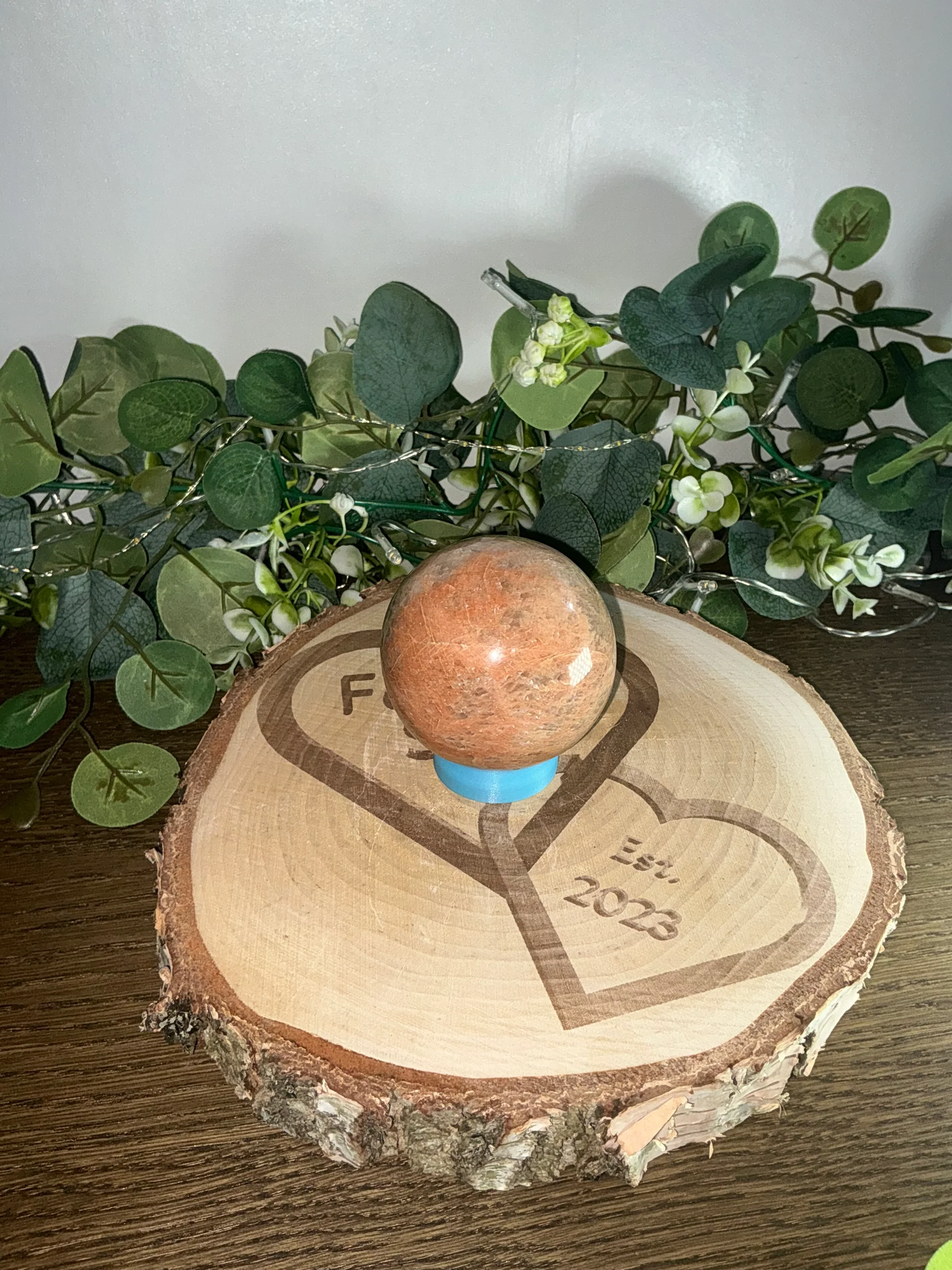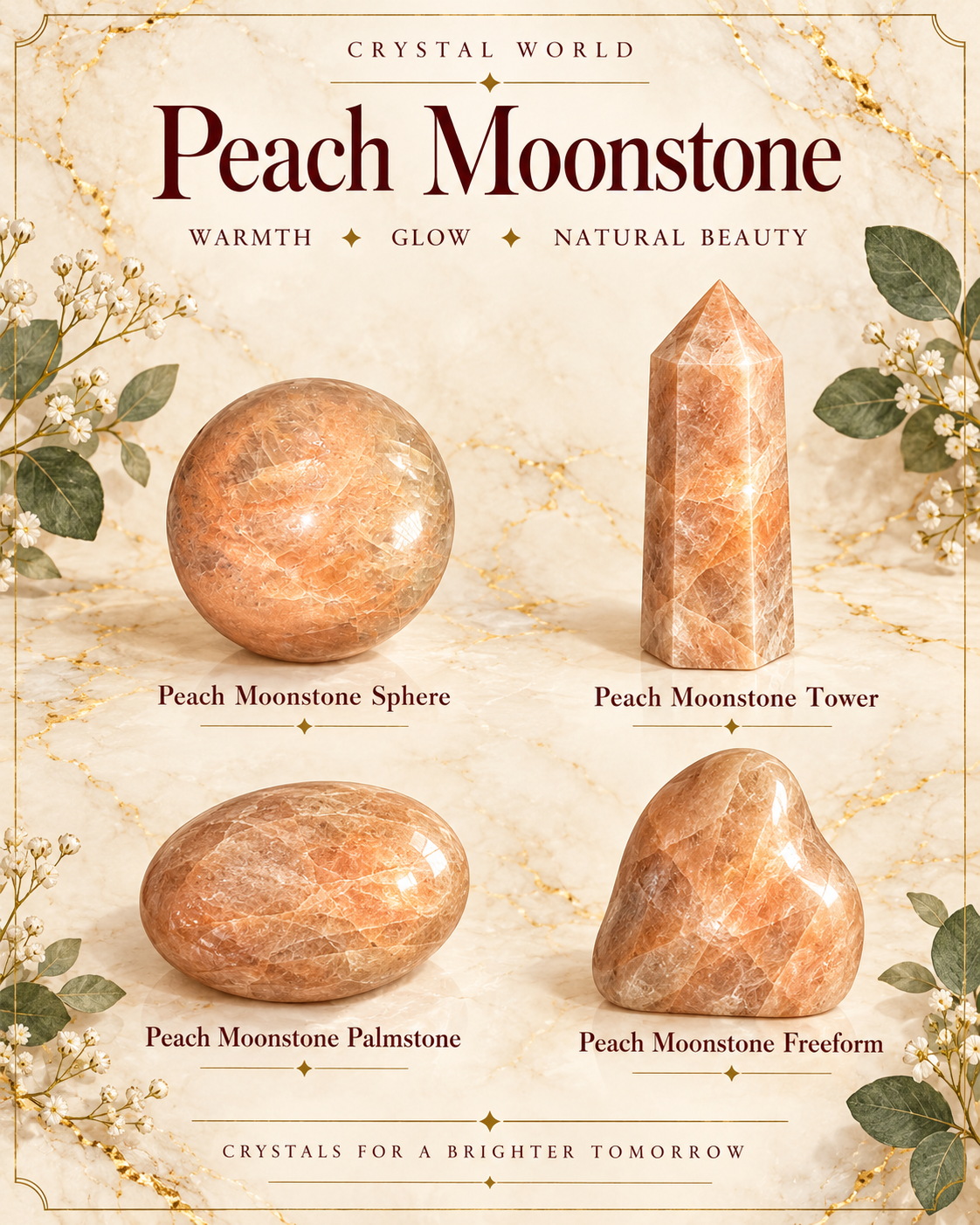
Meet the crystal

Forever SnS Crystal Passport
Peach Moonstone
Pronounced: PEECH MOON-stohn
Peach Moonstone is a warm peach to orange variety of feldspar valued for its soft adularescent glow, creamy colour and gentle internal shimmer.
CWExplore this passport
Showing Science & Formation
Scientific passport
The mineral facts
Observable and measurable properties used to describe and identify this mineral.
- Chemical formula
- KAlSi₃O₈
- Mineral class
- Silicate — Feldspar Group
- Crystal system
- Monoclinic
- Mohs hardness
- 6–6.5
- Lustre
- Vitreous to pearly
- Streak
- White
- Specific gravity
- Approximately 2.55–2.60
- Transparency
- Translucent to opaque
Common colours
Peach, apricot, orange, cream and pinkish-beige
Cleavage and fracture
Perfect cleavage in two directions; uneven fracture.
From the Earth
How it forms
The geological processes that create this crystal over time.
Formation
Its geological story
Peach Moonstone forms in feldspar-rich igneous rocks, especially granites and pegmatites. During cooling, microscopic feldspar layers or intergrowths can develop inside the crystal. These internal structures scatter light and create the soft floating sheen known as adularescence. Trace impurities and inclusions can give the material its characteristic peach, apricot and orange colouring.
A closer look
Scientific notes
Peach Moonstone is a colour variety of moonstone rather than a separate mineral species. Moonstone is usually associated with potassium-rich feldspar showing adularescence caused by microscopic internal layering. The exact feldspar composition can vary between deposits, so not every specimen sold as Peach Moonstone will have identical chemistry. Its warm colour is different from the optical sheen: the peach colour comes from the material itself, while adularescence is caused by the way light interacts with its internal structure.
Passport stamps
Where in the world?
Important countries, regions and mineral localities connected with this crystal.
India
Commercial moonstone deposits
Various feldspar-producing regions
India is one of the world’s major moonstone sources and is especially important in the commercial supply of coloured moonstone, including peach, cream and brown material.
Sri Lanka
Alluvial moonstone deposits
Various gem-producing districts
Sri Lanka is one of the classic and most important sources of natural moonstone. Moonstone is recovered from gem-bearing deposits alongside many other feldspar and gemstone materials.
Madagascar
Sahambano–Manivola area near Ihosy
Ihorombe Region
A documented Madagascan moonstone occurrence was discovered in a granitic pegmatite between Sahambano and Manivola near Ihosy. This locality is important because laboratory gemological work confirmed genuine moonstone from Madagascar and helped distinguish it from labradorite.
Tanzania
Namalulu, Simanjiro District
Manyara Region
Namalulu is a documented Tanzanian moonstone locality that has produced feldspar crystals showing a visible moonstone sheen. It demonstrates that moonstone occurs in East African metamorphic and pegmatitic gem regions as well as the better-known Asian deposits.
Madagascar
Andilamena
Alaotra-Mangoro Region
Andilamena is a modern Madagascan feldspar locality where unusual moonstone-like material with orange optical effects has been documented. It is useful for showing the wide range of colour and optical behaviour found within feldspar gems.
Crystal Detective
Look closely. Ask better questions.
Safe observations at home are separated from professional laboratory identification. No single home test can prove every specimen's identity or origin.
Safe checks at home
Look for warm peach, cream or apricot colouring with a soft floating sheen that moves as the stone is turned. Natural material may contain cloudy patches, internal veils or small inclusions. The glow should appear beneath the surface rather than looking like glitter sitting on top. Avoid destructive scratch testing on polished specimens.
Professional methods
Refractive index testing can help identify feldspar. Microscopy can reveal internal lamellae and inclusions responsible for adularescence. Raman spectroscopy and X-ray diffraction can identify the feldspar species. Specific gravity and optical testing can help distinguish Peach Moonstone from glass and other lookalike stones.
Imitations and treatments
Peach Moonstone may be confused with Peach Aventurine, Sunstone, coloured glass and other peach-toned feldspars. Some glass imitations may show an artificial glow or evenly distributed glitter. Dyed feldspar may show unnaturally strong colour concentrated in cracks. Because Peach Moonstone is a trade colour name, incorrect feldspar identification is more common than deliberate fakery.
The Mythical Library
Stories carried through time
Folklore can be enjoyed without confusing it with evidence. Where a popular tale is a later retelling, the passport says so.
The Mythical Library
Choose a book to enter the full-screen reader.
Beliefs, traditions and cultural context
What people have believed
Peach Moonstone does not have a clearly documented ancient spiritual tradition under this specific modern colour name. In contemporary crystal spirituality, Peach Moonstone is often associated with emotional warmth, intuition, calm, creativity and new beginnings. Its soft peach colour has also led modern practitioners to connect it with nurturing, confidence and gentle personal growth. Moonstone more broadly has a long history of symbolic association with the Moon, cycles, femininity and change in several modern and historical traditions. These interpretations belong to cultural symbolism and contemporary crystal spirituality and are not scientifically demonstrated medical, psychological or physical effects.
Handle thoughtfully
Safety notes
Finished Peach Moonstone is generally safe for normal handling. Cutting, grinding or drilling can create fine silicate dust that should not be inhaled. Use wet-working methods, suitable respiratory protection and eye protection during lapidary work. Do not ingest powdered mineral material.
Keep it beautiful
Care and cleaning
Clean Peach Moonstone gently with lukewarm water, mild soap and a soft cloth. Avoid steam and ultrasonic cleaning because feldspar has good cleavage and may contain internal fractures. Protect from sharp knocks and drops. Avoid harsh chemicals and sudden temperature changes. Store separately from harder gemstones such as Quartz and Diamond to reduce scratching.
Follow the evidence
Sources and further reading
We show the references used while researching this passport so visitors can check important claims and continue learning.
- 1
Overview
Moonstone
Gemological Institute of America · Gemological Institute of America
Primary gemological reference for Moonstone, including its feldspar composition, peach body colour, Mohs hardness, specific gravity and adularescent optical effect.
Checked 8 Oct 2026
- 2
Science
Moonstone Description
Gemological Institute of America · Gemological Institute of America
Explains moonstone as feldspar containing microscopic orthoclase and albite intergrowths and describes how these layers produce the characteristic adularescent sheen.
Checked 8 Oct 2026
- 3
Localities
June Birthstones — Moonstone Sources
Gemological Institute of America · Gemological Institute of America
Used for major global moonstone sources, including India, Sri Lanka, Madagascar, Myanmar, Tanzania, Brazil and the United States.
Checked 8 Oct 2026
- 4
Localities
Moonstone from Madagascar
Gems & Gemology contributors · Gemological Institute of America
Documents moonstone from a granitic pegmatite between Sahambano and Manivola near Ihosy, Madagascar, and discusses the need to distinguish true moonstone from labradorite.
Checked 8 Oct 2026
- 5
Localities
Feldspar var. Moonstone — Namalulu, Tanzania
Mindat.org contributors · Mindat.org / Hudson Institute of Mineralogy
Documents moonstone from Namalulu in Tanzania, including feldspar crystals showing a visible moonstone sheen.
Checked 8 Oct 2026
- 6
Home identification
Moonstone Buyer’s Guide
Gemological Institute of America · Gemological Institute of America
Used for recognised moonstone colours, transparency, adularescence and the characteristics used to evaluate genuine moonstone.
Checked 8 Oct 2026
- 7
Myths and folklore
Forever SnS Mythical Library — Original Peach Moonstone Folklore
Forever SnS · Forever SnS Ltd
The Moon That Learned to Blush and The Light Between the Layers are original contemporary Forever SnS stories inspired by Peach Moonstone’s warm colour and genuine adularescent optical effect. They are not presented as ancient or traditional folklore.
Checked 8 Oct 2026
- 8
Beliefs and traditions
Forever SnS — Modern Peach Moonstone symbolism context
Forever SnS · Forever SnS Ltd
Used to distinguish contemporary spiritual symbolism from geological fact. Associations with warmth, intuition, creativity and personal growth are presented only as modern beliefs.
Checked 8 Oct 2026
- 9
Safety and care
June Birthstones — Moonstone Care and Cleaning
Gemological Institute of America · Gemological Institute of America
Used for Moonstone hardness, toughness and cleaning guidance, including avoiding high heat, ultrasonic cleaners and steam cleaning.
Checked 8 Oct 2026
From the Forever SnS collection
Shop products featuring Peach Moonstone
Each listing shows the actual product details, photographs and current availability.
Passport complete