Meet the crystal

Forever SnS Crystal Passport
Orange Banded Calcite
Pronounced: OR-inj BAN-did KAL-site
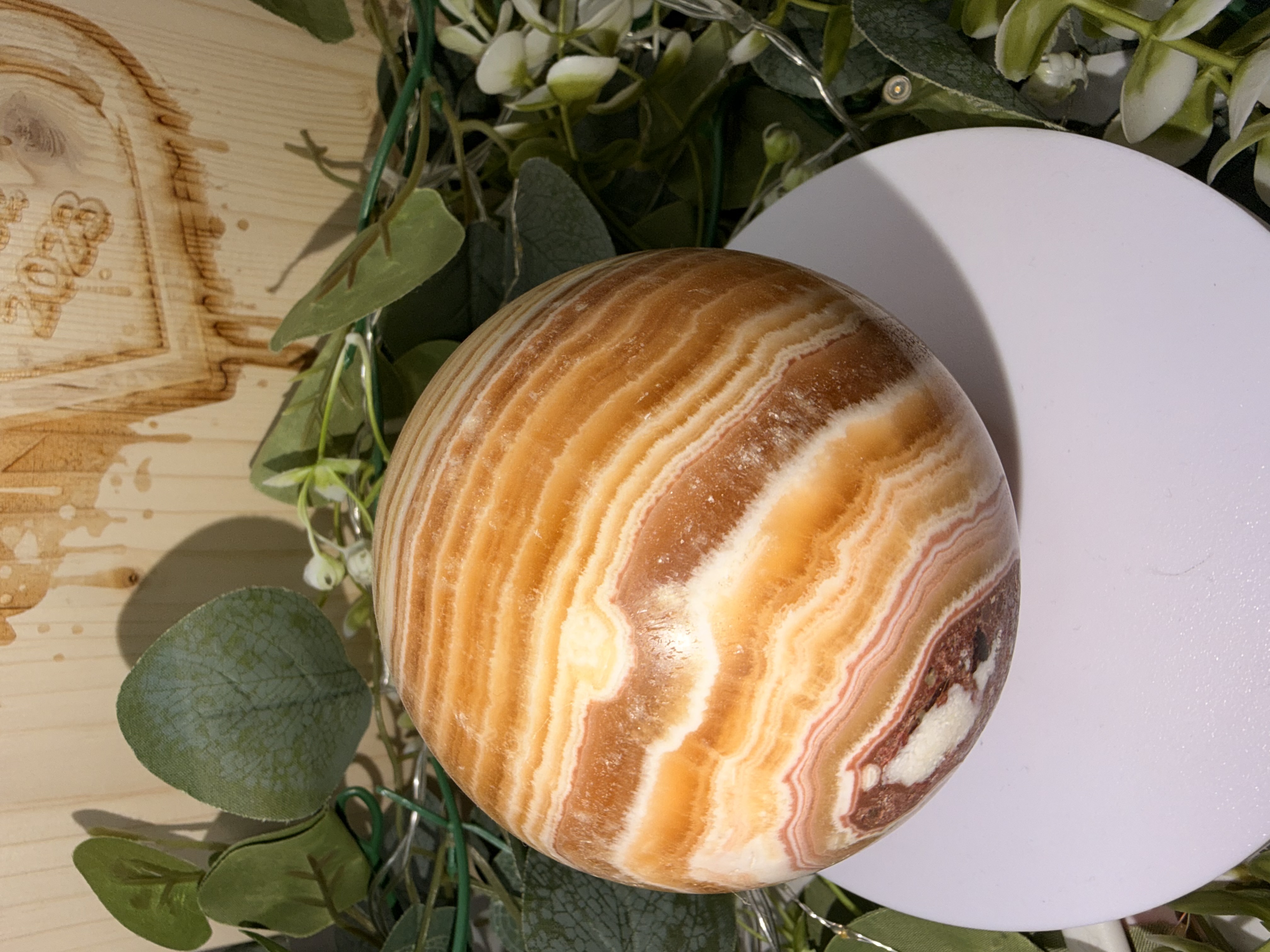
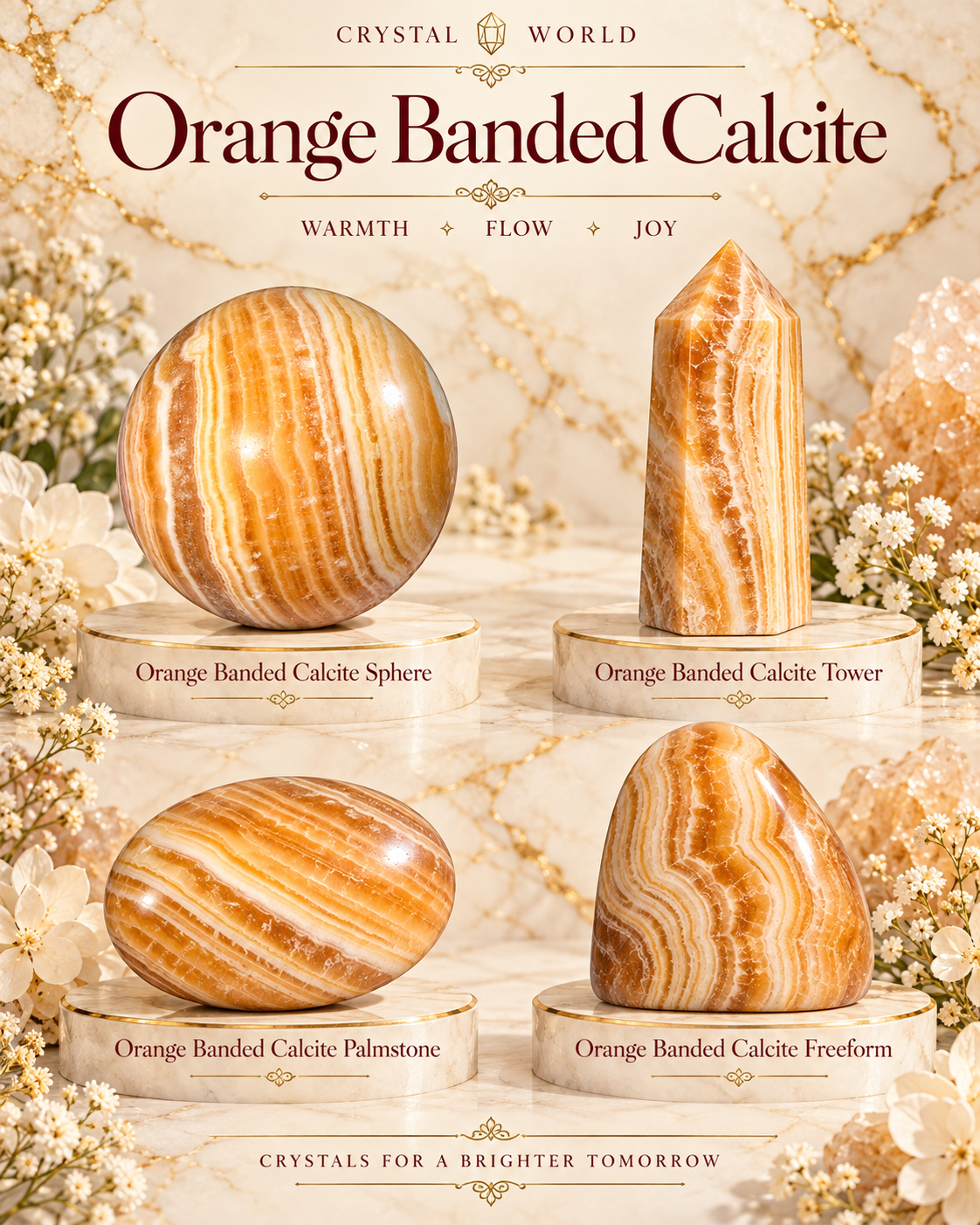
Orange Banded Calcite is a layered calcium-carbonate material displaying orange, cream, white, honey and brown bands. It is primarily Calcite, although some deposits may also contain Aragonite, and it is often incorrectly marketed as Onyx or Onyx Marble.
CWExplore this passport
Showing Science & Formation
Scientific passport
The mineral facts
Observable and measurable properties used to describe and identify this mineral.
- Chemical formula
- CaCO₃
- Mineral class
- Carbonate — primarily Calcite
- Crystal system
- Trigonal
- Mohs hardness
- Approximately 3
- Lustre
- Vitreous to pearly
- Streak
- White
- Specific gravity
- Approximately 2.7
- Transparency
- Translucent to opaque
Common colours
Orange, cream, white, honey, peach, brown and yellow-orange
Cleavage and fracture
Perfect rhombohedral cleavage; brittle with uneven to conchoidal fracture.
From the Earth
How it forms
The geological processes that create this crystal over time.
Formation
Its geological story
Orange Banded Calcite forms through repeated deposition of calcium carbonate from mineral-rich water. This commonly occurs around springs, caves, fractures and other environments where calcium-bearing water releases carbon dioxide and deposits Calcite. Each new layer can contain slightly different amounts of iron, manganese or other impurities, producing contrasting orange, cream, white and brown bands. Some deposits may contain both Calcite and Aragonite, especially where changing temperature, chemistry or water conditions favoured different calcium-carbonate structures during formation.
A closer look
Scientific notes
Orange Banded Calcite is a commercial description rather than a separate mineral species. Its visible layers record repeated episodes of calcium-carbonate deposition. Although the material is normally dominated by Calcite, some banded ornamental deposits contain both Calcite and Aragonite. It is often sold as Onyx, Onyx Marble or Mexican Onyx, but these names should not be confused with true Onyx, which is a banded variety of Chalcedony composed of silica. Its orange, honey and brown colours are generally caused by iron-rich impurities or other trace materials incorporated during growth.
Passport stamps
Where in the world?
Important countries, regions and mineral localities connected with this crystal.
Mexico
Tecali de Herrera and surrounding limestone onyx deposits
Puebla
Puebla is one of Mexico’s best-known regions for decorative banded Calcite traditionally sold as Mexican Onyx or Onyx Marble. The material is valued for translucent cream, honey, orange and brown banding and has long been carved and polished for ornamental use.
Mexico
Pedrara Quarry, El Mármol
Baja California
El Mármol is a documented source of strongly banded Cave Onyx composed of Calcite. Specimens show contrasting layers typical of the decorative material commonly marketed as banded onyx or onyx marble.
Argentina
El Rosario Mountain, La Toma
San Luis Province
La Toma is a documented locality for Cave Onyx, a naturally banded variety of Calcite. It demonstrates that ornamental banded Calcite is not unique to Mexico and can form wherever calcium-rich waters repeatedly deposit carbonate layers.
Italy
Paglio Pignolino Mine, Dossena
Lombardy
The Paglio Pignolino Mine is another documented Cave Onyx locality. Its inclusion helps show the worldwide occurrence of naturally banded Calcite formed through repeated carbonate deposition.
Turkey
Gölemezli hydrothermal travertine system
Denizli Province
Gölemezli contains scientifically studied onyx-like banded Calcite veins formed through repeated episodes of calcium-carbonate deposition from hydrothermal fluids. It provides an excellent geological example of how banded Calcite develops layer by layer inside fractures.
Crystal Detective
Look closely. Ask better questions.
Safe observations at home are separated from professional laboratory identification. No single home test can prove every specimen's identity or origin.
Safe checks at home
Look for flowing or parallel bands of orange, cream, white, honey and brown. Natural banding usually varies in thickness, colour and direction rather than forming perfectly repeated lines. Polished material may appear softly translucent when held near a strong light. Because Calcite is relatively soft, avoid scratch testing valuable or polished pieces. Orange Banded Calcite is much softer than true Onyx or Quartz. Acid will react with Calcite, but acid testing should never be performed on collectible pieces because it permanently damages the surface.
Professional methods
X-ray diffraction can confirm Calcite and identify any Aragonite present. Raman spectroscopy can distinguish Calcite from other carbonate minerals. Polarised-light microscopy can identify Calcite’s optical properties and examine the individual growth bands. SEM-EDS or other chemical analysis can investigate iron and other elements responsible for colour variation.
Imitations and treatments
X-ray diffraction can confirm Calcite and identify any Aragonite present. Raman spectroscopy can distinguish Calcite from other carbonate minerals. Polarised-light microscopy can identify Calcite’s optical properties and examine the individual growth bands. SEM-EDS or other chemical analysis can investigate iron and other elements responsible for colour variation.
The Mythical Library
Stories carried through time
Folklore can be enjoyed without confusing it with evidence. Where a popular tale is a later retelling, the passport says so.
The Mythical Library
Choose a book to enter the full-screen reader.
Beliefs, traditions and cultural context
What people have believed
Orange Banded Calcite does not have a clearly documented ancient spiritual tradition under this modern commercial name. In contemporary crystal spirituality, it is commonly associated with creativity, motivation, confidence, emotional warmth and gradual personal growth. Its layered appearance is sometimes used symbolically to represent accumulated experience, change over time and the idea that different stages of life remain part of the whole. Modern practitioners often associate orange varieties with the Sacral chakra and sometimes the Solar Plexus chakra. These interpretations belong to contemporary crystal spirituality and symbolism and are not scientifically demonstrated medical, psychological or physical effects.
Handle thoughtfully
Safety notes
Finished Orange Banded Calcite is generally safe for normal handling. It is soft and brittle and may chip along cleavage planes. Cutting, grinding or drilling produces fine mineral dust that should not be inhaled. Use wet-working methods, eye protection and suitable respiratory protection during lapidary work. Do not ingest powdered mineral material or use loose specimens in drinking water.
Keep it beautiful
Care and cleaning
Clean gently with lukewarm water, mild soap and a soft cloth. Avoid vinegar, acids and acidic household cleaners because Calcite reacts with acid. Avoid ultrasonic and steam cleaning. Do not soak for long periods. Protect polished pieces from knocks and sharp impacts. Store separately from harder minerals such as Quartz, which can easily scratch Calcite.
Follow the evidence
Sources and further reading
We show the references used while researching this passport so visitors can check important claims and continue learning.
- 1
Overview
Cave Onyx
Mindat.org contributors · Mindat.org / Hudson Institute of Mineralogy
Primary mineralogical reference for Cave Onyx and banded Calcite. Confirms that the material is banded Calcite of karst or stalagmitic origin and explains that calling it true Onyx is technically incorrect because true Onyx is silica-rich Chalcedony.
Checked 28 Sept 2026
- 2
Science
Banded Calcite and Travertine in Ancient Stoneworking
Multiple archaeological and geological researchers · Nature Portfolio — Heritage Science · 2025
Used for the archaeological and geological description of translucent banded Calcite as a fine-grained calcium-carbonate decorative stone historically used for carved bowls, vessels and ornamental objects.
Checked 28 Sept 2026
- 3
Localities
Limestone Onyx from Puebla, Mexico
Mindat.org contributors · Mindat.org / Hudson Institute of Mineralogy
Used to document Puebla, Mexico as a recognised locality for Limestone Onyx, a decorative banded variety of Calcite.
Checked 28 Sept 2026
- 4
Localities
Cave Onyx — Pedrara Quarry, El Mármol, Mexico
Mindat.org contributors · Mindat.org / Hudson Institute of Mineralogy
Documents strongly banded Cave Onyx from the Pedrara Quarry at El Mármol, Baja California, Mexico.
Checked 28 Sept 2026
- 5
Laboratory identification
Calcite Veining and Feeding Conduits in a Hydrothermal System
Scientific research contributors · Sedimentary Geology / Elsevier · 2018
Used to explain how onyx-like banded Calcite veins can form through repeated episodes of calcium-carbonate deposition from hydrothermal fluids travelling through fractures.
Checked 28 Sept 2026
- 6
Myths and folklore
Forever SnS Mythical Library — Original Orange Banded Calcite Folklore
Forever SnS · Forever SnS Ltd · 2026
The Mountain That Painted in Layers and The River That Refused to Forget are original contemporary Forever SnS stories inspired by the genuine layered formation of banded Calcite. They are not presented as ancient legends or traditional cultural folklore.
Checked 28 Sept 2026
- 7
Beliefs and traditions
Forever SnS — Modern Orange Banded Calcite symbolism context
Forever SnS · Forever SnS Ltd · 2026
Used to distinguish modern crystal symbolism from geological and historical fact. Associations with creativity, growth and layered experience are presented only as contemporary beliefs.
Checked 28 Sept 2026
From the Forever SnS collection
Shop products featuring Orange Banded Calcite
Each listing shows the actual product details, photographs and current availability.
Passport complete