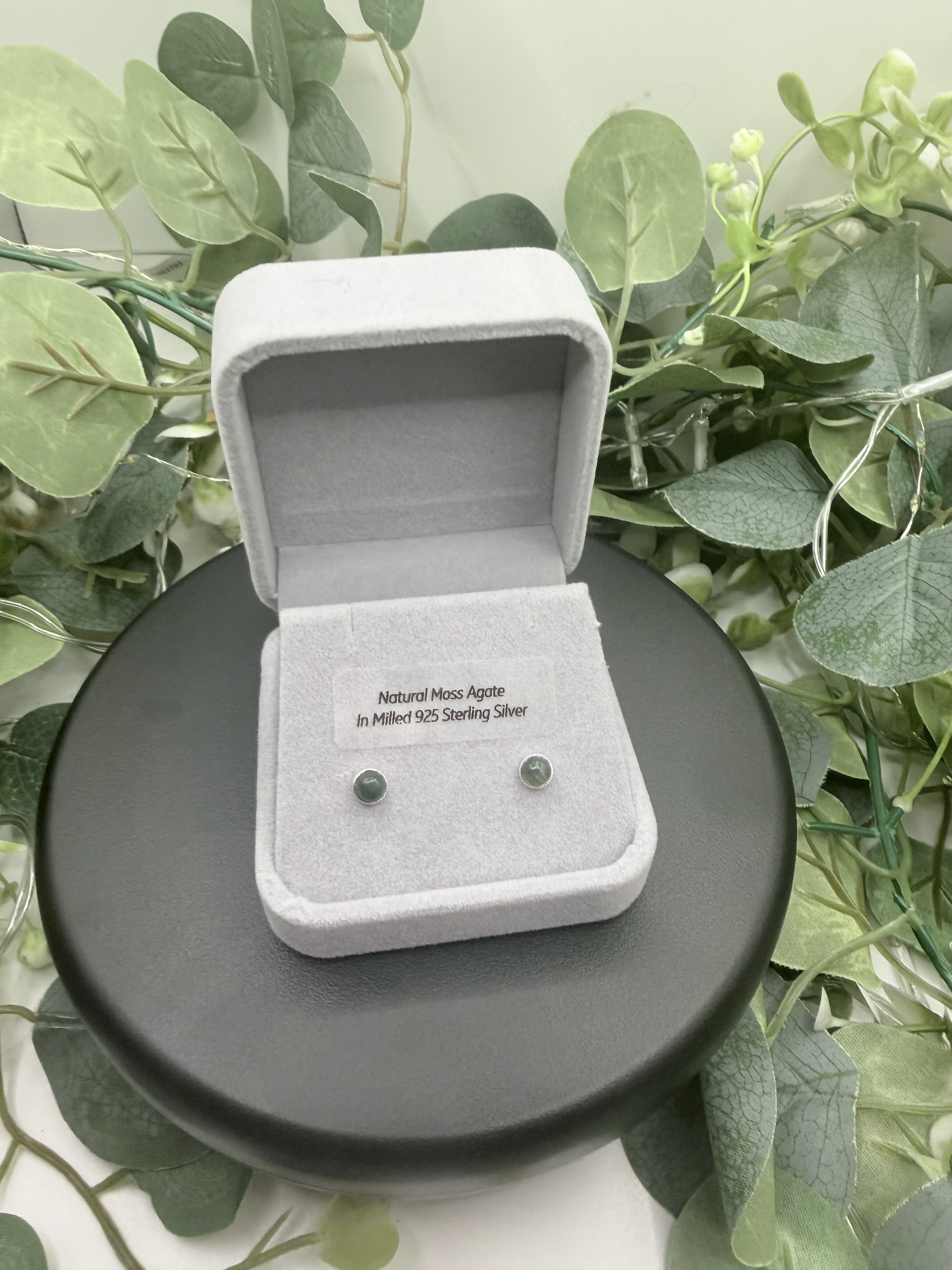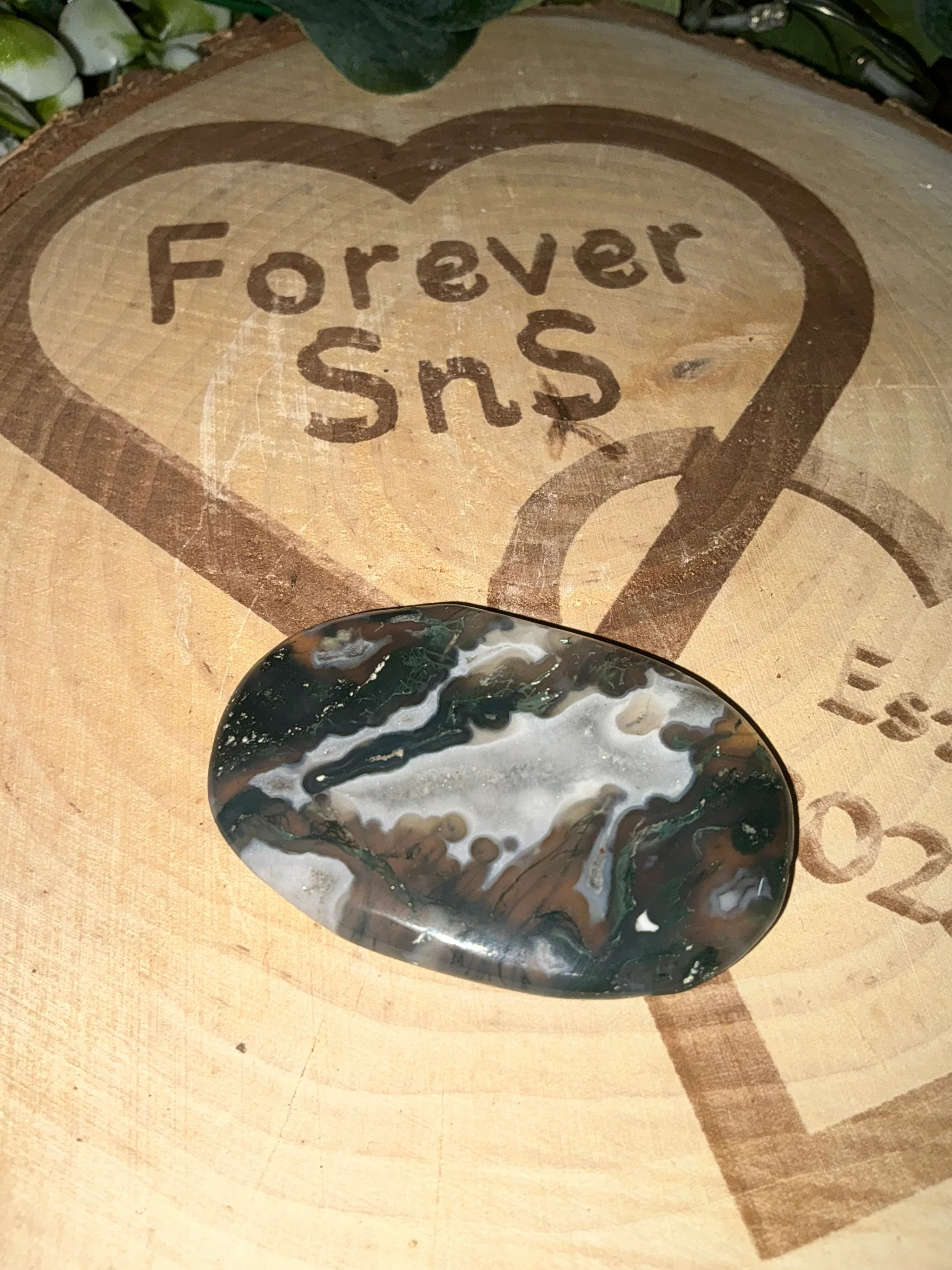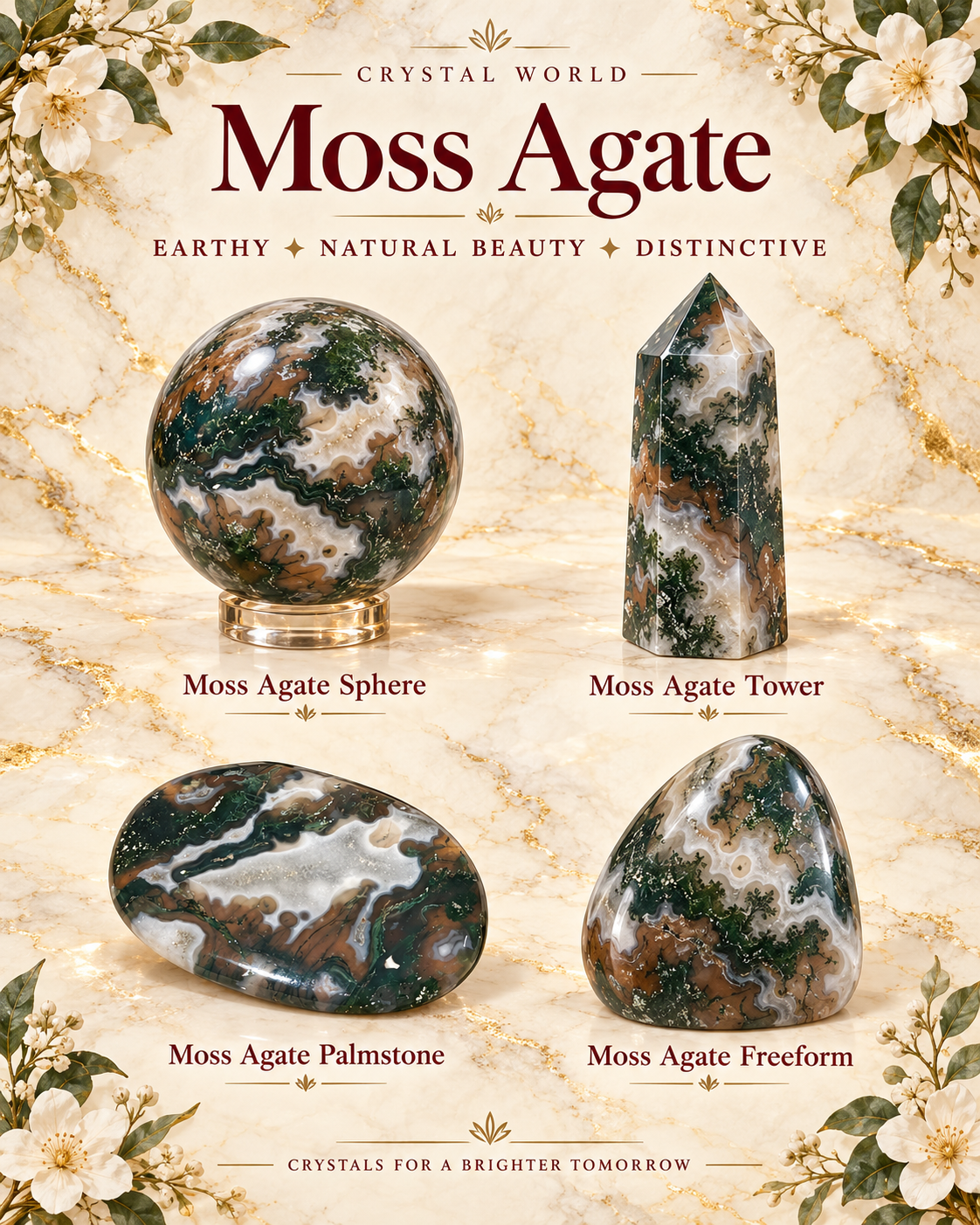
Meet the crystal

Forever SnS Crystal Passport
Moss Agate
Pronounced: MOSS AG-it
Moss Agate is a translucent chalcedony variety containing natural green, brown or reddish mineral inclusions that form moss-like, branching or landscape-style patterns.
CWExplore this passport
Showing Science & Formation
Scientific passport
The mineral facts
Observable and measurable properties used to describe and identify this mineral.
- Chemical formula
- SiO₂
- Mineral class
- Silicate — Quartz family
- Crystal system
- Trigonal
- Mohs hardness
- 6.5–7
- Lustre
- Waxy to vitreous
- Streak
- White
- Specific gravity
- Approximately 2.6
- Transparency
- Translucent to semi-transparent
Common colours
Clear, white, green, brown, red, black and grey
Cleavage and fracture
No true cleavage; conchoidal to uneven fracture.
From the Earth
How it forms
The geological processes that create this crystal over time.
Formation
Its geological story
Moss Agate forms when silica-rich fluids deposit microscopic Quartz and chalcedony within cavities or fractures in rock. During formation, green chlorite-group minerals and other iron- or manganese-bearing material can become enclosed within the silica. These inclusions may grow in branching, dendritic, plume-like or mossy patterns. Repeated silica deposition gradually surrounds and preserves these mineral structures within the chalcedony.
A closer look
Scientific notes
Moss Agate is a variety of included chalcedony rather than a separate mineral species. Unlike many traditional agates, it often does not display regular concentric or parallel banding. Its moss-like patterns are mineral inclusions and are not fossilised plants. The exact inclusion minerals vary between specimens, so green material should not automatically be identified as chlorite without further examination. Moss Agate belongs to the microcrystalline Quartz family and shares the same basic silica composition as agate, jasper and chalcedony.
Passport stamps
Where in the world?
Important countries, regions and mineral localities connected with this crystal.
India
Morbi and surrounding agate-producing area
Gujarat
Gujarat has a long history of agate collecting and working, and Moss Agate has been documented from the Morbi area. Historical accounts describe material with dark green and reddish-brown moss-like markings that was collected and polished for the agate trade.
India
Jalna District
Maharashtra
Jalna is a documented Indian Moss Agate locality within the Deccan volcanic region. Silica-rich fluids moving through volcanic rocks produced chalcedony and agate, including material with moss-like internal inclusions.
United States
Yellowstone River, Custer County
Montana
The Yellowstone River area is famous for Montana Moss Agate. The material is typically translucent chalcedony containing dark branching or dendritic inclusions that create striking scenic patterns.
United States
Eagle Point, Jackson County
Oregon
Eagle Point is a documented Oregon locality for both Moss Agate and Dendritic Agate. It is useful for showing how chalcedony can contain branching mineral inclusions that resemble plant forms without actually containing fossilised vegetation.
United States
Bear Creek and Maury Mountains, Crook County
Oregon
Crook County is another documented Oregon Moss Agate area, with occurrences recorded at Bear Creek and the Maury Mountains. These localities form part of Oregon’s well-known chalcedony and agate-producing landscape.
Crystal Detective
Look closely. Ask better questions.
Safe observations at home are separated from professional laboratory identification. No single home test can prove every specimen's identity or origin.
Safe checks at home
Look for a translucent or semi-transparent chalcedony body containing irregular green, brown or reddish inclusions. Natural patterns commonly resemble moss, branches, foliage or landscapes but should vary naturally throughout the stone. The inclusions usually appear to sit inside the stone rather than being painted onto its surface. Moss Agate is relatively hard and should resist scratching from ordinary steel. Avoid destructive scratch testing on polished or valuable pieces.
Professional methods
Microscopic examination can reveal the relationship between the chalcedony and internal mineral inclusions. Raman spectroscopy can confirm Quartz and may identify individual inclusion minerals. X-ray diffraction can identify crystalline components within the material. Chemical analysis can investigate iron, manganese and other elements responsible for coloured inclusions. Gemological testing can distinguish chalcedony from glass, resin and softer lookalike stones.
Imitations and treatments
Moss Agate may be imitated using dyed chalcedony, glass, resin or other decorative materials containing artificial inclusions. Dyed material may show unusually intense green colour concentrated along fractures or porous areas. Some stones sold as Moss Agate may actually be other forms of included chalcedony or dendritic agate. Natural Moss Agate should not be assumed to contain fossilised moss or other plant material.
The Mythical Library
Stories carried through time
Folklore can be enjoyed without confusing it with evidence. Where a popular tale is a later retelling, the passport says so.
The Mythical Library
Moss Agate
Choose a book to enter the full-screen reader.
Beliefs, traditions and cultural context
What people have believed
Moss Agate has a long decorative history and has often been associated symbolically with landscapes, vegetation and the natural world because of its distinctive moss-like mineral patterns. In contemporary crystal spirituality, Moss Agate is commonly associated with grounding, growth, abundance, patience, stability and connection with nature. Its green inclusions have led modern practitioners to associate it with the Heart chakra, renewal and personal growth. Some modern traditions also call Moss Agate a gardener’s or agriculture-related stone because its patterns resemble vegetation. These symbolic and spiritual associations are cultural or contemporary beliefs and are not scientifically demonstrated medical, psychological or physical effects. Its genuine scientific interest lies in the beautiful mineral inclusions naturally preserved within chalcedony.
Handle thoughtfully
Safety notes
Finished Moss Agate is generally safe for normal handling. Cutting, drilling or grinding can produce respirable crystalline silica dust, which should not be inhaled. Use wet-working methods, suitable respiratory protection and eye protection during lapidary work. Do not ingest powdered material.
Keep it beautiful
Care and cleaning
Clean Moss Agate with lukewarm water, mild soap and a soft cloth or brush. Avoid hydrofluoric acid and harsh chemical cleaners. Avoid sudden extreme temperature changes. Ultrasonic cleaning may be suitable for sound untreated material, but gentle hand cleaning is safest where fractures or treatments are present. Store separately from harder gemstones such as Sapphire and Diamond.
Follow the evidence
Sources and further reading
We show the references used while researching this passport so visitors can check important claims and continue learning.
- 1
Overview
Moss Agate
Mindat.org contributors · Mindat.org / Hudson Institute of Mineralogy
Primary mineralogical and locality reference for Moss Agate as a variety of chalcedony and for documented occurrences worldwide.
Checked 13 Oct 2026
- 2
Science
Chalcedony
Mindat.org contributors · Mindat.org / Hudson Institute of Mineralogy
Used for the chalcedony classification, silica composition and documented Moss Agate localities, including Morbi and Jalna in India.
Checked 13 Oct 2026
- 3
Localities
The Agate Industry of Khambat (Cambay), India
Daniel Russell · Mindat.org
Historical reference documenting Moss Agate from the Morvi area of Gujarat and describing dark green and reddish-brown moss-like markings in material used by the regional agate industry.
Checked 13 Oct 2026
- 4
Localities
Yellowstone River, Custer County, Montana, USA
Mindat.org contributors · Mindat.org / Hudson Institute of Mineralogy
Documents Montana Moss Agate from the Yellowstone River in Custer County, one of the best-known North American Moss Agate localities.
Checked 13 Oct 2026
- 5
Localities
Eagle Point, Jackson County, Oregon, USA
Mindat.org contributors · Mindat.org / Hudson Institute of Mineralogy
Documents both Moss Agate and Dendritic Agate from Eagle Point, Oregon.
Checked 13 Oct 2026
- 6
Localities
Crook County, Oregon, USA
Mindat.org contributors · Mindat.org / Hudson Institute of Mineralogy
Documents Moss Agate occurrences at Bear Creek and the Maury Mountains in Crook County, Oregon.
Checked 13 Oct 2026
- 7
Myths and folklore
Forever SnS Mythical Library — Original Moss Agate Folklore
Forever SnS · Forever SnS Ltd · 2026
The Forest That Never Grew and The Gardener of Stone are original contemporary Forever SnS stories inspired by Moss Agate’s natural mineral inclusions and landscape-like appearance. They are not presented as ancient or traditional folklore.
Checked 13 Oct 2026
- 8
Beliefs and traditions
Forever SnS — Modern Moss Agate symbolism context
Forever SnS · Forever SnS Ltd · 2026
Used to distinguish contemporary crystal symbolism from geological and historical fact. Associations with nature, growth, grounding, patience and abundance are presented only as modern beliefs.
Checked 13 Oct 2026
From the Forever SnS collection
Shop products featuring Moss Agate
Each listing shows the actual product details, photographs and current availability.
Passport complete