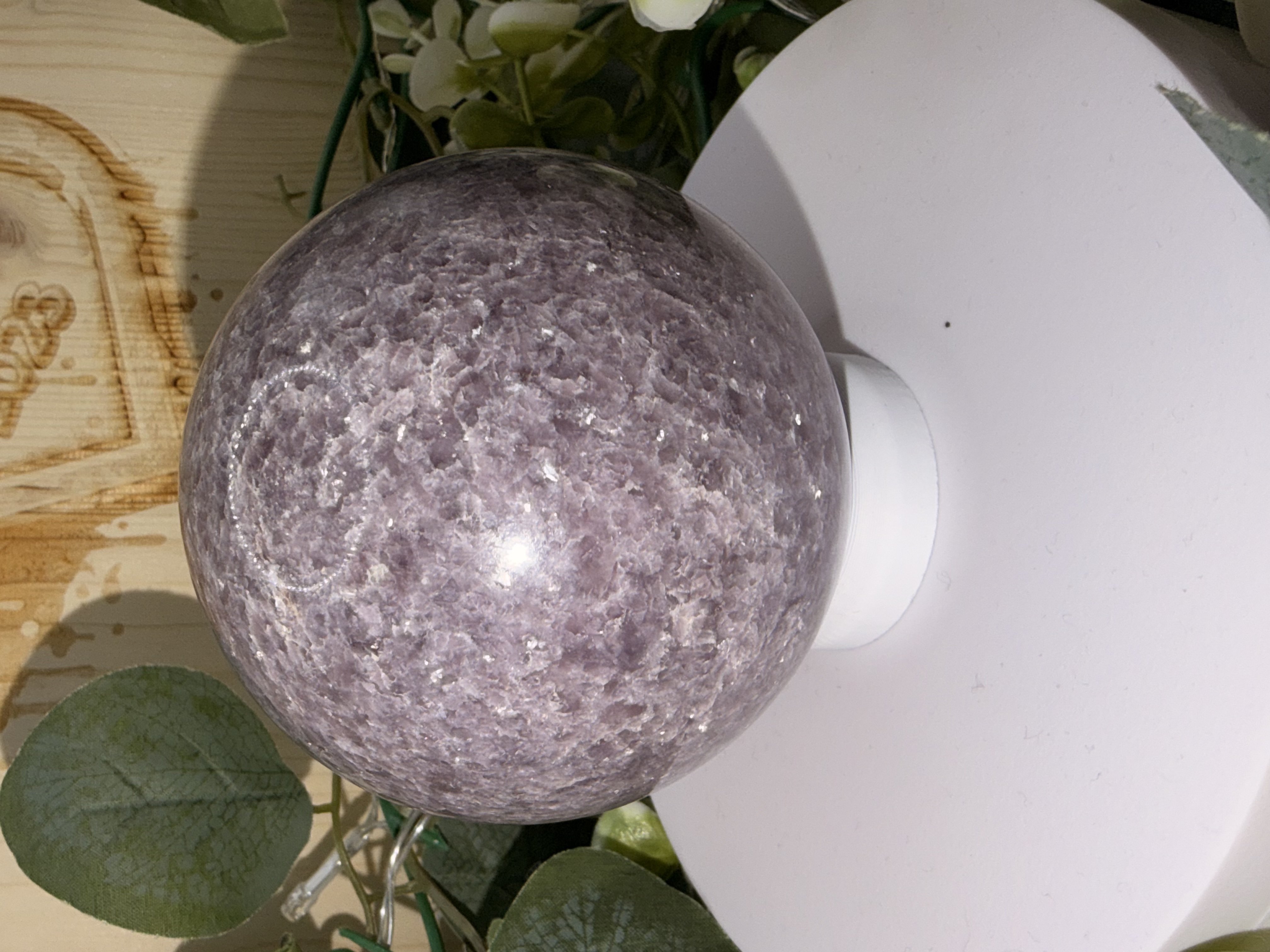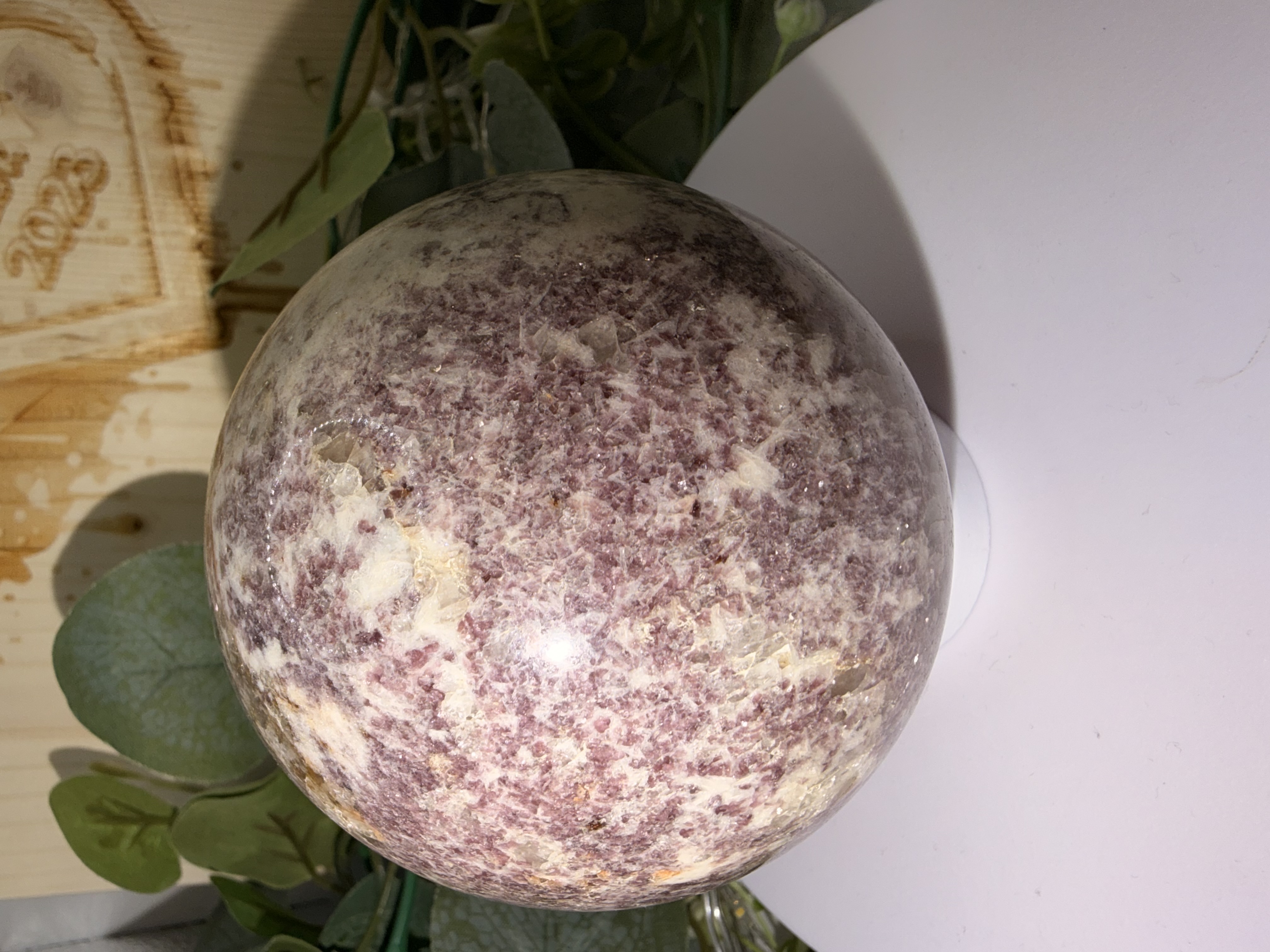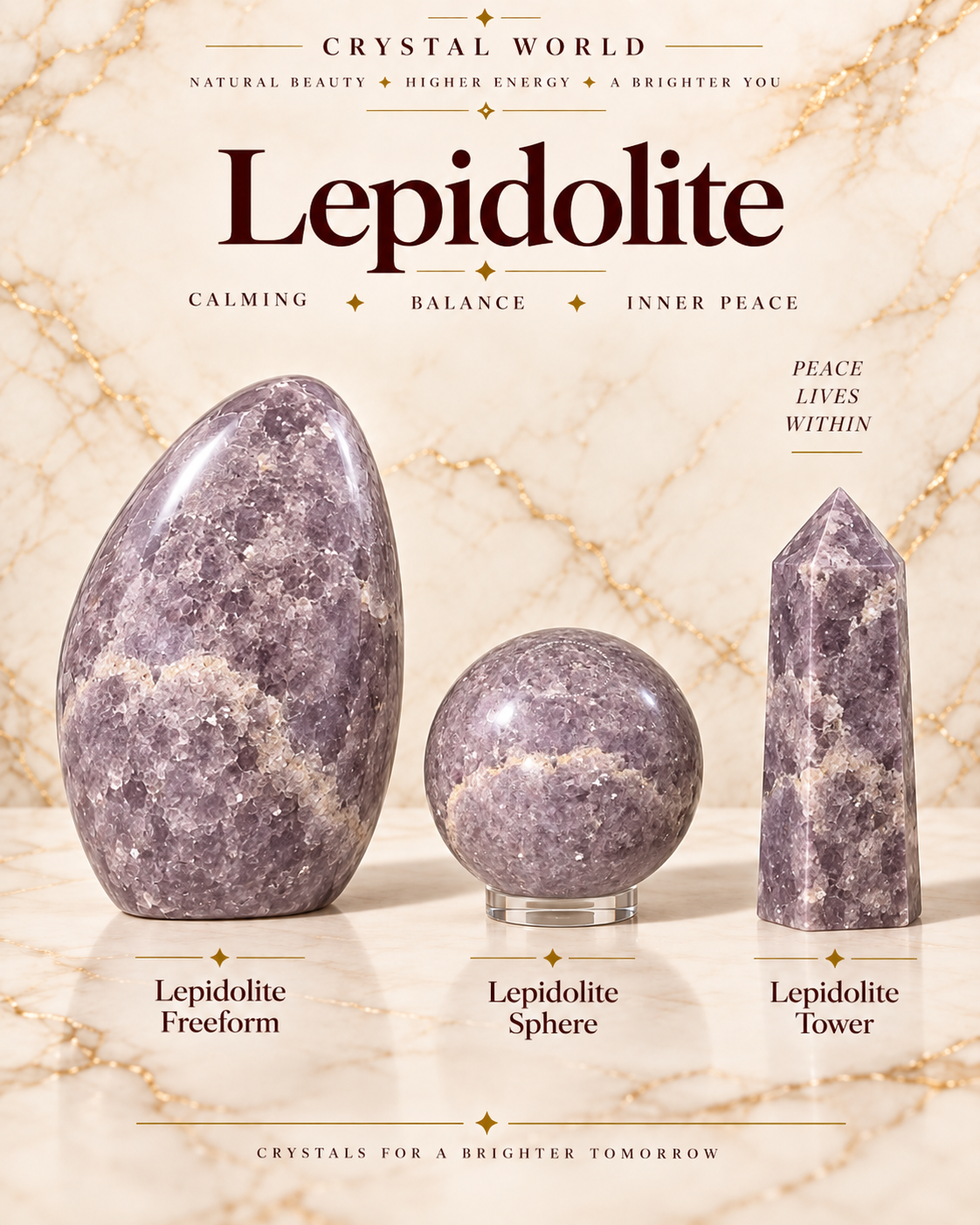
Meet the crystal

Forever SnS Crystal Passport
Lapidolite
Pronounced: leh-PID-oh-lite
Lepidolite is a lithium-rich mica best known for its lilac, lavender, pink and violet colouring and its sparkling, flaky texture. It commonly forms in lithium-rich granite pegmatites alongside minerals such as quartz, feldspar, tourmaline and spodumene.
CWExplore this passport
Showing Science & Formation
Scientific passport
The mineral facts
Observable and measurable properties used to describe and identify this mineral.
- Chemical formula
- Variable lithium-mica composition; commonly represented approximately as K(Li,Al)₃(Si,Al)₄O₁₀(F,OH)₂
- Mineral class
- Silicate — Phyllosilicate / Mica Group
- Crystal system
- Monoclinic, although lithium-mica members can show more than one structural polytype
- Mohs hardness
- 2.5–4
- Lustre
- Vitreous to pearly
- Streak
- White
- Specific gravity
- Approximately 2.8–2.9
- Transparency
- Transparent to translucent in thin sheets; massive material commonly translucent to opaque
Common colours
Lilac, lavender, violet, pink, rose, grey, silvery white, colourless and occasionally yellowish
Cleavage and fracture
Perfect basal cleavage in one direction; uneven fracture when broken across the sheets
From the Earth
How it forms
The geological processes that create this crystal over time.
Formation
Its geological story
Lepidolite forms mainly in lithium-rich granitic pegmatites. As granitic magma cools, most common rock-forming minerals crystallise first. Water, lithium, fluorine, rubidium and other elements can become increasingly concentrated in the remaining melt and mineral-rich fluids. During these late stages of crystallisation, lithium-bearing mica can form alongside minerals such as quartz, feldspar, tourmaline, spodumene and beryl. Because pegmatites cool slowly and may contain abundant fluids, they can produce unusually large and chemically complex crystals. Lepidolite may therefore occur as fine-grained masses, scaly aggregates, flat plates or large layered mica “books”.
A closer look
Scientific notes
The name Lepidolite has historically been applied broadly to pink, lilac or violet lithium-rich mica. Modern mineralogical classification is more precise. Much material traditionally labelled Lepidolite lies within a compositional series involving lithium micas such as polylithionite and trilithionite, and the exact chemistry can vary significantly between specimens. This is why there is no single simple chemical formula that perfectly describes every specimen sold as Lepidolite. The purple, pink and lilac colours are commonly associated with manganese and other trace-element effects within the mica. Lepidolite may also contain significant amounts of rubidium and fluorine in addition to lithium. Historically it was an important lithium ore, and USGS still lists Lepidolite among lithium-bearing pegmatite minerals.
Passport stamps
Where in the world?
Important countries, regions and mineral localities connected with this crystal.
Brazil
Santa Rosa Mine, Itambacuri
Minas Gerais
The Santa Rosa Mine is a well-known Brazilian pegmatite locality that has produced abundant Lepidolite alongside elbaite tourmaline, albite, cleavelandite and quartz. It is a useful example of the lithium-rich pegmatite environment in which Lepidolite commonly forms.
Zimbabwe
Bikita Pegmatite, Bikita District
Masvingo
Bikita is one of the classic lithium-rich pegmatite districts of southern Africa. Lepidolite is documented there alongside other lithium and rare-element minerals, making the locality important both mineralogically and historically in the study of lithium-bearing pegmatites.
United States
Pala Mining District, San Diego County
California
The Pala district is one of the most famous gem pegmatite regions in the United States. Lepidolite occurs in several mines there alongside colourful tourmaline and other pegmatite minerals, making it a classic North American locality for collector specimens.
Australia
Mount Francisco, Port Hedland Shire
Western Australia
Lepidolite is documented from Mount Francisco and neighbouring pegmatite workings in Western Australia. The area illustrates the global distribution of lithium-rich pegmatites and the wide geological settings in which Lepidolite-group material can occur.
United States
Pidlite Deposit, Mora County
New Mexico
The Pidlite Deposit is a documented Lepidolite occurrence in New Mexico and is part of the broader history of lithium-bearing pegmatites in the United States. It provides another good example of Lepidolite occurring in specialised granitic pegmatite systems.
Crystal Detective
Look closely. Ask better questions.
Safe observations at home are separated from professional laboratory identification. No single home test can prove every specimen's identity or origin.
Safe checks at home
Look for Lepidolite’s characteristic flaky, layered or sparkling mica texture. Many specimens show visible thin sheets or scales that reflect light individually, producing a pearly or glittering appearance. Typical colours include lilac, lavender, pink and violet-grey. A magnifying glass may reveal stacks of very thin mica layers, especially around broken edges. Lepidolite is much softer than quartz and many common gemstones, but avoid scratch testing polished pieces because its layered structure is easily damaged. Thin flakes of true mica may flex slightly rather than snapping immediately, although this should not be deliberately tested on a valuable specimen. Colour alone is not enough for identification because several other purple minerals can look similar.
Professional methods
Professional identification may include optical microscopy, X-ray diffraction, Raman spectroscopy and chemical analysis. X-ray diffraction is particularly useful for distinguishing lithium mica phases and structural polytypes. Electron microprobe analysis, SEM-EDS or XRF can detect potassium, aluminium, silicon, fluorine and associated elements, although lithium itself can require specialised analytical techniques because it is difficult to detect using some routine X-ray methods. ICP-MS, atomic absorption or other laboratory methods may be used when accurate lithium concentration is required. Because “Lepidolite” can cover a compositional range rather than one perfectly fixed species, detailed chemical and structural testing may be necessary for exact classification.
Imitations and treatments
Lepidolite is not usually heavily treated because its natural lavender and pink colouring is already commercially attractive. It may, however, be confused with Purple Fluorite, Sugilite, Charoite, dyed quartz, dyed mica-rich rock or purple resin composites. Natural Lepidolite commonly shows a flaky or micaceous sparkle rather than the glassy appearance of quartz or fluorite. Dyed material may show unnaturally intense colour concentrated in fractures or porous zones. Some polished material sold simply as “Lepidolite” is actually a mixed rock containing Lepidolite together with quartz, feldspar or other minerals rather than pure mica. This is not necessarily fake, but it should ideally be described accurately.
The Mythical Library
Stories carried through time
Folklore can be enjoyed without confusing it with evidence. Where a popular tale is a later retelling, the passport says so.
The Mythical Library
Choose a book to enter the full-screen reader.
Beliefs, traditions and cultural context
What people have believed
Lepidolite does not have a strongly documented ancient spiritual tradition under its modern mineral name. The name itself comes from the Greek lepidos, meaning scale, referring to its scaly mica texture. Its recognition and use as a lithium-bearing mineral developed primarily through modern mineralogy and mining rather than ancient gemstone traditions. In contemporary crystal spirituality, Lepidolite is commonly associated with calm, emotional balance, transition, reflection and releasing old patterns. It is frequently linked with the Third Eye and Crown chakras and is often used symbolically during meditation or periods of personal change. Because Lepidolite genuinely contains lithium, modern crystal literature sometimes makes claims connecting it with the medical use of lithium salts for mood disorders. That connection needs to be treated particularly carefully: the presence of lithium in a mineral does not provide scientific evidence that holding or wearing Lepidolite has the pharmacological effects of prescribed lithium medication. Any calming or emotional associations therefore belong to modern spiritual practice and crystal symbolism, not established medical treatment.
Handle thoughtfully
Safety notes
Finished Lepidolite specimens are generally safe for normal handling. The main practical concern is fragility. Mica splits very easily along its perfect cleavage, so thin flakes and exposed edges can break or peel. Avoid deliberately grinding, crushing or drilling Lepidolite without suitable protective equipment. Mineral dust from mixed pegmatite material may contain quartz and other silicate minerals and should not be inhaled. Use appropriate eye protection, respiratory protection, dust extraction or wet-working methods during lapidary work. Lepidolite contains naturally occurring lithium, but this does not mean handling the mineral is equivalent to taking lithium medication or that lithium can safely be extracted or consumed from the stone. Do not ingest mineral powders or use Lepidolite to make drinking-water “elixirs”.
Keep it beautiful
Care and cleaning
Lepidolite is relatively soft and has perfect cleavage, so it should be handled more carefully than harder stones such as Quartz. Dust gently with a soft, dry brush or microfiber cloth. If necessary, use a slightly damp cloth for polished material, then dry it carefully. Avoid prolonged soaking, harsh chemicals, abrasive cleaning products, steam cleaners and ultrasonic cleaning. Do not scrub rough specimens aggressively because thin mica flakes may detach. Store Lepidolite separately from harder minerals so that its surface is not scratched or crushed.
Follow the evidence
Sources and further reading
We show the references used while researching this passport so visitors can check important claims and continue learning.
- 1
Overview
Lepidolite: Mineral information, data and localities
Mindat.org contributors · Mindat.org / Hudson Institute of Mineralogy
Primary mineralogical reference for Lepidolite. Used to support the modern classification of Lepidolite as a traditional group or series name for lithium-rich mica rather than a single IMA-approved mineral species, and for its worldwide locality information.
Checked 13 Sept 2026
- 2
Science
Lepidolite
John W. Anthony, Richard A. Bideaux, Kenneth W. Bladh and Monte C. Nichols · Handbook of Mineralogy / Mineral Data Publishing
Used for traditional mineralogical data including chemical composition, mica structure, hardness, density, lustre, colour, cleavage, geological occurrence and associated pegmatite minerals.
Checked 13 Sept 2026
- 3
Science
Lithium Deposits in the United States
U.S. Geological Survey · U.S. Geological Survey · 2020
Used for geological and economic context concerning lithium-bearing pegmatites. USGS includes Lepidolite among the diverse pegmatite minerals in which lithium occurs and provides context for historic lithium production from pegmatite deposits.
Checked 13 Sept 2026
- 4
Localities
Lepidolite from Santa Rosa Mine, Itambacuri, Minas Gerais, Brazil
Mindat.org contributors · Mindat.org / Hudson Institute of Mineralogy
Supports the Brazilian location entry. Lepidolite is well documented at Santa Rosa Mine together with tourmaline, elbaite, albite, cleavelandite and quartz.
Checked 13 Sept 2026
- 5
Localities
Locations and mines
Lepidolite from Bikita Pegmatite, Bikita District, Zimbabwe · Mindat.org contributors · Mindat.org / Hudson Institute
Supports the Zimbabwe location entry and documents Lepidolite at the important Bikita lithium-rich pegmatite.
Checked 13 Sept 2026
- 6
Localities
Lepidolite from Pala Mining District, San Diego County, California
Mindat.org contributors · Mindat.org / Hudson Institute of Mineralogy
Supports the Pala locality. Lepidolite is documented from numerous mines within this famous Californian gem pegmatite district.
Checked 13 Sept 2026
- 7
Home identification
Lepidolite
John W. Anthony, Richard A. Bideaux, Kenneth W. Bladh and Monte C. Nichols · Handbook of Mineralogy / Mineral Data Publishing
Used for identification characteristics including colour, pearly to vitreous lustre, relatively low hardness, perfect basal cleavage and mica-like habit.
Checked 13 Sept 2026
- 8
Laboratory identification
Lepidolite: Mineral information, data and localities
Mindat.org contributors · Mindat.org / Hudson Institute of Mineralogy
Used to support the complexity of the Lepidolite name and the need for chemical and structural analysis to distinguish lithium-mica members such as polylithionite and trilithionite.
Checked 13 Sept 2026
- 9
Fakes and treatments
Lepidolite: Mineral information, data and localities
Mindat.org contributors · Mindat.org / Hudson Institute of Mineralogy
Used as the mineralogical baseline for identifying genuine lithium-rich mica and distinguishing it from purple minerals, dyed materials and mixed rocks commercially sold simply as Lepidolite.
Checked 13 Sept 2026
- 10
Myths and folklore
Forever SnS Mythical Library — Original Lepidolite Folklore
Forever SnS · Forever SnS Ltd · 2026
The Stone That Learned to Let Go and The Lavender Light Beneath the Mountain are original contemporary folklore created for the Forever SnS Mythical Library. They draw inspiration from Lepidolite’s layered mica structure, lithium-rich pegmatite formation and lavender colouring but are not presented as ancient legends or documented historic cultural traditions.
Checked 13 Sept 2026
- 11
Beliefs and traditions
The Crystal Bible Volume 1
Judy Hall · Godsfield Press / Hachette UK · 2003
Used solely to document contemporary crystal-spiritual beliefs associated with Lepidolite. These meanings are included as modern traditions and symbolism and are not used as scientific or medical evidence.
Checked 13 Sept 2026
- 12
Safety and care
Pegmatite Investigations 1942–45, Black Hills, South Dakota
U.S. Geological Survey · U.S. Geological Survey · 1953
Used as a geological reference documenting Lepidolite as a lithium-bearing mica in pegmatites and its association with quartz, albite, spodumene and other minerals. This supports the Passport’s caution that dust from mixed pegmatite material may contain other silicate minerals and should not be inhaled.
Checked 13 Sept 2026
From the Forever SnS collection
Shop products featuring Lapidolite
Each listing shows the actual product details, photographs and current availability.
Passport complete