Meet the crystal

Forever SnS Crystal Passport
Larvikite
Pronounced: LAR-vih-kite
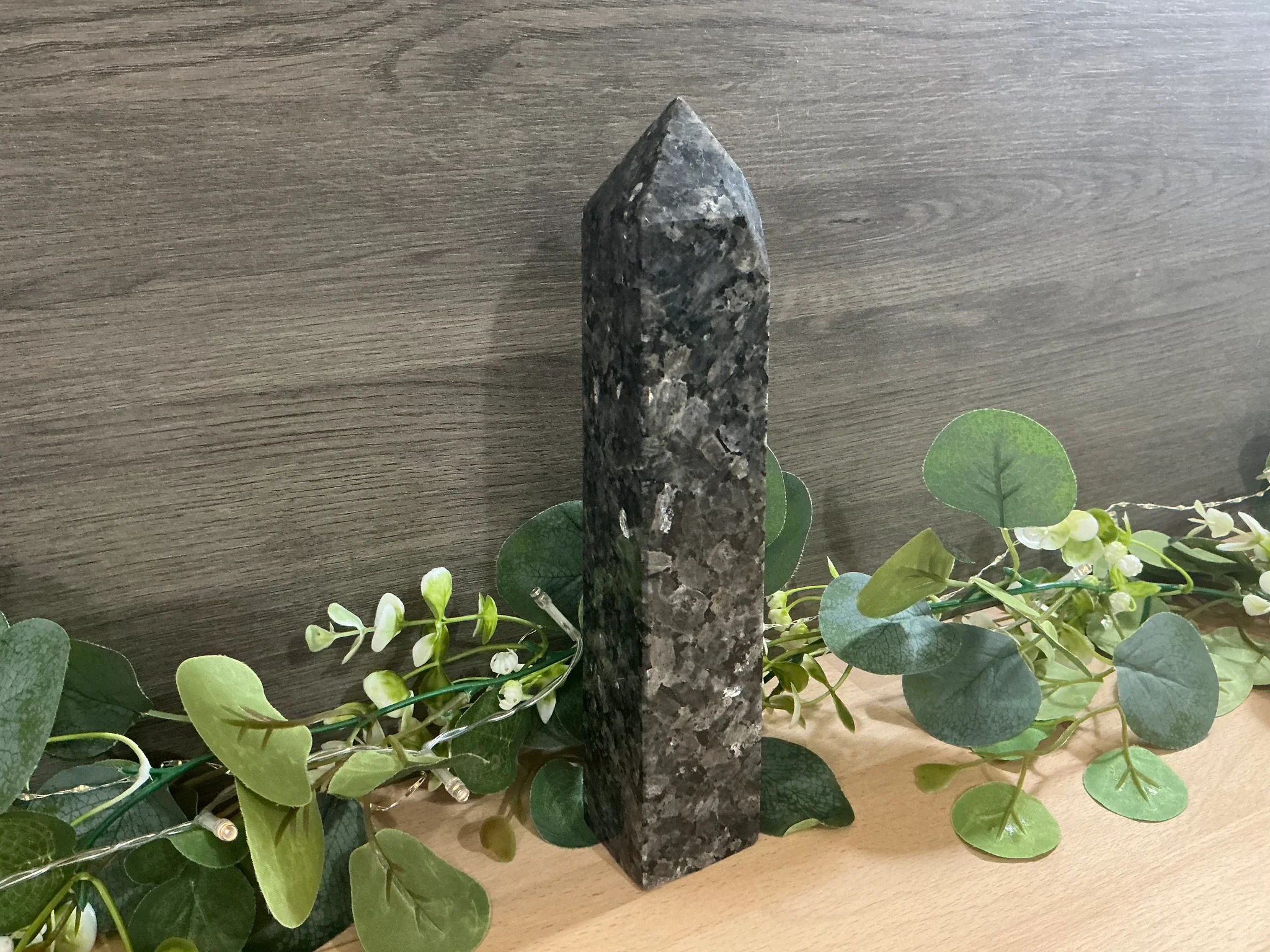
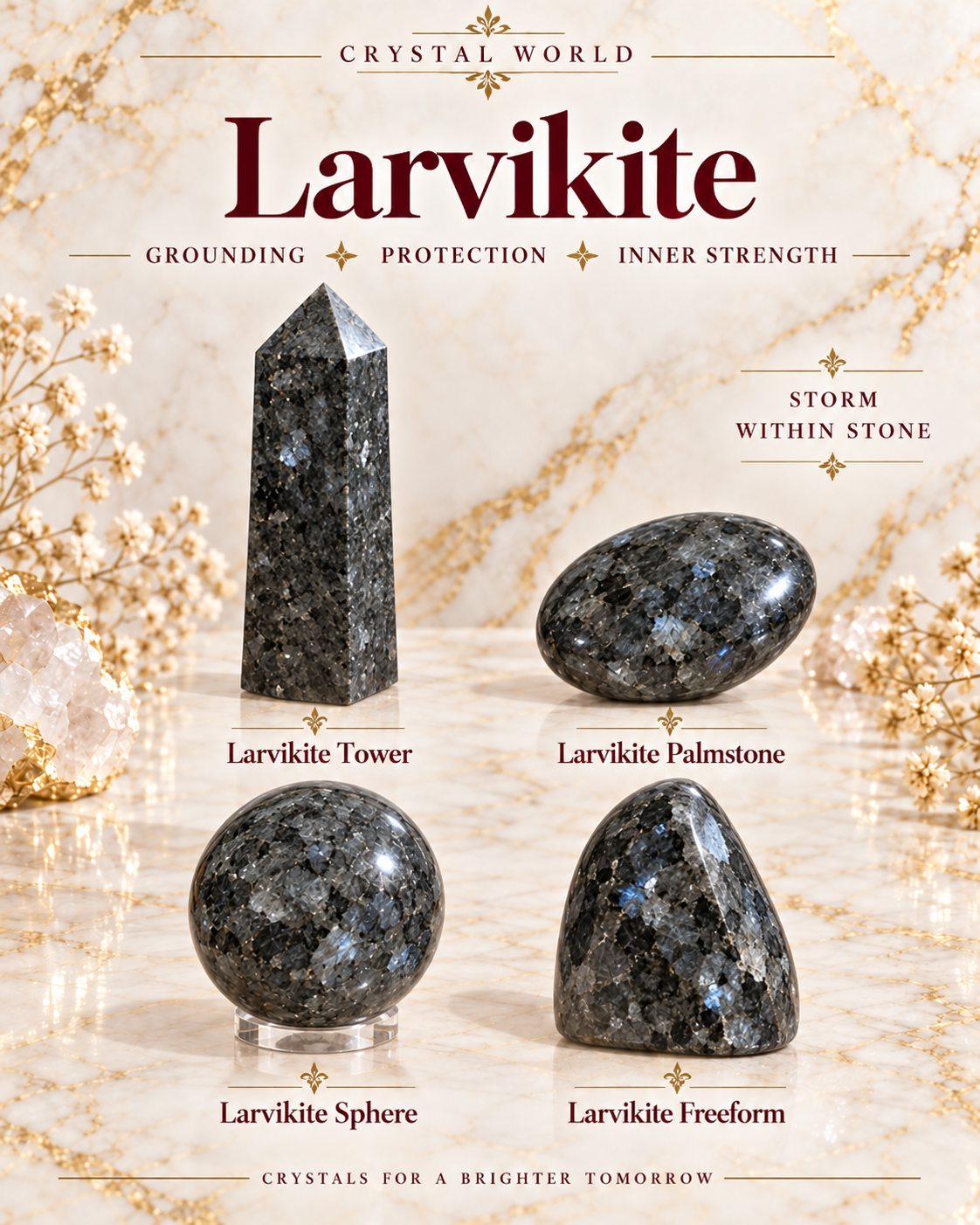
Larvikite is a dark grey to bluish igneous rock from southern Norway, famous for brilliant silver, blue and occasionally green flashes produced within its large feldspar crystals. Despite often being sold alongside crystals, Larvikite is a rock composed of several minerals rather than a single mineral species.
CWExplore this passport
Showing Science & Formation
Scientific passport
The mineral facts
Observable and measurable properties used to describe and identify this mineral.
- Chemical formula
- No single chemical formula — Larvikite is a rock composed of several minerals
- Mineral class
- Igneous rock — primarily monzonite / feldspar-rich plutonic rock
- Crystal system
- Not applicable to the rock as a whole. Individual feldspar minerals within Larvikite have their own
- Mohs hardness
- Approximately 6–6.5 overall, reflecting its feldsp
- Lustre
- Generally dull on rough surfaces; polished surfaces may appear vitreous to highly reflective, with strong feldspar iridescence
- Streak
- Not normally used diagnostically for rocks; individual light-coloured feldspars generally produce a pale or white streak
- Specific gravity
- Typically approximately 2.6–2.8, depending on mineral composition
- Transparency
- Opaque
Common colours
Dark grey, blue-grey, charcoal, blackish grey, with silver, blue, turquoise or occasionally green iridescent flashes
Cleavage and fracture
Larvikite itself does not have a single cleavage pattern because it is a multi-mineral rock. Individual feldspar crystals possess cleavage, while the rock as a whole tends to break irregularly.
From the Earth
How it forms
The geological processes that create this crystal over time.
Formation
Its geological story
Larvikite formed when magma cooled slowly beneath the Earth's surface within the Oslo Rift, a major geological rift system in southern Norway. Slow underground cooling allowed large feldspar crystals to develop. The Larvikite-Lardalite Plutonic Complex consists of several separate intrusive bodies, including ring-shaped structures formed during repeated episodes of magma emplacement over several million years. static.ngu.no As the feldspar crystals formed and cooled, microscopic intergrowths or lamellae developed within them. Light interacting with these tiny internal structures produces optical interference, creating the characteristic blue or silver flash visible on polished Larvikite surfaces.
A closer look
Scientific notes
Larvikite is primarily classified as a monzonitic plutonic rock, although related varieties may extend toward syenitic compositions. Its dominant minerals are alkali feldspar and plagioclase. Accessory minerals may include augite, amphibole, biotite and locally other minerals depending on the intrusion. Store norske leksikon The optical effect is sometimes casually called labradorescence in the commercial crystal trade, but Larvikite's blue iridescence is specifically associated with microscopic structures in its complex feldspars. The Geological Survey of Norway describes Larvikite as a deep-seated igneous rock containing two types of feldspar capable of producing its characteristic play of colour. Norges Geologiske Undersøkelse Different parts of the Larvikite complex produce commercial varieties including Blue Pearl, Emerald Pearl, Malerød and Stålaker, each differing in base colour and intensity of iridescence.
Passport stamps
Where in the world?
Important countries, regions and mineral localities connected with this crystal.
Norway
Larvik Municipality
Vestfold
Larvik Municipality is the type and namesake area for Larvikite. The rock occurs within the Larvikite-Lardalite Plutonic Complex of the Oslo Rift and is internationally recognised for its coarse feldspar crystals and blue iridescence. The IUGS lists Larvikite as a Heritage Stone and identifies Larvik Municipality as its principal source area.
Norway
Tvedalen quarry district
Vestfold
The Tvedalen area forms part of the famous Larvikite quarrying district around Larvik. The region contains multiple commercial stone varieties and is important both for dimension-stone production and for mineral-rich pegmatites associated with the Larvikite complex.
Norway
Ula–Nevlunghavn coastal exposures
Vestfold
The coastline between Ula and Nevlunghavn provides some of the clearest natural exposures of the Larvikite plutons. IUGS highlights this stretch as an exceptional place to study the structure, layering and glacially polished surfaces of these blue monzonitic rocks.
Norway
Stålaker / Krukåsen quarry area
Vestfold
Stålaker and Krukåsen are associated with recognised commercial varieties of Larvikite. Different intrusions within the complex produce visibly different stone types, reflecting changes in mineralogy and magma chemistry across the plutonic system.
Norway
Malerød quarry area
Vestfold
Malerød is another recognised commercial Larvikite variety/locality within the broader Larvik complex. It helps demonstrate that “Larvikite” is not visually uniform; different intrusions can vary in base colour, feldspar texture and strength of iridescence.
Crystal Detective
Look closely. Ask better questions.
Safe observations at home are separated from professional laboratory identification. No single home test can prove every specimen's identity or origin.
Safe checks at home
Look for a dark grey to black, coarse-grained rock containing clearly visible feldspar crystals. Turn the specimen slowly under a strong directional light. Genuine Larvikite typically produces flashes from individual feldspar grains, meaning one area may suddenly flash blue or silver while neighbouring grains remain dark. The effect should appear to move or disappear as the viewing angle changes. Unlike polished Labradorite, which may show large continuous areas of colour across individual crystals, Larvikite normally shows multiple separate flashing feldspar grains embedded in a dark rock matrix. Look closely at the surface. Larvikite should show a natural crystalline texture rather than the uniform appearance of glass or resin.
Professional methods
Petrographic microscopy can identify the individual feldspar, pyroxene, amphibole and mica minerals that make up Larvikite. Thin-section microscopy is particularly useful for observing feldspar intergrowths and identifying the rock's igneous texture. X-ray diffraction can identify its constituent mineral phases. Electron microprobe or SEM-EDS analysis can determine the chemical composition of individual feldspar and accessory minerals. Whole-rock geochemical analysis can be used to classify Larvikite within the broader monzonitic intrusive suite of the Oslo Rift.
Imitations and treatments
Larvikite may be confused commercially with Labradorite, Black Moonstone, Indigo Gabbro and other dark feldspar-rich rocks. It is also frequently marketed as Blue Pearl Granite, particularly in the architectural stone industry. Despite this name, Larvikite is not technically granite. IUGS Some sellers may label Larvikite as “Black Labradorite”. This is also inaccurate because Labradorite is a specific plagioclase feldspar mineral, whereas Larvikite is a multi-mineral rock. Polishing is the standard treatment used to reveal Larvikite's natural iridescence and should not be considered deceptive. Artificial surface coatings are unnecessary for genuine high-quality material, although resin treatments may occasionally be used in commercial slabs or heavily fractured decorative stone.
The Mythical Library
Stories carried through time
Folklore can be enjoyed without confusing it with evidence. Where a popular tale is a later retelling, the passport says so.
The Mythical Library
Choose a book to enter the full-screen reader.
Beliefs, traditions and cultural context
What people have believed
Larvikite has a genuine cultural history as a Norwegian building and ornamental stone, but most of the spiritual meanings attached to it in crystal shops are modern. Commercial quarrying and international use expanded during the late nineteenth and twentieth centuries. Larvikite became widely used in prestigious buildings, monuments, facades and gravestones throughout Europe and internationally. The IUGS notes its use in prominent buildings including major banks, hotels and commercial landmarks. IUGS Norway selected Larvikite as its national rock in 2008, reflecting its geological, cultural and economic significance. Store norske leksikon In modern crystal spirituality, Larvikite is commonly associated with grounding, protection, inner strength, reflection and connection with the Earth. Its dark appearance combined with sudden blue flashes has also inspired symbolic associations with finding clarity in darkness, hidden potential and seeing beneath the surface. Some modern practitioners associate it with the Root, Third Eye or Crown chakras. These are contemporary spiritual interpretations rather than scientifically demonstrated physical or psychological effects. Larvikite's documented significance lies instead in its remarkable geology, its unusual feldspar iridescence and its long-standing importance to Norwegian stone culture.
Handle thoughtfully
Safety notes
Finished Larvikite specimens are generally safe for normal handling. Cutting, grinding or drilling the rock can create fine mineral dust, including silicate particles, which should not be inhaled. Use wet-working methods, suitable dust extraction, eye protection and respiratory protection during lapidary or fabrication work. Large polished pieces can be heavy and may develop sharp edges if broken. Do not ingest powdered material or use crushed Larvikite in drinking-water preparations.
Keep it beautiful
Care and cleaning
Larvikite is relatively durable and has been used extensively as architectural and dimension stone. For polished specimens, clean with lukewarm water, mild soap and a soft cloth. Avoid abrasive cleaners that could gradually dull the polished surface. Do not expose polished pieces repeatedly to strong acids. Specimens containing fractures or delicate edges should be protected from impacts. A soft microfiber cloth works particularly well for restoring the reflective polished surface and revealing the feldspar flashes.
Follow the evidence
Sources and further reading
We show the references used while researching this passport so visitors can check important claims and continue learning.
- 1
Overview
Larvikite
Tom Heldal and Anette Granseth · International Union of Geological Sciences — International Commission on Geoheritage · 2017 designation
Primary authoritative reference for Larvikite as an internationally recognised Norwegian Heritage Stone. Used for lithology, appearance, Larvik locality, commercial varieties and its international architectural importance.
Checked 20 Sept 2026
- 2
Science
The Larvikite Plutonic Rocks of the Oslo Rift
Tom Heldal and Kristin Rangnes · International Union of Geological Sciences — International Commission on Geoheritage · 2024 heritage-site publication
Used for Larvikite's monzonitic classification, Permian age, formation beneath the Oslo Rift, ring-shaped plutonic structure, feldspar composition and the scientific explanation of its blue iridescence.
Checked 20 Sept 2026
- 3
Localities
The Larvikite Plutonic Rocks of the Oslo Rift
Tom Heldal and Kristin Rangnes · IUGS International Commission on Geoheritage · 2024
Supports Larvik Municipality and the Ula–Nevlunghavn coastline as principal geological areas where Larvikite intrusions are exceptionally exposed and scientifically important.
Checked 20 Sept 2026
- 4
Localities
The First 55 IUGS Heritage Stones — Larvikite
International Union of Geological Sciences Heritage Stone contributors · IUGS International Commission on Geoheritage · 2024
Used for the distribution of Larvikite quarries and recognised commercial varieties including light Larvikite, dark Larvikite, Malerød, Bergan and Stålaker/Krukåsen.
Checked 20 Sept 2026
- 5
Home identification
The Larvikite Plutonic Rocks of the Oslo Rift
Tom Heldal and Kristin Rangnes · IUGS International Commission on Geoheritage · 2024
Used for recognising Larvikite's characteristic coarse feldspar texture and angle-dependent blue iridescence caused by cryptoperthitic feldspar intergrowths.
Checked 20 Sept 2026
- 6
Laboratory identification
Global Stone Heritage: Larvikite, Norway
Tom Heldal, G. B. Meyer and R. Dahl · Geological Society of London Special Publications · 2015
Major scientific reference on Larvikite geology, quarrying, petrography and heritage use. Used for the relationship between different intrusions and commercial stone varieties and for geological context within the Larvikite-Lardalite Plutonic Complex.
Checked 20 Sept 2026
- 7
Fakes and treatments
Larvikite
Tom Heldal and Anette Granseth · IUGS International Commission on Geoheritage · 2017 designation
Used as the geological baseline for distinguishing genuine Larvikite from commercially confused materials. Also documents trade names such as Blue Pearl and Emerald Pearl and confirms that Larvikite is monzonite rather than true granite.
Checked 20 Sept 2026
- 8
Myths and folklore
Forever SnS Mythical Library — Original Larvikite Folklore
Forever SnS · Forever SnS Ltd · 2026
The Stone That Remembered the Night Sky and The Mountain That Refused to Be Gold are original contemporary folklore created for the Forever SnS Mythical Library. They are inspired by Larvikite's Norwegian origin, feldspar iridescence and documented architectural history, but are not presented as Norse mythology, Viking legends or traditional Norwegian folklore.
Checked 20 Sept 2026
- 9
Beliefs and traditions
Larvikite — Architectural and Cultural Heritage
Tom Heldal, G. B. Meyer and R. Dahl · Geological Society of London / IUGS Heritage Stone programme · 2015
Used for Larvikite's genuine cultural history as a Norwegian ornamental and architectural stone. Documents use in buildings, monuments, banks, funerary architecture and international export rather than attributing invented ancient spiritual traditions to the rock.
Checked 20 Sept 2026
- 10
Beliefs and traditions
The Crystal Bible Volume 1
Judy Hall · Godsfield Press / Hachette UK · 2003
Used only as contextual reference for modern crystal-spiritual traditions around dark feldspar-rich stones, grounding and protection symbolism. These modern interpretations are not treated as scientific effects or historic Norwegian folklore.
Checked 20 Sept 2026
From the Forever SnS collection
Shop products featuring Larvikite
Each listing shows the actual product details, photographs and current availability.
Passport complete