Meet the crystal

Forever SnS Crystal Passport
Lapis Lazuli
Pronounced: LAP-iss LAZ-yoo-lee
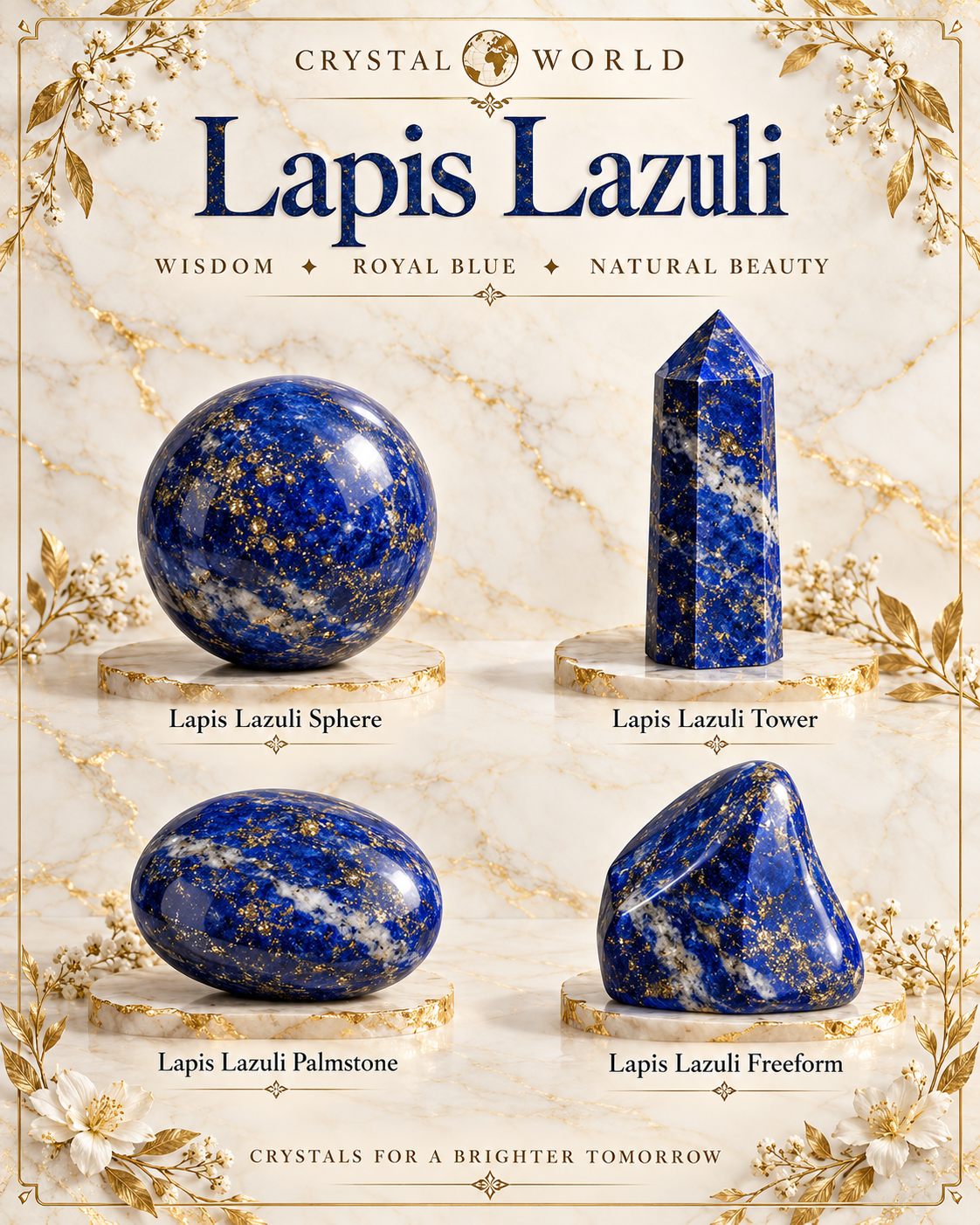
Lapis Lazuli is a deep blue ornamental rock composed mainly of lazurite, calcite and pyrite, prized for its intense colour, golden metallic flecks and exceptionally long history of use in jewellery, carving and pigment.
CWExplore this passport
Showing Science & Formation
Scientific passport
The mineral facts
Observable and measurable properties used to describe and identify this mineral.
- Chemical formula
- No single formula — multi-mineral rock
- Mineral class
- Rock — mainly lazurite, calcite and pyrite
- Crystal system
- Not applicable — multi-mineral rock
- Mohs hardness
- 5–6
- Lustre
- Waxy to vitreous
- Streak
- Variable — commonly pale blue to white
- Specific gravity
- Approximately 2.5–3.0
- Transparency
- Semi-translucent to opaque
Common colours
Royal blue, violet-blue, deep blue, greenish-blue and pale blue, often with white calcite and golden pyrite
Cleavage and fracture
No single cleavage because Lapis Lazuli is a rock; fracture varies with mineral composition and is commonly uneven.
From the Earth
How it forms
The geological processes that create this crystal over time.
Formation
Its geological story
Lapis Lazuli is a rock rather than a single mineral species. Its main blue component is lazurite, a member of the sodalite group. Calcite commonly produces white areas and pyrite produces metallic golden flecks. The intensity of blue depends largely on the amount and quality of lazurite present. Lazurite should not be confused with lazulite, which is a completely different phosphate mineral. Because Lapis Lazuli is made from several minerals, its hardness, specific gravity and appearance can vary between specimens.
A closer look
Scientific notes
Lapis Lazuli is a rock rather than a single mineral species. Its main blue component is lazurite, a member of the sodalite group. Calcite commonly produces white areas and pyrite produces metallic golden flecks. The intensity of blue depends largely on the amount and quality of lazurite present. Lazurite should not be confused with lazulite, which is a completely different phosphate mineral. Because Lapis Lazuli is made from several minerals, its hardness, specific gravity and appearance can vary between specimens.
Passport stamps
Where in the world?
Important countries, regions and mineral localities connected with this crystal.
Afghanistan
Sar-e-Sang, Hindu Kush Mountains
Badakhshan Province
Sar-e-Sang is the most famous and historically important Lapis Lazuli source in the world. The deposits have supplied blue stone since prehistoric and ancient times and are among the oldest known continuously exploited gemstone sources. Material from Sar-e-Sang was traded over enormous distances into Mesopotamia, Egypt, Persia and other early civilisations.
Chile
Flor de los Andes deposit, Monte Patria
Coquimbo Region
The Flor de los Andes deposit is the best-known Chilean Lapis Lazuli locality and has been commercially mined since the early twentieth century. The material occurs high in the Andes within contact-metamorphosed limestone and can produce strong blue Lapis Lazuli containing lazurite, calcite, pyrite, wollastonite, haüyne and diopside.
Russia
Malo-Bystrinskoe deposit, Lake Baikal area
Irkutsk Oblast
The Lake Baikal region is a classic Russian source of Lapis Lazuli. The Malo-Bystrinskoe deposit has produced material studied both mineralogically and for comparison with historic ultramarine pigments, making it important in both geology and art conservation research.
Canada
Kimmirut, Baffin Island
Nunavut
Southern Baffin Island contains a scientifically important Lapis Lazuli occurrence near Kimmirut. The material occurs within highly metamorphosed carbonate-rich rocks and has been studied in detail to understand how Lapis Lazuli forms in metamorphosed sedimentary environments.
Myanmar
Mogok Township
Mandalay Region
Mogok is one of the world’s most famous gem-producing districts and also contains documented occurrences of Lapis Lazuli. Several localities within the district, including Lay-bauk and Chaung-gyi, have produced Lapis Lazuli alongside the many other gemstones for which Mogok is renowned.
Crystal Detective
Look closely. Ask better questions.
Safe observations at home are separated from professional laboratory identification. No single home test can prove every specimen's identity or origin.
Safe checks at home
Look for a rich blue body colour, often accompanied by white calcite and metallic golden pyrite. Natural pyrite usually appears as irregular metallic flecks or patches rather than perfectly even glitter. White calcite may occur as veins or cloudy areas. Colour should not appear unnaturally concentrated in surface cracks. Avoid destructive scratch testing on polished or valuable specimens.
Professional methods
Microscopy can identify lazurite, calcite, pyrite and other component minerals. Raman spectroscopy can distinguish lazurite from similar blue minerals and identify associated phases. X-ray diffraction can confirm the mixture of minerals present. Refractive index and specific gravity testing may support gemological identification. Chemical and spectroscopic analysis can help distinguish natural Lapis Lazuli from dyed material, reconstructed products and imitations.
Imitations and treatments
Lapis Lazuli may be imitated by dyed Howlite, dyed Magnesite, glass, ceramic materials and reconstructed stone. Pale natural Lapis Lazuli may be dyed to produce a stronger blue colour. Some material may be impregnated with wax, oil or resin to improve colour or surface appearance. Dyed stones may show strong blue colour concentrated in cracks, pores or around white areas. Perfectly even metallic glitter may indicate an imitation rather than natural pyrite.
The Mythical Library
Stories carried through time
Folklore can be enjoyed without confusing it with evidence. Where a popular tale is a later retelling, the passport says so.
The Mythical Library
Lapis Lazuli
Choose a book to enter the full-screen reader.
Beliefs, traditions and cultural context
What people have believed
Lapis Lazuli has one of the longest genuine cultural histories of any decorative stone. It was highly valued in ancient Mesopotamia and Egypt and was also traded and used across Greece, Rome, Persia, China and other regions. It was fashioned into jewellery, seals, carvings, inlays and ceremonial objects. Its intense blue colour became associated with status, royalty, the heavens and sacred imagery in several historical cultures. Ground Lapis Lazuli was later used to produce natural ultramarine pigment, an exceptionally valuable blue pigment used in important European artworks. In contemporary crystal spirituality, Lapis Lazuli is commonly associated with wisdom, truth, communication, self-expression and intuition. Modern practitioners often connect it with the Third Eye and Throat chakras. These contemporary spiritual interpretations are not scientifically demonstrated medical, psychological or physical effects. Its historical significance, however, is genuine and exceptionally well documented.
Handle thoughtfully
Safety notes
Finished Lapis Lazuli is generally safe for normal handling. Cutting, grinding or drilling can create fine mineral dust that should not be inhaled. Because Lapis Lazuli contains several minerals, including silicates and sometimes sulphide minerals such as pyrite, wet-working methods, suitable respiratory protection and eye protection should be used during lapidary work. Do not ingest powdered material.
Keep it beautiful
Care and cleaning
Clean Lapis Lazuli gently with lukewarm water, mild soap and a soft cloth. Avoid prolonged soaking. Avoid acids and harsh chemical cleaners because calcite within the rock can react with acidic substances. Avoid steam and ultrasonic cleaning, particularly where the material contains fractures, dyes, waxes or resin treatments. Protect from hard knocks and scratching. Store separately from harder gemstones such as Quartz, Sapphire and Diamond.
Follow the evidence
Sources and further reading
We show the references used while researching this passport so visitors can check important claims and continue learning.
- 1
Overview
Lapis Lazuli Description
Gemological Institute of America · Gemological Institute of America
Primary gemological reference explaining that Lapis Lazuli is a rock composed mainly of lazurite, calcite and pyrite, with additional minerals sometimes present.
Checked 15 Oct 2026
- 2
Localities
Lapis-Lazuli from Sar-E-Sang, Badakhshan, Afghanistan
Jean Wyart, Pierre Bariand and Jean Filippi · Gems & Gemology / Gemological Institute of America · 1981
Detailed mineralogical and geological study of the historic Sar-e-Sang Lapis Lazuli deposits in Badakhshan, Afghanistan.
Checked 15 Oct 2026
- 3
Localities
Lapis Lazuli from the Coquimbo Region, Chile
Robert R. Coenraads and Claudio Canut de Bon · Gems & Gemology / Gemological Institute of America · 2000
Scientific study of the Chilean Lapis Lazuli deposit in the Coquimbo Region, including its mineralogy, geological formation and commercial mining history.
Checked 15 Oct 2026
- 4
Localities
Lapis Lazuli from Lake Baikal Area, Russia
Mindat.org contributors · Mindat.org / Hudson Institute of Mineralogy
Documents Lapis Lazuli from the Lake Baikal area, including the Malo-Bystrinskoe lazurite deposit in Irkutsk Oblast.
Checked 15 Oct 2026
- 5
Localities
Lapis Lazuli from Kimmirut, Baffin Island, Canada
Mindat.org contributors · Mindat.org / Hudson Institute of Mineralogy
Documents the scientifically important Lapis Lazuli occurrence near Kimmirut on southern Baffin Island and lists major geological studies of the deposit.
Checked 15 Oct 2026
- 6
Laboratory identification
Gems on Canvas: Pigments Historically Sourced from Gem Materials
Gems & Gemology contributors · Gemological Institute of America · 2022
Discusses Lapis Lazuli mineralogy and its historic use in natural ultramarine pigment, including modern research into the blue sodalite-group minerals present in different deposits.
Checked 15 Oct 2026
- 7
Myths and folklore
Forever SnS Mythical Library — Original Lapis Lazuli Folklore
Forever SnS · Forever SnS Ltd
The Blue Stone That Crossed Kingdoms and The Painter Who Bought a Piece of the Night are original contemporary Forever SnS stories inspired by the genuine ancient trade of Lapis Lazuli and its historic use in natural ultramarine pigment. They are not presented as ancient or traditional folklore.
Checked 15 Oct 2026
- 8
Beliefs and traditions
Lapis Lazuli History and Lore
Gemological Institute of America · Gemological Institute of America
Historical reference for the use and trade of Lapis Lazuli across ancient Mesopotamia, Egypt, China, Greece and Rome, as well as the long history of the Badakhshan deposits.
Checked 15 Oct 2026
- 9
Beliefs and traditions
Journey Through Colour — Ultramarine
The National Gallery · The National Gallery, London
Art-historical reference explaining that natural ultramarine was produced from Lapis Lazuli mined in Badakhshan and was among the richest and most expensive historic blue pigments.
Checked 15 Oct 2026
- 10
Beliefs and traditions
Forever SnS — Modern Lapis Lazuli symbolism context
Forever SnS · Forever SnS Ltd · 2026
Used to separate modern crystal symbolism from historical and mineralogical fact. Contemporary associations with wisdom, truth, communication and intuition are presented only as modern beliefs.
Checked 15 Oct 2026
Passport complete
