Meet the crystal

Forever SnS Crystal Passport
Labradorite
Pronounced: LAB-ruh-dor-ite
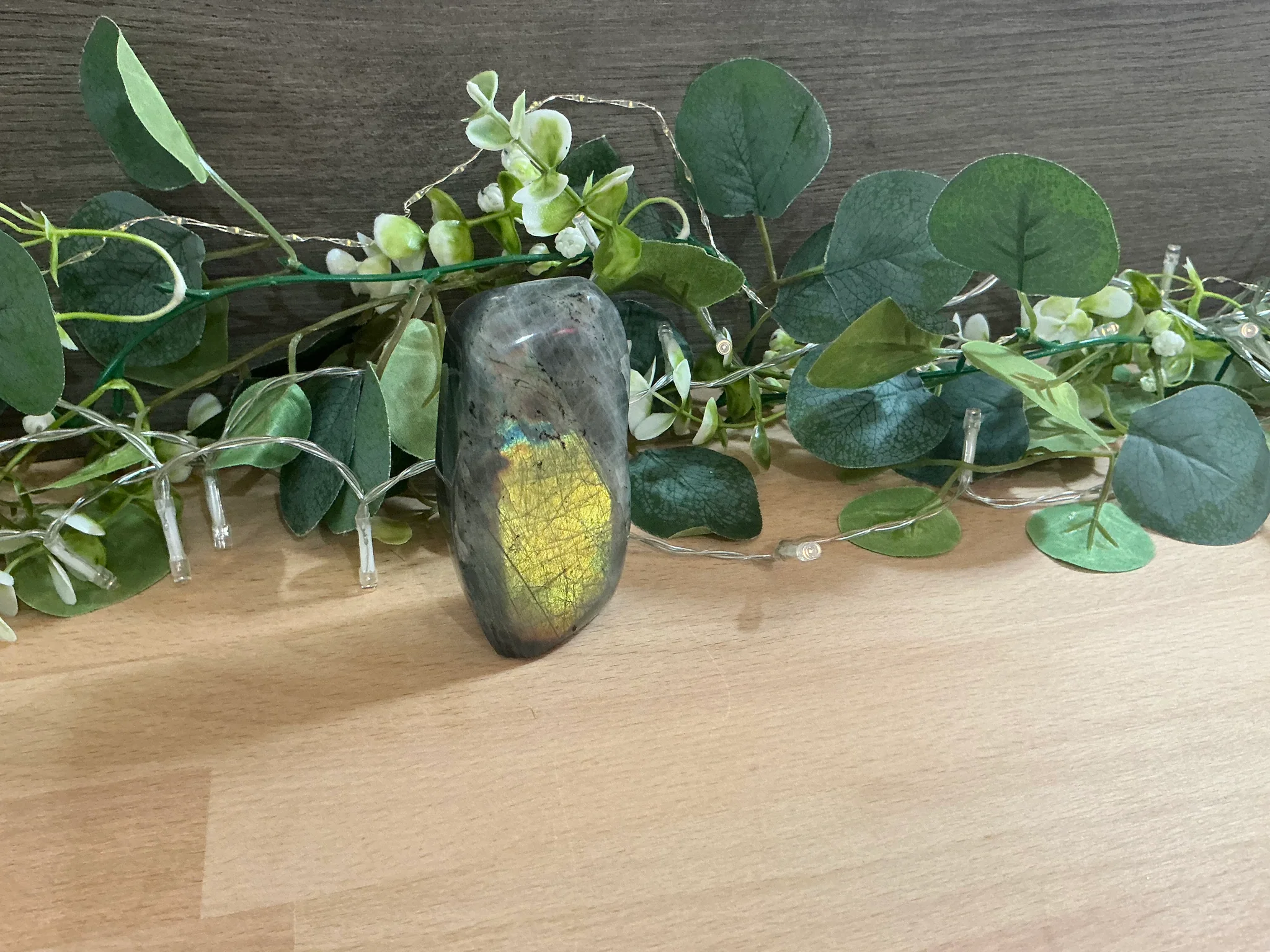
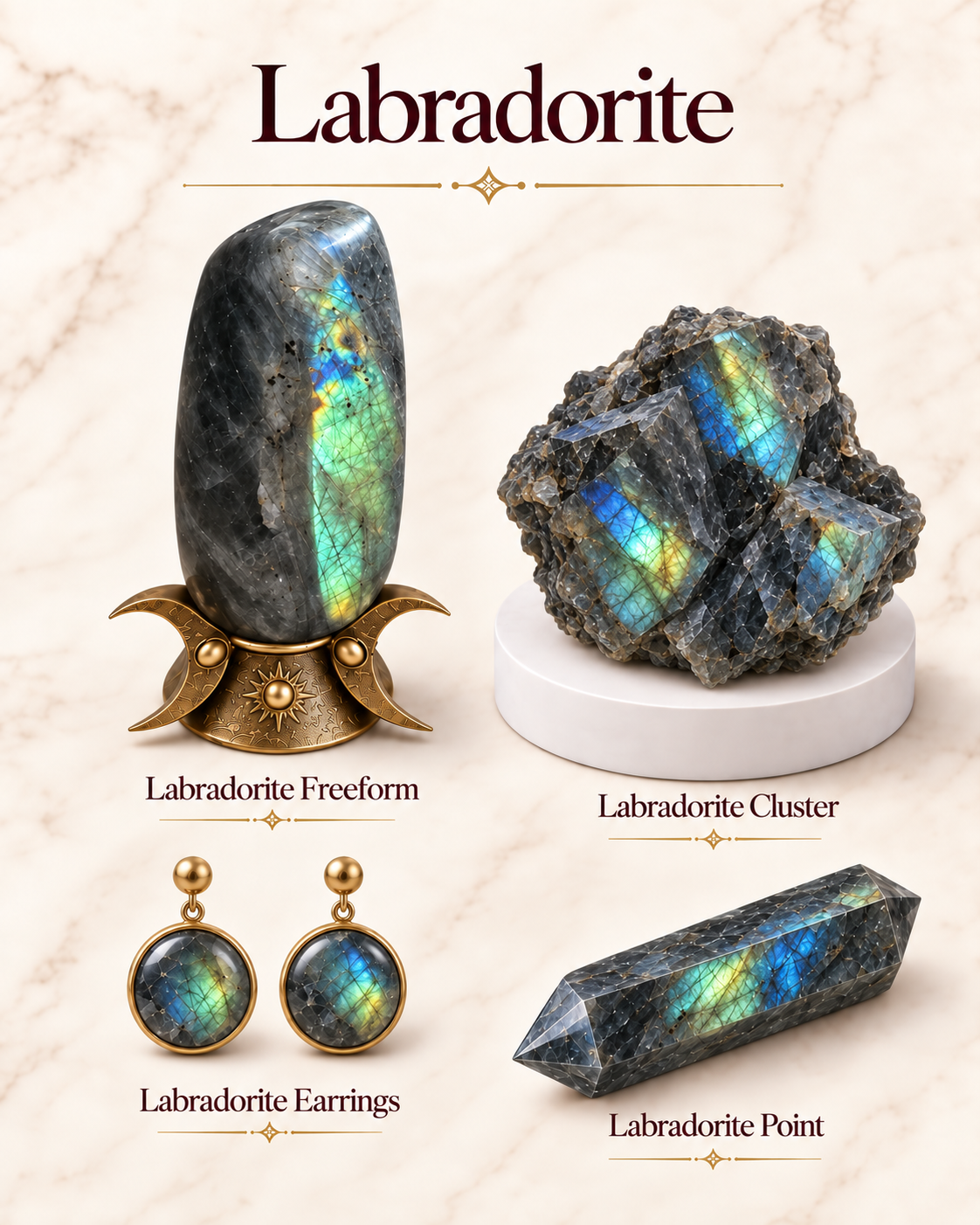
Labradorite is a plagioclase feldspar famous for its spectacular flashes of blue, green, gold, orange and purple known as labradorescence. Often appearing grey or dark at first glance, the stone can burst into vivid colour as it is moved through the light.
CWExplore this passport
Showing Science & Formation
Scientific passport
The mineral facts
Observable and measurable properties used to describe and identify this mineral.
- Chemical formula
- (Ca,Na)(Al,Si)₄O₈
- Mineral class
- Silicate — Feldspar
- Crystal system
- Triclinic
- Mohs hardness
- 6–6.5
- Lustre
- Vitreous to pearly
- Streak
- White
- Specific gravity
- Approximately 2.68–2.72
- Transparency
- Transparent to translucent; some specimens may appear nearly opaque
Common colours
Grey, dark grey, colourless, white, brownish, greenish and bluish, often displaying blue, green, gold, yellow, orange, red or violet labradorescence
Cleavage and fracture
Perfect cleavage in two directions meeting at approximately right angles; fracture is uneven to conchoidal
From the Earth
How it forms
The geological processes that create this crystal over time.
Formation
Its geological story
Labradorite forms primarily as crystals within igneous rocks as molten magma cools and crystallises. It is particularly associated with rocks such as anorthosite, gabbro, basalt and norite. During cooling, subtle differences in the feldspar structure can develop into extremely fine internal layers. In suitable Labradorite these microscopic structures interact with incoming light and produce the optical phenomenon known as labradorescence. Labradorite may also occur in some metamorphic rocks where feldspar-bearing material has been altered by heat and pressure.
A closer look
Scientific notes
Labradorite belongs to the plagioclase feldspar solid-solution series between calcium-rich anorthite and sodium-rich albite. Mineralogically, Labradorite traditionally refers to compositions containing roughly 50–70% of the anorthite component. Its famous labradorescence is an optical interference phenomenon rather than pigmentation. Light enters the mineral and interacts with extremely fine internal structures or lamellae created during cooling and separation within the feldspar. Different wavelengths of light interfere with one another, producing the strong metallic-looking colours visible at particular viewing angles. Because the effect depends upon crystal orientation, a Labradorite specimen can look relatively plain from one direction and exceptionally colourful after being rotated only slightly.
Passport stamps
Where in the world?
Important countries, regions and mineral localities connected with this crystal.
Canada
Ford Harbour, Paul Island, Nain Complex, Labrador
Newfoundland and Labrador
Ford Harbour on Paul Island is Labradorite’s first recorded locality and the place from which the mineral takes its name. The Labrador material became famous for its remarkable iridescent colour flashes, and the Nain Complex remains one of the most historically important Labradorite localities in the world.
Madagascar
Ampanihy District — including the Norcross and Fotadrevo Labradorite quarries
Atsimo-Andrefana
Southern Madagascar is one of the best-known modern sources of decorative Labradorite. The material occurs within large anorthosite bodies in the Ampanihy District and is quarried at several localities around Fotadrevo and Maniry. Madagascar is particularly famous for polished Labradorite showing broad blue, green and multicoloured flashes, including material commercially described as “peacock blue”.
Finland
Ylämaa Spectrolite Quarries, Lappeenranta
South Karelia
Ylämaa is famous for Spectrolite, the name used for exceptionally vivid Finnish Labradorite displaying intense spectral labradorescence. Material from this locality can show brilliant blue, green, yellow, orange and other colours. Spectrolite from Ylämaa has become internationally recognised as one of Finland’s distinctive gem materials.
United States
Ponderosa Sunstones Mine, Harney County
Oregon
The Ponderosa Mine produces gem-quality calcic Labradorite commonly known as Oregon Sunstone. Unlike classic Labradorite whose visual display is dominated by labradorescence, some Oregon material contains microscopic native copper inclusions responsible for aventurescence and vivid red, green and orange colours. The locality is important because it demonstrates just how varied Labradorite-family gem material can be.
Crystal Detective
Look closely. Ask better questions.
Safe observations at home are separated from professional laboratory identification. No single home test can prove every specimen's identity or origin.
Safe checks at home
Rotate the specimen slowly beneath a strong light and look for labradorescence that appears and disappears as the viewing angle changes. Natural Labradorite commonly has a grey, dark grey or brownish base colour with flashes that seem to originate from within the stone rather than sitting on its surface. Examine the specimen with magnification for natural cleavage, internal structures, fractures and variations in colour. Genuine material usually does not show the perfectly uniform appearance associated with manufactured glass. Avoid scratch tests on finished or valuable pieces. Labradorite has good cleavage and can chip or split if struck despite having a Mohs hardness of around 6–6.5. Visual examination alone cannot provide absolute identification.
Professional methods
Professional identification can include refractive-index testing, specific-gravity measurement, polarised-light microscopy and detailed examination of the feldspar's optical properties. Petrographic microscopy can be particularly useful for identifying plagioclase feldspar and observing characteristic twinning and internal structures. X-ray diffraction (XRD) can determine the mineral's crystal structure, while techniques such as electron microprobe analysis, SEM-EDS or XRF can examine its elemental composition. Advanced analysis can also determine the calcium-to-sodium ratio and therefore its position within the plagioclase feldspar series.
Imitations and treatments
Labradorite is generally valued for its natural optical effect and does not normally require treatment. Imitations may include coloured or iridescent glass, coated material and other feldspars with similar optical effects. Glass imitations may contain rounded bubbles, unusually uniform colour or an iridescence that remains visible from almost every angle instead of appearing and disappearing with orientation. Labradorite may also be confused with Larvikite, Moonstone and other feldspars. The trade name Rainbow Moonstone is commonly applied to pale or white Labradorite showing colourful adularescent flashes despite not being mineralogically identical to traditional orthoclase Moonstone. Artificial coatings can sometimes create a rainbow surface effect. A coating normally appears on the surface, whereas true labradorescence appears to originate from structures inside the stone.
The Mythical Library
Stories carried through time
Folklore can be enjoyed without confusing it with evidence. Where a popular tale is a later retelling, the passport says so.
The Mythical Library
Choose a book to enter the full-screen reader.
Beliefs, traditions and cultural context
What people have believed
Labradorite's dramatic flashes of colour have inspired numerous modern stories associating the mineral with the Northern Lights. Popular accounts frequently describe Indigenous peoples of Labrador believing that the aurora was trapped within the stone. However, precise historical documentation for many versions of this story is difficult to establish, so such accounts should be treated cautiously rather than presented as confirmed ancient tradition. The mineral's name itself has a genuine geographical connection with Labrador, Canada, where notable material became known to European mineralogists during the eighteenth century. In contemporary crystal and New Age traditions, Labradorite is commonly associated with transformation, protection, intuition, creativity and personal discovery. Its changing colours have encouraged symbolism involving hidden potential and seeing beyond outward appearances. Modern spiritual practices sometimes associate Labradorite with the Third Eye and Crown chakras and use it during meditation or reflective practices. These interpretations belong to contemporary crystal spirituality and folklore and are not scientifically established properties of the mineral.
Handle thoughtfully
Safety notes
Finished Labradorite specimens are generally safe to handle normally. However, the mineral can break along its cleavage planes and damaged pieces may develop sharp edges. Avoid deliberately crushing, grinding or cutting the material without appropriate equipment. Cutting and polishing can generate fine mineral and silicate dust, which should not be inhaled. Suitable respiratory protection, eye protection, dust extraction and wet-working methods should be used during lapidary work. Small pieces should be kept away from young children and pets where ingestion or choking could be a risk.
Keep it beautiful
Care and cleaning
Clean Labradorite gently using a soft cloth or soft brush. Brief cleaning with lukewarm water and mild soap is generally suitable, followed by thorough drying. Avoid sudden temperature changes, harsh chemicals, abrasive cleaners and prolonged exposure to aggressive cleaning solutions. Ultrasonic and steam cleaners are best avoided because natural fractures and cleavage planes can make some specimens vulnerable to damage. Store Labradorite separately from harder gemstones to reduce scratching and avoid impacts that could cause cleavage or chipping.
Follow the evidence
Sources and further reading
We show the references used while researching this passport so visitors can check important claims and continue learning.
- 1
Science
Labradorite: Mineral information, data and localities
Mindat.org contributors · Mindat.org / Hudson Institute of Mineralogy
Primary mineralogical reference for Labradorite. Used to verify its feldspar classification, composition range, formula, Mohs hardness, colour, lustre, streak, first recorded locality and the scientific explanation of labradorescence.
Checked 11 Sept 2026
- 2
Localities
Labradorite from the Nain Complex, Labrador, Canada
Mindat.org contributors · Mindat.org / Hudson Institute of Mineralogy
Supports Labradorite's Canadian locality information, including the Nain Complex and Paul Island occurrences. Labrador is historically important because the mineral's name derives from material from this region.
Checked 11 Sept 2026
- 3
Localities
Ampanihy District, Atsimo-Andrefana, Madagascar
Mindat.org contributors · Mindat.org / Hudson Institute of Mineralogy
Supports the Madagascar locality information. Labradorite sold as Madagascar material is produced from several anorthosite-hosted quarries within the Ampanihy District, including localities around Fotadrevo and Maniry.
Checked 11 Sept 2026
- 4
Localities
Ylämaa Spectrolite Quarries, Finland
Mindat.org contributors; locality references include Kai Hytönen · Mindat.org / Hudson Institute of Mineralogy
Supports the Finnish locality and Spectrolite information. Ylämaa is famous for strongly labradorescent material known as Spectrolite and is one of the world's classic Labradorite gem localities.
Checked 11 Sept 2026
- 5
Home identification
Labradorite gemstone information
Gemdat.org Management Team and cited gemological references · Gemdat.org
Used to cross-check gemological identification information including hardness, specific gravity, refractive index, cleavage, fracture, transparency, crystal system, geological occurrence and optical characteristics.
Checked 11 Sept 2026
- 6
Laboratory identification
Guide to Phenomenal Gems — Labradorescence
GIA Research · Gemological Institute of America · 2026
Used for the scientific explanation of labradorescence. GIA describes the effect as coloured flashes produced when light interacts with extremely thin internal lamellar structures formed during cooling.
Checked 11 Sept 2026
- 7
Fakes and treatments
An Introduction to Gem Treatments
Gemological Institute of America · Gemological Institute of America
Used to document treatment possibilities within feldspar. GIA reports that varieties including Labradorite and Andesine can accept copper diffusion treatment capable of significantly altering their colour. Such treatment may require qualified laboratory testing to identify with certainty.
Checked 11 Sept 2026
- 8
Myths and folklore
Forever SnS Mythical Library — Original Labradorite Folklore
Forever SnS · Forever SnS Ltd · 2026
The Night the Sky Fell into Stone and The Keeper of the Seven Colours are original contemporary folklore written for the Forever SnS Mythical Library. They are inspired by Labradorite's genuine geological history, optical properties and important localities but are not claimed to be ancient legends, Indigenous traditions or documented historical folklore.
Checked 11 Sept 2026
- 9
Beliefs and traditions
The Crystal Bible Volume 1
Judy Hall · Godsfield Press / Hachette UK · 2003
Used solely as a reference for contemporary crystal lore and metaphysical beliefs associated with Labradorite. It is not used as evidence for scientific, medical or mineralogical claims. The publisher describes the book as covering crystal attributes, applications and crystal-healing traditions.
Checked 11 Sept 2026
- 10
Safety and care
Sunstone Care and Cleaning
Gemological Institute of America · Gemological Institute of America
Used for general feldspar durability and cleaning guidance. GIA notes that feldspars possess cleavage that makes them vulnerable to impact and recommends warm soapy water while avoiding ultrasonic and steam cleaning. This source discusses Sunstone specifically, including Labradorite-family material, and is used here for feldspar care principles rather than to imply that all Labradorite is Sunstone.
Checked 11 Sept 2026
From the Forever SnS collection
Shop products featuring Labradorite
Each listing shows the actual product details, photographs and current availability.
Passport complete