Meet the crystal

Forever SnS Crystal Passport
Kambaba Jasper
Pronounced: kam-BAH-buh JAS-per
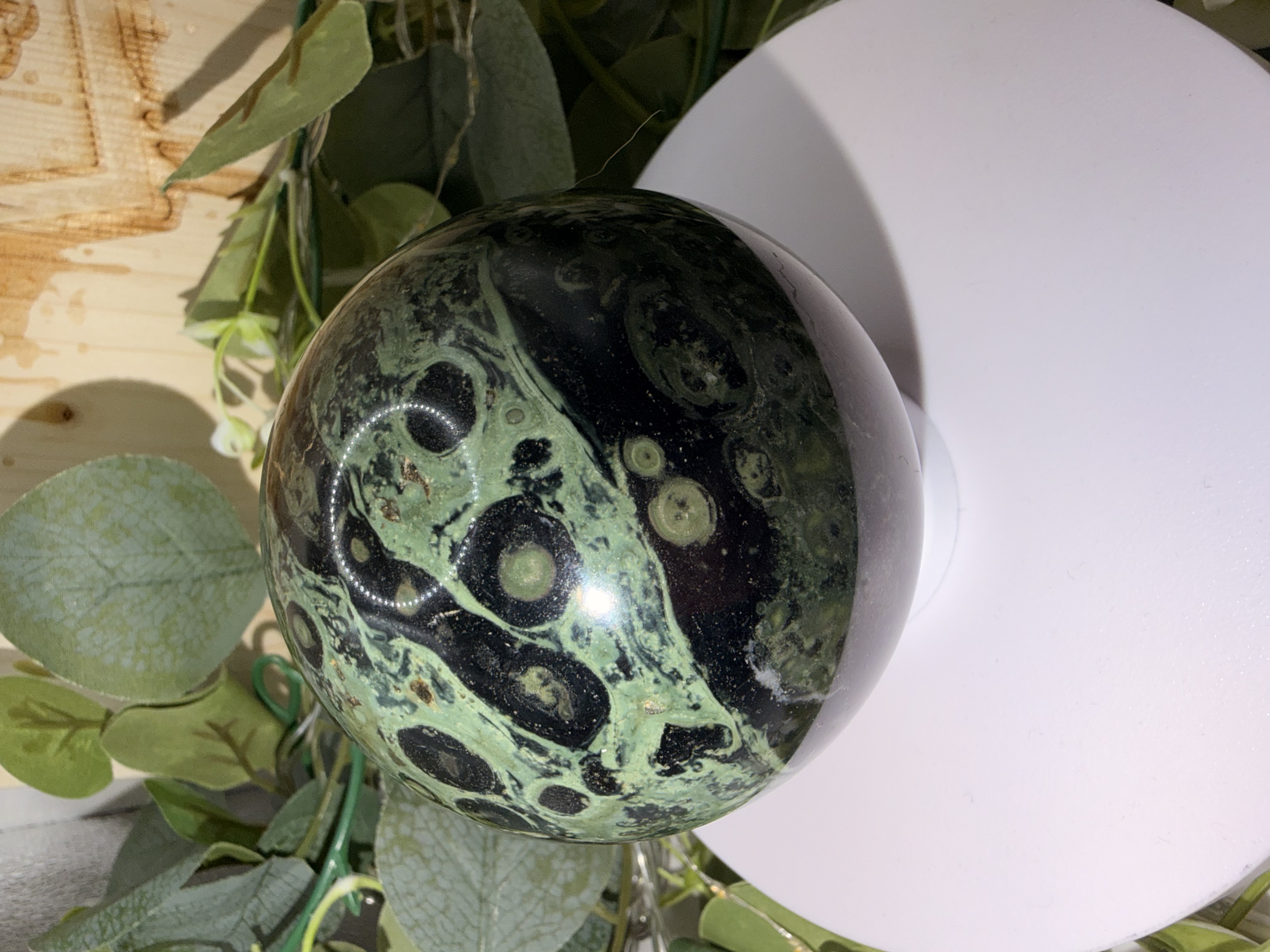
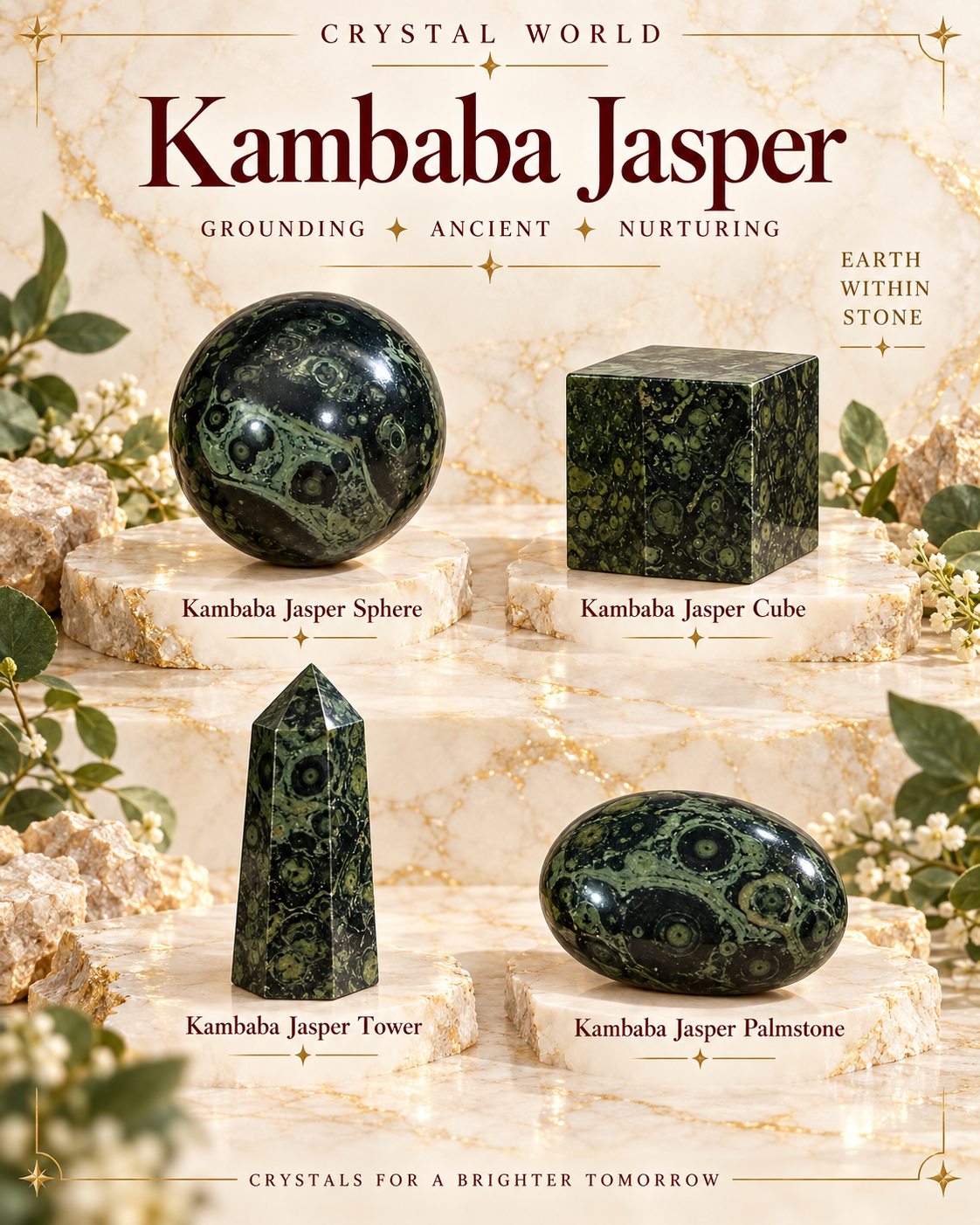
Kambaba Jasper is the familiar commercial name for a distinctive dark green and black volcanic rock from Madagascar. Despite its name, it is not a true Jasper, and modern mineralogical testing indicates that its rounded patterns are volcanic mineral structures rather than fossil stromatolites.
CWExplore this passport
Showing Science & Formation
Scientific passport
The mineral facts
Observable and measurable properties used to describe and identify this mineral.
- Chemical formula
- No single formula — multi-mineral volcanic rock
- Mineral class
- Igneous rock — rhyolitic volcanic rock
- Crystal system
- Not applicable — multi-mineral rock
- Mohs hardness
- Approximately 6–7
- Lustre
- Generally dull to waxy when rough and vitreous to highly polished when finished.
- Streak
- Not normally used diagnostically for this multi-mineral rock.
- Specific gravity
- Approximately 2.6–2.9, depending on the proportions of its constituent minerals.
- Transparency
- Opaque
Common colours
Dark forest green, olive green, grey-green and black, usually with rounded black or very dark green orbicular patterns, swirls and eye-like markings.
Cleavage and fracture
The rock as a whole has no single cleavage direction because it consists of several intergrown minerals. Broken material typically shows an irregular to uneven fracture.
From the Earth
How it forms
The geological processes that create this crystal over time.
Formation
Its geological story
Kambaba Jasper is interpreted as a volcanic rhyolitic rock. Rhyolite forms from silica-rich magma that reaches or approaches the Earth's surface and cools relatively quickly. Within the Madagascan material, Quartz, Aegirine, Albite and potassium feldspar form the greenish groundmass. The characteristic dark rounded and swirling structures are aggregates containing extremely fine amphibole needles. These mineral aggregates developed during the crystallisation and alteration history of the volcanic rock, producing the orbicular appearance that later led people to mistake the material for fossil stromatolite. The known commercial material is quarried in western-central Madagascar, probably within the Tsiroanomandidy area of the Bongolava Region, although the exact extraction sites have historically been poorly documented.
A closer look
Scientific notes
Kambaba Jasper is one of the best examples of a commercial crystal name becoming much more widely known than the rock's geological identity. It is not technically Jasper. Jasper is generally a dense, opaque, microcrystalline silica-rich material, whereas tested Kambaba material has been identified as a rhyolitic volcanic rock composed of several distinct minerals. It is also commonly described online as a fossil stromatolite or fossilised blue-green algae. Thin-section and X-ray diffraction analysis performed by the EPI Institute in Germany identified the material as volcanic rather than sedimentary and found no evidence that the characteristic dark rings are fossil microbial structures. The green groundmass contains Quartz, Aegirine, Albite and potassium feldspar, while the darker rounded formations consist largely of extremely fine amphibole needles. For customer familiarity, Kambaba Jasper remains an appropriate commercial name provided the Passport clearly explains its true geological nature.
Passport stamps
Where in the world?
Important countries, regions and mineral localities connected with this crystal.
Madagascar
Tsiroanomandidy area
Bongolava
The Tsiroanomandidy area in western-central Madagascar is the source region most commonly associated with commercial Kambaba Jasper. It is important because the material sold worldwide under this name is generally attributed to this part of Madagascar.
Madagascar
Tsiroanomandidy District
Bongolava
Tsiroanomandidy District is useful as a broader locality reference because exact quarry information for Kambaba Jasper has often been poorly documented. Using the district helps keep the Passport accurate while still reflecting the accepted commercial source area.
Crystal Detective
Look closely. Ask better questions.
Safe observations at home are separated from professional laboratory identification. No single home test can prove every specimen's identity or origin.
Safe checks at home
Look for a dark green to grey-green background crossed by irregular black or extremely dark green circles, swirls and eye-like patterns. The patterns should vary naturally in size, shape and distribution rather than appearing perfectly repeated. Polished Kambaba Jasper normally has a smooth, glassy to waxy finish but remains completely opaque. Examine the dark orbs with a magnifying glass. They may show irregular radiating or fibrous-looking internal textures rather than the clearly layered structures expected from many genuine stromatolites. Do not rely on the word Jasper as proof of composition because Kambaba Jasper is a commercial name rather than a strict mineralogical classification. Avoid destructive scratch testing of finished pieces.
Professional methods
Thin-section petrography can reveal the volcanic texture and individual mineral components within Kambaba Jasper. X-ray diffraction can identify minerals including Quartz, Aegirine, Albite, potassium feldspar and amphibole phases. Raman spectroscopy may also be used to identify individual mineral components. SEM imaging can examine the extremely fine amphibole needles that form the dark rounded aggregates. SEM-EDS or electron microprobe analysis can determine the elemental chemistry of the pyroxene, feldspar and amphibole minerals. These methods are also capable of distinguishing the volcanic mineral structures from genuine fossil stromatolite textures.
Imitations and treatments
Kambaba Jasper is sometimes confused with Nebula Stone, Orbicular Jasper, Ocean Jasper and genuine stromatolite material. Nebula Stone is another dark green and black commercial volcanic rock with a broadly similar mineral composition, which has caused considerable naming confusion in the market. Genuine stromatolite fossils may also have rounded or layered patterns, but their structures developed through biological sedimentary processes rather than volcanic crystallisation. Some sellers continue to describe Kambaba Jasper as fossilised algae or a stromatolite. This is best regarded as outdated commercial information rather than proof that the specimen is fake. The most common treatment is simply cutting and polishing. Dyed or resin-filled material is theoretically possible, so unnaturally vivid colours, obvious resin-filled fractures or surface colour concentrations should be examined more closely.
The Mythical Library
Stories carried through time
Folklore can be enjoyed without confusing it with evidence. Where a popular tale is a later retelling, the passport says so.
The Mythical Library
Choose a book to enter the full-screen reader.
Beliefs, traditions and cultural context
What people have believed
Kambaba Jasper is primarily a modern commercial stone and does not have a well-documented ancient spiritual tradition under that name. Its green and black appearance has led contemporary crystal traditions to associate it with grounding, calm, nature, emotional stability and connection with the Earth. It is often linked with the Heart and Root chakras in modern crystal spirituality. Some modern sources describe Kambaba Jasper as carrying the energy or wisdom of ancient stromatolites because it was widely believed to contain fossilised cyanobacteria. That particular explanation should be treated cautiously. Modern mineralogical testing indicates that the Madagascan material is volcanic rhyolite rather than fossil stromatolite. The spiritual symbolism can still be documented as a modern belief, but it should not be justified using the inaccurate claim that the stone contains fossilised ancient algae. These spiritual associations are contemporary beliefs and are not scientifically demonstrated medical, psychological or physical effects.
Handle thoughtfully
Safety notes
Finished Kambaba Jasper specimens are generally safe for normal handling. Cutting, grinding or drilling the stone can produce fine mineral dust containing Quartz and other silicate minerals. Respirable crystalline silica dust should not be inhaled. Use wet-working methods, suitable dust extraction, eye protection and appropriate respiratory protection during lapidary work. Do not intentionally ingest powdered mineral material or place loose or powdered stone into drinking water.
Keep it beautiful
Care and cleaning
Kambaba Jasper is relatively durable and takes a strong polish. Clean polished specimens using lukewarm water, mild soap and a soft cloth. Avoid abrasive cleaners that could gradually dull the surface. Avoid severe impacts, especially on carvings, towers and thin edges. Strong acids and aggressive chemical cleaners are unnecessary and should be avoided. Ultrasonic cleaning is best avoided where a specimen contains fractures or unknown resin treatments. Store separately from harder or sharp-edged minerals to protect the polished surface.
Follow the evidence
Sources and further reading
We show the references used while researching this passport so visitors can check important claims and continue learning.
- 1
Overview
Crocodile Jasper / Kambaba Jasper
Mindat.org contributors · Mindat.org / Hudson Institute of Mineralogy
Used as the main mineralogical reference for Kambaba Jasper. Supports the explanation that the material is a greenish volcanic rhyolite rock from Madagascar rather than a true Jasper or confirmed stromatolite.
Checked 27 Sept 2026
- 2
Science
Is Kambaba Jasper A Stromatolite?
FossilEra editorial article · FossilEra
Summarises EPI thin-film and X-ray diffraction analysis showing that Kambaba Jasper is a volcanic rhyolite composed of Quartz, Aegirine, feldspars and amphibole rather than a stromatolite fossil.
Checked 27 Sept 2026
- 3
Localities
Tsiroanomandidy District, Bongolava Region, Madagascar
Mindat.org contributors · Mindat.org / Hudson Institute of Mineralogy
Used for the accepted commercial source area in western-central Madagascar. Helps support the locality entries while acknowledging that precise quarry information is not always clearly documented.
Checked 27 Sept 2026
- 4
Home identification
Crocodile Jasper / Kambaba Jasper
Mindat.org contributors · Mindat.org / Hudson Institute of Mineralogy
Used for the mineralogical identification of Kambaba Jasper as a multi-mineral volcanic rock and for distinguishing it from true Jasper and stromatolite material.
Checked 27 Sept 2026
- 5
Fakes and treatments
Is Kambaba Jasper A Stromatolite?
FossilEra editorial article · FossilEra
Useful for explaining that the widely repeated stromatolite claim is outdated and not supported by the mineralogical evidence.
Checked 27 Sept 2026
- 6
Myths and folklore
Forever SnS Mythical Library — Original Kambaba Jasper Folklore
Forever SnS · Forever SnS Ltd · 2026
The Stone That Was Mistaken for Ancient Life and The Crocodile Who Dreamed in Stone are original contemporary stories created for the Forever SnS Mythical Library. They are inspired by Kambaba Jasper’s appearance and trade history but are not presented as historical Madagascan folklore.
Checked 27 Sept 2026
- 7
Beliefs and traditions
Forever SnS — Modern crystal symbolism context
Forever SnS · Forever SnS Ltd · 2026
Used to separate modern crystal symbolism from geological fact. Kambaba Jasper’s spiritual meanings are treated as contemporary beliefs rather than ancient documented tradition.
Checked 27 Sept 2026
From the Forever SnS collection
Shop products featuring Kambaba Jasper
Each listing shows the actual product details, photographs and current availability.
Passport complete