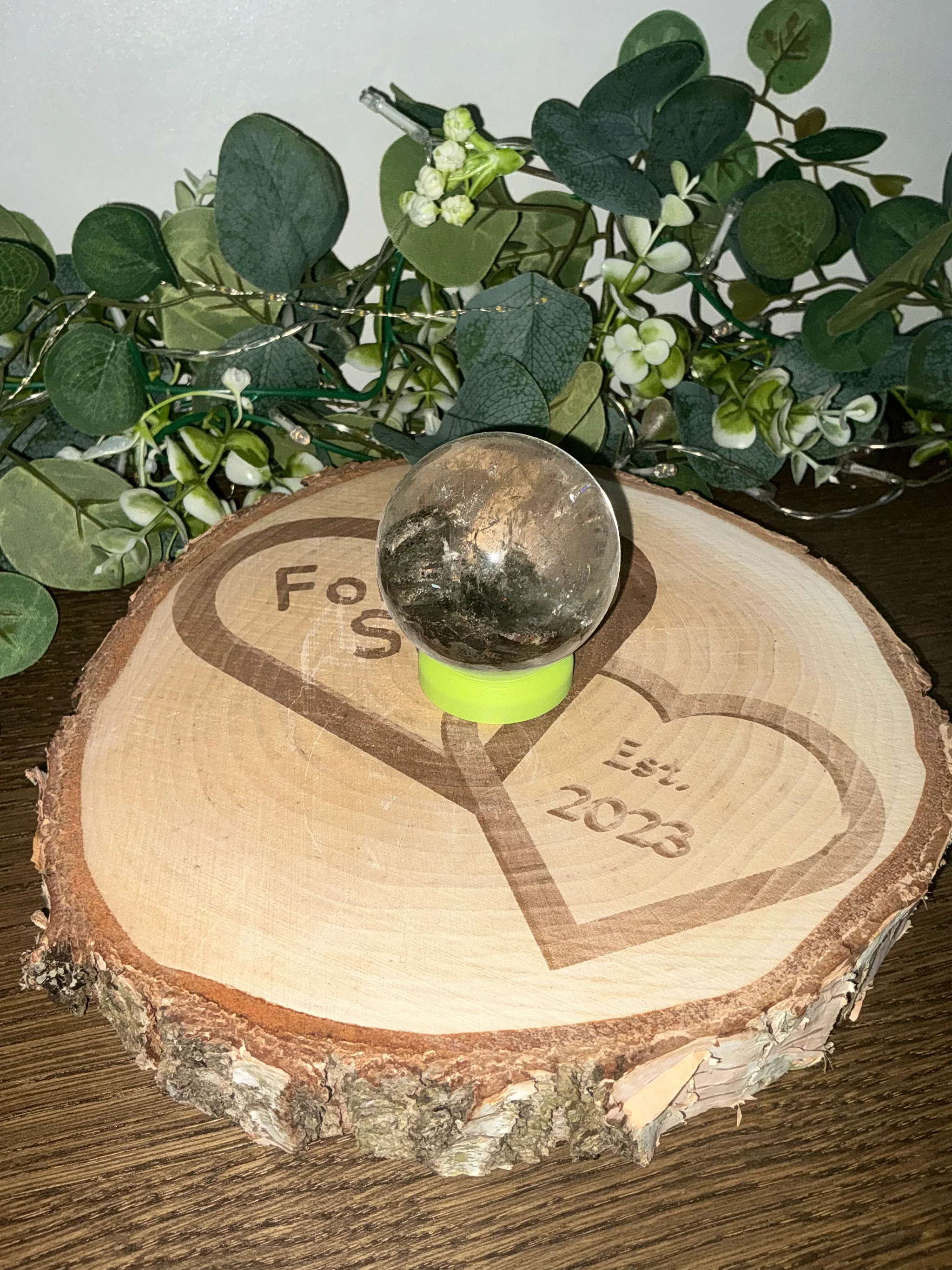
Meet the crystal

Forever SnS Crystal Passport
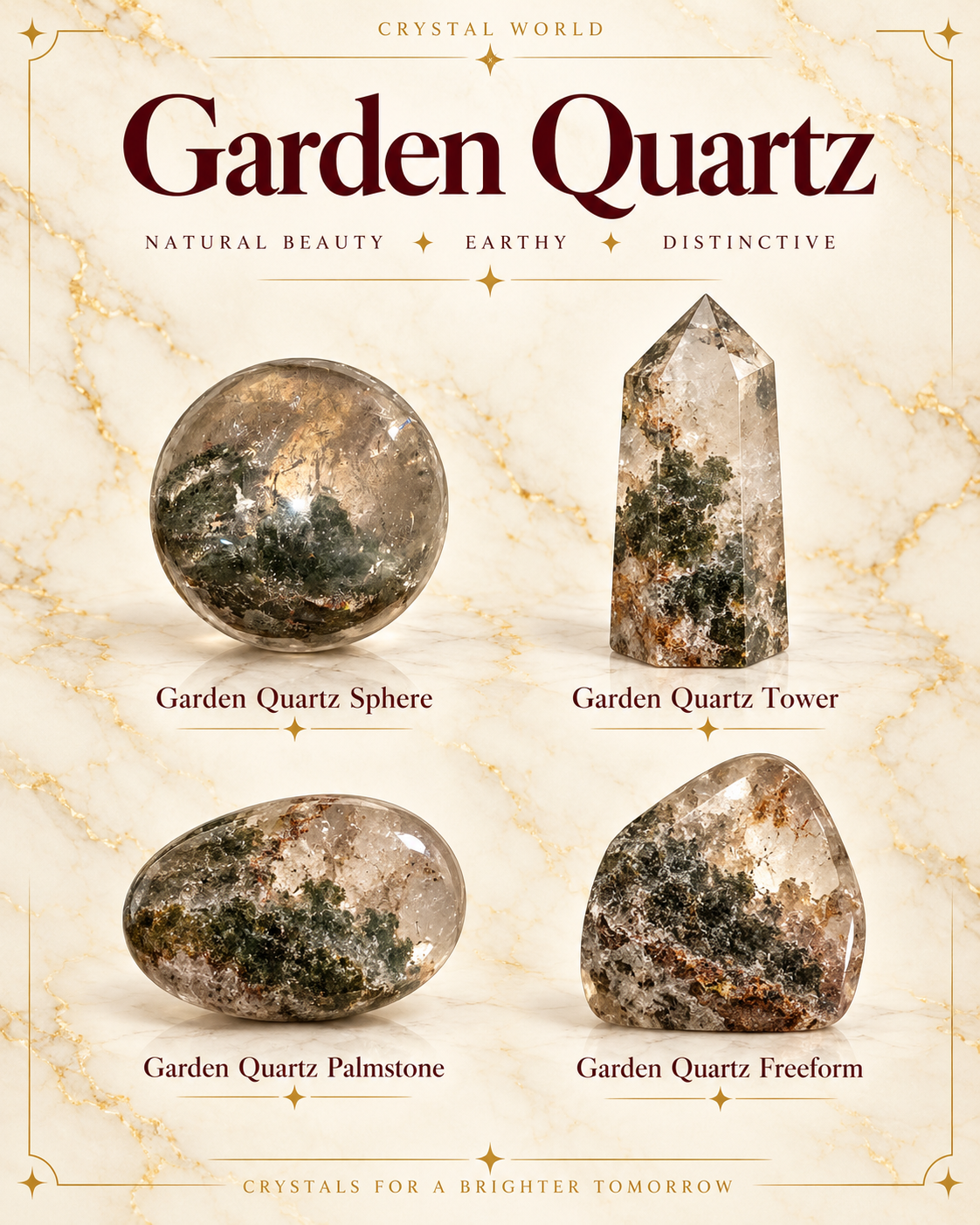
Garden Quartz
Pronounced: GAR-den KWORTS
Garden Quartz is a trade name for Quartz containing natural mineral inclusions that create landscape-like scenes, clouds, mossy patterns and colourful internal formations.
CWExplore this passport
Showing Science & Formation
Scientific passport
The mineral facts
Observable and measurable properties used to describe and identify this mineral.
- Chemical formula
- SiO₂
- Mineral class
- Silicate — Quartz
- Crystal system
- Trigonal
- Mohs hardness
- 7
- Lustre
- Vitreous
- Streak
- White
- Specific gravity
- Approximately 2.65
- Transparency
- Transparent to translucent
Common colours
Clear, white, green, red, brown, yellow, orange and grey
Cleavage and fracture
No true cleavage; conchoidal fracture.
From the Earth
How it forms
The geological processes that create this crystal over time.
Formation
Its geological story
Garden Quartz forms when Quartz grows around and encloses earlier mineral material. Minerals such as chlorite, hematite, iron oxides or clay may coat an earlier crystal surface or occur within the mineral-rich fluid while Quartz is still growing. Later Quartz growth can completely surround these materials, preserving them inside the crystal as inclusions. Repeated interruptions and renewed crystal growth can also create phantom-like layers and complex three-dimensional internal scenes.
A closer look
Scientific notes
Garden Quartz is a trade name rather than a recognised mineral species. The host mineral is Quartz, while the visible internal inclusions may consist of several different minerals. Lodolite is another commercial name commonly used for included Quartz, particularly Brazilian material. Not every Garden Quartz specimen contains the same inclusions, so colour alone should not be used to identify the enclosed minerals. Some specimens also contain true phantom growth, where an earlier stage of the Quartz crystal is outlined by inclusions before later Quartz growth encloses it.
Passport stamps
Where in the world?
Important countries, regions and mineral localities connected with this crystal.
Brazil
Diamantina
Minas Gerais
Diamantina is a major Quartz-producing area where transparent crystals containing Chlorite and other mineral inclusions are well documented. The locality is especially important for scenic and phantom-like included Quartz.
Brazil
Paulista, Presidente Kubitschek
Minas Gerais
Paulista is known for highly transparent Quartz containing layered clay minerals and green Chlorite. These inclusions can create dramatic internal landscape-like patterns closely resembling material sold as Garden Quartz.
Brazil
Seminário Farm, Joaquim Felício
Minas Gerais
Seminário Farm has produced clear Quartz crystals with distinct Chlorite phantoms and internal inclusion layers. These specimens provide an excellent natural example of how mineral coatings can become enclosed by later Quartz growth.
Brazil
Corinto
Minas Gerais
Corinto is one of Brazil’s major Quartz-producing areas and is documented with Quartz associated with Chlorite, Hematite, Goethite and other minerals that can create colourful and scenic inclusions.
Brazil
Presidente Kubitschek area
Minas Gerais
The wider Presidente Kubitschek area is known for included Quartz showing complex internal layers, Chlorite and clay minerals. It is a useful broader locality for scenic Quartz when exact mine-level provenance is unavailable.
Crystal Detective
Look closely. Ask better questions.
Safe observations at home are separated from professional laboratory identification. No single home test can prove every specimen's identity or origin.
Safe checks at home
Look for a clear or translucent Quartz body containing natural-looking internal mineral scenes. Common features include green mossy patches, reddish or brown clouds, pale clay-like areas, layered phantoms and irregular three-dimensional inclusions. The host Quartz should have a glassy lustre and a hardness of approximately 7. Natural inclusions are usually irregular and vary throughout the crystal rather than appearing perfectly repeated. Avoid destructive scratch testing on polished or valuable pieces.
Professional methods
Gemological testing can confirm that the host material is Quartz. Microscopy can examine the shape, texture and growth relationships of the inclusions. Raman spectroscopy can identify individual inclusion minerals. X-ray diffraction or chemical analysis may be used where the inclusion material is difficult to identify. Microscopic growth features can also help distinguish natural included Quartz from glass, resin or artificially altered specimens.
Imitations and treatments
Garden Quartz may be imitated using glass, resin or artificially included decorative material. Some natural included Quartz can also be dyed through fractures to intensify or change the colour of the inclusions. Bright colour concentrated strongly along cracks may indicate dye treatment. Garden Quartz is sometimes incorrectly labelled Phantom Quartz even when no true phantom crystal outline is present. Natural inclusions should not automatically be identified as chlorite, hematite or another specific mineral without supporting evidence.
The Mythical Library
Stories carried through time
Folklore can be enjoyed without confusing it with evidence. Where a popular tale is a later retelling, the passport says so.
The Mythical Library
Choose a book to enter the full-screen reader.
Beliefs, traditions and cultural context
What people have believed
Garden Quartz does not have a clearly documented ancient spiritual tradition under this modern trade name. In contemporary crystal spirituality, it is commonly associated with personal growth, reflection, grounding, connection with nature and exploring one’s inner world. Its landscape-like inclusions have encouraged modern symbolic associations with gardens, forests, memory and the idea of carrying a small natural world within the crystal. Some practitioners also associate Garden Quartz with meditation, visualisation and spiritual journeying. These interpretations belong to contemporary crystal spirituality and symbolism and are not scientifically demonstrated medical, psychological or physical effects. Its genuine scientific interest lies in the mineral inclusions preserved inside Quartz and the way those inclusions record different stages of crystal growth.
Handle thoughtfully
Safety notes
Finished Garden Quartz is generally safe for normal handling. Cutting, grinding or drilling Quartz can produce respirable crystalline silica dust, which should not be inhaled. Use wet-working methods, suitable respiratory protection and eye protection during lapidary work. Do not ingest powdered mineral material.
Keep it beautiful
Care and cleaning
Clean Garden Quartz with lukewarm water, mild soap and a soft cloth or brush. Avoid strong chemicals and sudden extreme temperature changes. Do not use aggressive cleaning methods on heavily fractured specimens. Ultrasonic cleaning is best avoided if the crystal contains significant internal fractures or unknown treatments. Store separately from softer minerals because Quartz can scratch them.
Follow the evidence
Sources and further reading
We show the references used while researching this passport so visitors can check important claims and continue learning.
- 1
Overview
Lodolite
Mindat.org contributors · Mindat.org contributors
Primary nomenclature reference for Lodolite as an unofficial trade name for included Quartz, particularly material from Minas Gerais, Brazil.
Checked 8 Oct 2026
- 2
Localities
Chlorite Group from Diamantina, Minas Gerais, Brazil
Mindat.org contributors · Mindat.org / Hudson Institute of Mineralogy
Documents Chlorite associated with Quartz at Diamantina, supporting the locality as a source of naturally included Quartz.
Checked 8 Oct 2026
- 3
Localities
Quartz from Seminário Farm, Joaquim Felício, Minas Gerais, Brazil
Mindat.org contributors · Mindat.org / Hudson Institute of Mineralogy
Documents Quartz associated with Chlorite from Seminário Farm, including specimens showing distinct internal Chlorite phantoms.
Checked 8 Oct 2026
- 4
Localities
Quartz from Corinto, Minas Gerais, Brazil
Mindat.org contributors · Mindat.org / Hudson Institute of Mineralogy
Documents Quartz from Corinto with Chlorite, Hematite, Goethite and other associated minerals relevant to scenic and included Quartz.
Checked 8 Oct 2026
- 5
Home identification
Included Quartz Locality Discussion — Brazil
Mindat.org contributors and mineral collectors · Mindat.org · 2014
Useful for understanding the difficulty of assigning precise mine-level provenance to Brazilian included Quartz because material comes from numerous localities across Minas Gerais and neighbouring regions.
Checked 8 Oct 2026
- 6
Laboratory identification
Quartz and Chlorite — Paulista, Presidente Kubitschek, Minas Gerais
Mindat.org contributors · Mindat.org · 2023 specimen record
Documents clear Quartz containing layered clay minerals and green Chlorite, demonstrating the complex inclusion structures that can produce Garden Quartz-style internal scenes.
Checked 8 Oct 2026
- 7
Myths and folklore
Forever SnS Mythical Library — Original Garden Quartz Folklore
Forever SnS · Forever SnS Ltd
The Garden That Grew Inside the Crystal and The Mountain That Kept Its Memories Inside are original contemporary Forever SnS stories inspired by genuine mineral inclusions and phantom growth in Quartz. They are not presented as ancient or traditional folklore.
Checked 8 Oct 2026
- 8
Beliefs and traditions
Forever SnS — Modern Garden Quartz symbolism context
Forever SnS · Forever SnS Ltd
Used to separate contemporary crystal symbolism from geological fact. Associations with growth, reflection, nature and inner landscapes are presented only as modern beliefs.
Checked 8 Oct 2026
From the Forever SnS collection
Shop products featuring Garden Quartz
Each listing shows the actual product details, photographs and current availability.
Passport complete