Meet the crystal

Forever SnS Crystal Passport
Flower Agate
Pronounced: FLOW-er AG-it
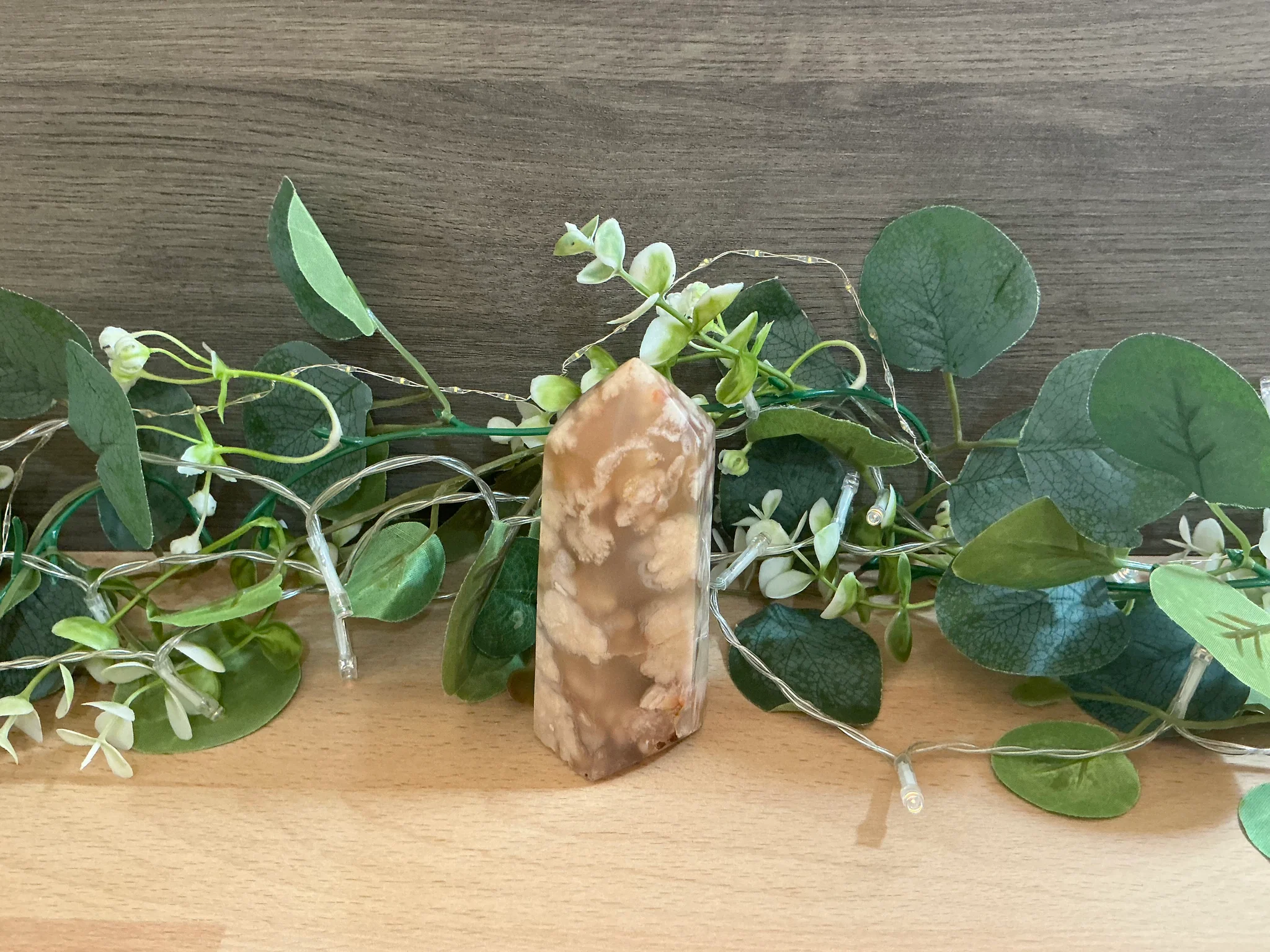
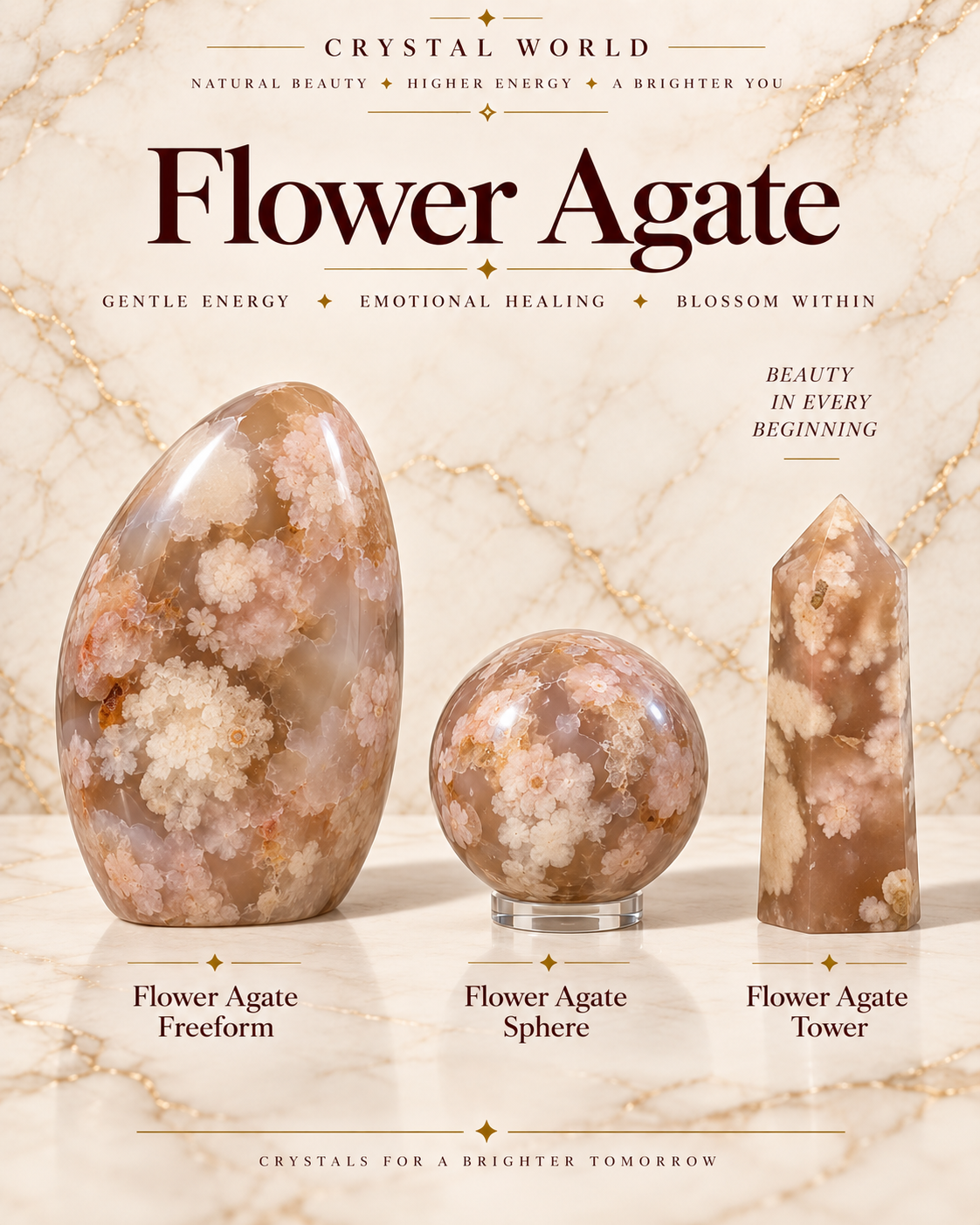
Flower Agate is a modern trade name for a Madagascan chalcedony material filled with soft, flower-like plume formations. Its translucent pink, peach and cream base is crossed by pale internal patterns that resemble petals, buds and blossoms suspended inside the stone.
CWExplore this passport
Showing Science & Formation
Scientific passport
The mineral facts
Observable and measurable properties used to describe and identify this mineral.
- Chemical formula
- SiO₂
- Mineral class
- Silicate — Chalcedony / Quartz family
- Crystal system
- Trigonal — referring to the quartz component; chalcedony is microcrystalline
- Mohs hardness
- 6.5–7
- Lustre
- Waxy to vitreous when polished
- Streak
- White
- Specific gravity
- Approximately 2.58–2.64
- Transparency
- Translucent to opaque, with more translucent base material surrounding denser floral inclusions
Common colours
Pale pink, peach, cream, beige, white and occasionally pale greenish or greyish tones
Cleavage and fracture
No true cleavage; typically conchoidal to uneven fracture
From the Earth
How it forms
The geological processes that create this crystal over time.
Formation
Its geological story
Flower Agate forms through the deposition of silica-rich material in cavities within rock, broadly following the same processes that form other chalcedony and agate varieties. Silica-bearing fluids or gels enter open spaces in the host rock and gradually solidify into microcrystalline quartz. Within Flower Agate, secondary opaque or translucent chalcedony structures grow outward from multiple points inside the material. These radial or plume-like growths form three-dimensional bodies that resemble buds, petals or flower heads when exposed by cutting and polishing. Different cuts through the same internal structure can therefore reveal very different “flower” patterns. The exact geological conditions responsible for producing this particularly strong floral habit are still not as thoroughly documented in published mineralogical literature as those of many long-established gem materials.
A closer look
Scientific notes
Flower Agate is scientifically better described as floral or plume-bearing chalcedony than as a separate mineral. The flower-like structures are themselves silica-rich chalcedony growths rather than actual fossil plants or botanical material. Because these internal formations are three-dimensional, a polished surface can intersect them at different angles. This creates circular blossoms, elongated petals, buds and cloud-like patterns depending on how the rough material is cut. The commercial name became popular relatively recently, and much of the material now sold as Flower Agate is sourced from Madagascar. The term “agate” is commercially useful but slightly broader than strict mineralogical definitions because some Flower Agate specimens show little or no obvious classical banding.
Passport stamps
Where in the world?
Important countries, regions and mineral localities connected with this crystal.
Madagascar
Commercial Flower Agate deposits — precise mine frequently unrecorded
Central Madagascar
Madagascar is the established commercial source of the material known as Flower Agate. The distinctive pink-to-peach chalcedony containing pale three-dimensional floral plumes entered the international mineral market in significant quantities around 2018. Precise mine-level provenance is often absent from retail supply chains, so Madagascar is the most defensible general origin when a more detailed locality has not been supplied.
Madagascar
Ambatofinandrahana area
Amoron'i Mania
The Ambatofinandrahana area is reported as an important source region for Flower Agate within Madagascar. The material is associated with silica-rich volcanic or hydrothermal environments where chalcedony developed inside cavities and produced the characteristic plume-like structures. Because detailed peer-reviewed mine documentation remains limited, this is best presented as a reported source area rather than a single confirmed named mine.
Madagascar
Antsirabe area — reported commercial source
Vakinankaratra
The wider Antsirabe region is frequently associated with Madagascar's gemstone and chalcedony trade and is reported by some modern geological and commercial references as a Flower Agate-producing area. Exact mine attribution is often unavailable, so specimens should only be assigned this more specific origin when supplier documentation supports it.
Crystal Detective
Look closely. Ask better questions.
Safe observations at home are separated from professional laboratory identification. No single home test can prove every specimen's identity or origin.
Safe checks at home
Hold the specimen beneath good lighting and look for pale flower- or plume-shaped structures that appear to sit inside a translucent chalcedony base. Natural patterns should vary in size, depth, shape and orientation rather than appearing perfectly repeated. Turning the specimen may reveal that individual “flowers” continue beneath the surface or change shape with viewing angle, helping show that they are three-dimensional internal formations. Look for natural variations in colour and translucency. Genuine material is often soft pink, peach, beige or cream rather than extremely bright or uniformly coloured. Avoid scratch testing polished or collectible pieces. Chalcedony is relatively hard, but destructive testing is unnecessary for routine identification.
Professional methods
Professional testing may include refractive-index measurement, specific-gravity testing, microscopy and polarised-light examination. Raman spectroscopy and X-ray diffraction can confirm the silica mineral phases present. Microscopy can examine the plume structures and determine whether colour or inclusions are natural, dyed or artificially introduced. SEM imaging and elemental techniques such as EDS or XRF may be used where more detailed analysis of colour-causing components or inclusions is required.
Imitations and treatments
Flower Agate may be imitated or confused with dyed chalcedony, plume agate, pink agate, resin composites and other silica materials containing attractive internal patterns. Dyed material may show unnaturally intense colour concentrated along fractures, porous areas or surface-reaching cracks. Artificial resin or glass may contain rounded bubbles, flow features or an unusually uniform internal appearance. Most genuine Flower Agate is sold for its natural internal patterning, so heavy treatment would generally reduce the feature that gives the material its appeal. However, dyeing and loose commercial labelling can occur, so unusually vivid specimens deserve closer inspection.
The Mythical Library
Stories carried through time
Folklore can be enjoyed without confusing it with evidence. Where a popular tale is a later retelling, the passport says so.
The Mythical Library
Choose a book to enter the full-screen reader.
Beliefs, traditions and cultural context
What people have believed
Flower Agate is a relatively recent addition to the international crystal trade, so it does not have a well-established ancient cultural tradition under the name Flower Agate. Most of its spiritual meanings are modern and draw directly from its flower-like appearance. Contemporary crystal traditions commonly associate Flower Agate with growth, personal development, creativity, new beginnings and gradually bringing ideas or goals into fruition. Its internal blossom patterns are often used symbolically to represent potential unfolding over time, which is why modern crystal practitioners sometimes connect it with nurturing, transformation and self-confidence. It is commonly associated with the Heart and Sacral chakras in modern crystal practice, although these correspondences vary between authors and traditions.
Handle thoughtfully
Safety notes
Finished Flower Agate specimens are generally safe for normal handling. Like other quartz-rich materials, cutting, grinding, drilling or crushing it can generate fine crystalline silica dust. This dust should not be inhaled. Lapidary work should use suitable dust extraction, wet-working methods, eye protection and appropriate respiratory protection. Broken pieces may develop sharp edges, and small fragments should be kept away from young children and pets.
Keep it beautiful
Care and cleaning
Flower Agate is relatively durable, with a hardness around 6.5–7. Clean it with lukewarm water, mild soap and a soft cloth or brush. Avoid harsh chemicals, abrasive cleaners and severe thermal shock. Ultrasonic or steam cleaning is best avoided for heavily fractured specimens, pieces containing druzy cavities or material with unknown treatments. Store polished specimens separately from harder minerals to reduce scratching and protect carved points and thin edges from impact.
Follow the evidence
Sources and further reading
We show the references used while researching this passport so visitors can check important claims and continue learning.
- 1
Overview
Flower Agate Mineral Guide: Formation, Inclusion Structure and Geological Origins
Laura Konst · Tali & Loz Crystals · 2026
Primary modern reference used for Flower Agate's identification as a Madagascan chalcedony trade variety, its three-dimensional plume structures, approximate market history and geological interpretation. Useful because specialist mineralogical literature devoted specifically to Flower Agate remains limited.
Checked 13 Sept 2026
- 2
Science
Flower Agate Mineral Guide: Formation, Inclusion Structure and Geological Origins
Laura Konst · Tali & Loz Crystals · 2026
Used for the description of Flower Agate as primarily chalcedony with pale plume-like mineral growths inside a translucent pink-to-peach silica matrix. Also supports the distinction between the three-dimensional floral structures and traditional flat or concentric agate banding.
Checked 13 Sept 2026
- 3
Localities
What is Flower Agate
Geology In editorial contributors · Geology In · 2025
Used for reported Madagascar locality information, particularly the Ambatofinandrahana and Antsirabe areas. Because detailed mine-level Flower Agate provenance remains poorly represented in primary mineralogical databases, the Passport treats these as reported source regions rather than claiming a precise mine without supporting documentation.
Checked 13 Sept 2026
- 4
Home identification
Flower Agate: What It Is and How to Spot the Real Thing
Beyond Bohemian editorial contributors · Beyond Bohemian · 2026
Used for practical identification guidance, including recognition of Flower Agate's natural milky plume formations, muted pink-to-peach matrix and the possibility of dyed or loosely labelled material in the commercial market.
Checked 13 Sept 2026
- 5
Laboratory identification
What Is Flower Agate? The Geology Behind Its Blossoming Plumes
Saralynn Tauras-Craig · Mandala Gems · 2026
Used as a secondary geological reference for Flower Agate's microcrystalline chalcedony composition and the interpretation of its floral patterns as natural mineral growth rather than preserved flowers or artificial decoration.
Checked 13 Sept 2026
- 6
Fakes and treatments
Flower Agate Crystal Guide: Properties, Sourcing and Care
Beyond Bohemian editorial contributors · Beyond Bohemian · 2026
Used as a supporting commercial reference for natural appearance, sourcing and possible treatment indicators. The Passport treats unusually vivid colours, dye concentrated in cracks and inconsistent provenance as reasons for further examination rather than automatically declaring a specimen fake.
Checked 13 Sept 2026
- 7
Myths and folklore
Forever SnS Mythical Library — Original Flower Agate Folklore
Forever SnS · Forever SnS Ltd · 2026
The Garden That Grew Inside the Stone and The Keeper of the Unopened Flowers are original contemporary folklore created for the Forever SnS Mythical Library. They are inspired by Flower Agate's genuine three-dimensional plume formations and modern blossom symbolism but are not presented as ancient Madagascan stories, inherited traditions or historical folklore.
Checked 13 Sept 2026
- 8
Beliefs and traditions
Flower Agate Crystal Guide: Properties, Sourcing and Care
Beyond Bohemian editorial contributors · Beyond Bohemian · 2026
Used solely to document contemporary crystal-spiritual associations surrounding Flower Agate, including growth, potential, new beginnings and Heart/Sacral chakra symbolism. The source itself acknowledges that Flower Agate does not have deep ancient metaphysical traditions. These associations are included as modern beliefs and not as scientific or medical effects.
Checked 13 Sept 2026
- 9
Beliefs and traditions
Flower Agate Meaning & Metaphysical Properties
Gems Lore editorial contributors · Gems Lore · 2026
Used to document modern symbolic interpretations such as growth, patience, creativity and gradual progress. This source is particularly useful because it explicitly separates reflective symbolism from unsupported claims that the crystal can alter fertility, hormones, relationships or other medical and personal outcomes.
Checked 13 Sept 2026
- 10
Safety and care
Silica, Crystalline — Overview
Occupational Safety and Health Administration · U.S. Department of Labor — OSHA
Used specifically for the warning regarding respirable crystalline silica produced when silica-rich stone is cut, drilled, ground or crushed. OSHA states that these activities can generate extremely fine respirable particles associated with serious lung disease. This warning concerns airborne dust generated during working of the stone, not ordinary handling of intact Flower Agate.
Checked 13 Sept 2026
From the Forever SnS collection
Shop products featuring Flower Agate
Each listing shows the actual product details, photographs and current availability.
Passport complete