Meet the crystal

Forever SnS Crystal Passport
Clear Quartz
Pronounced: KLEER KWORTS
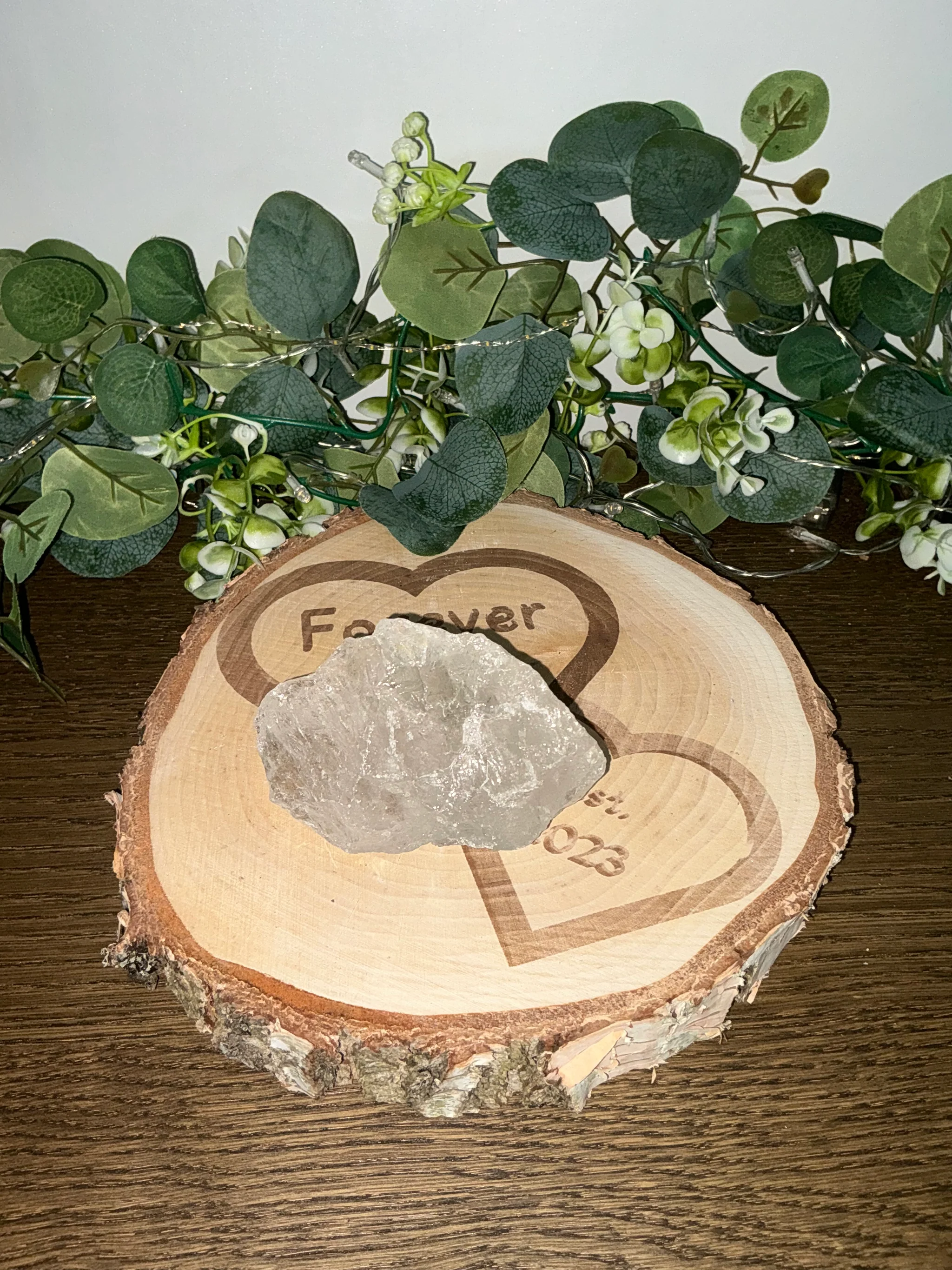
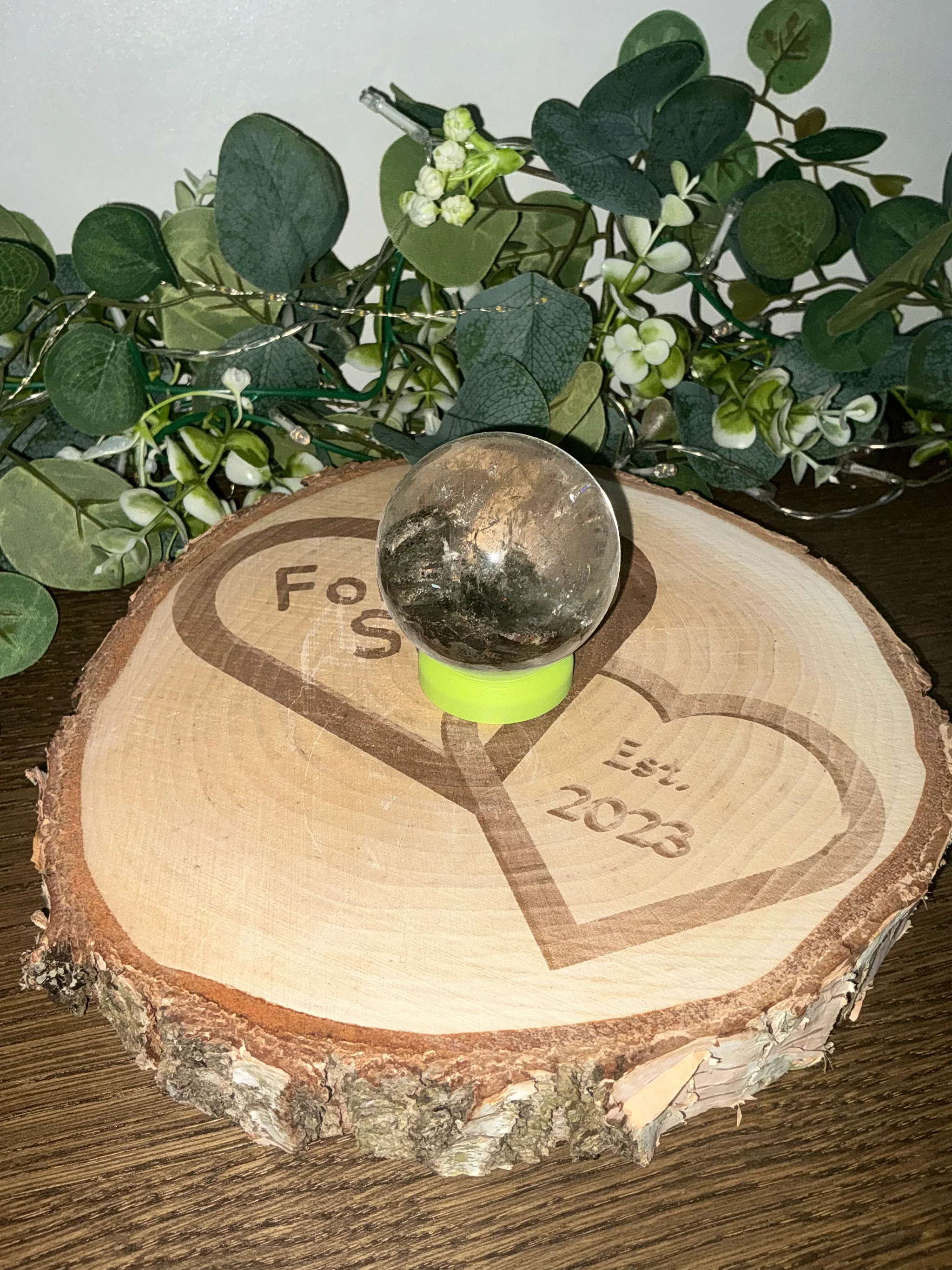
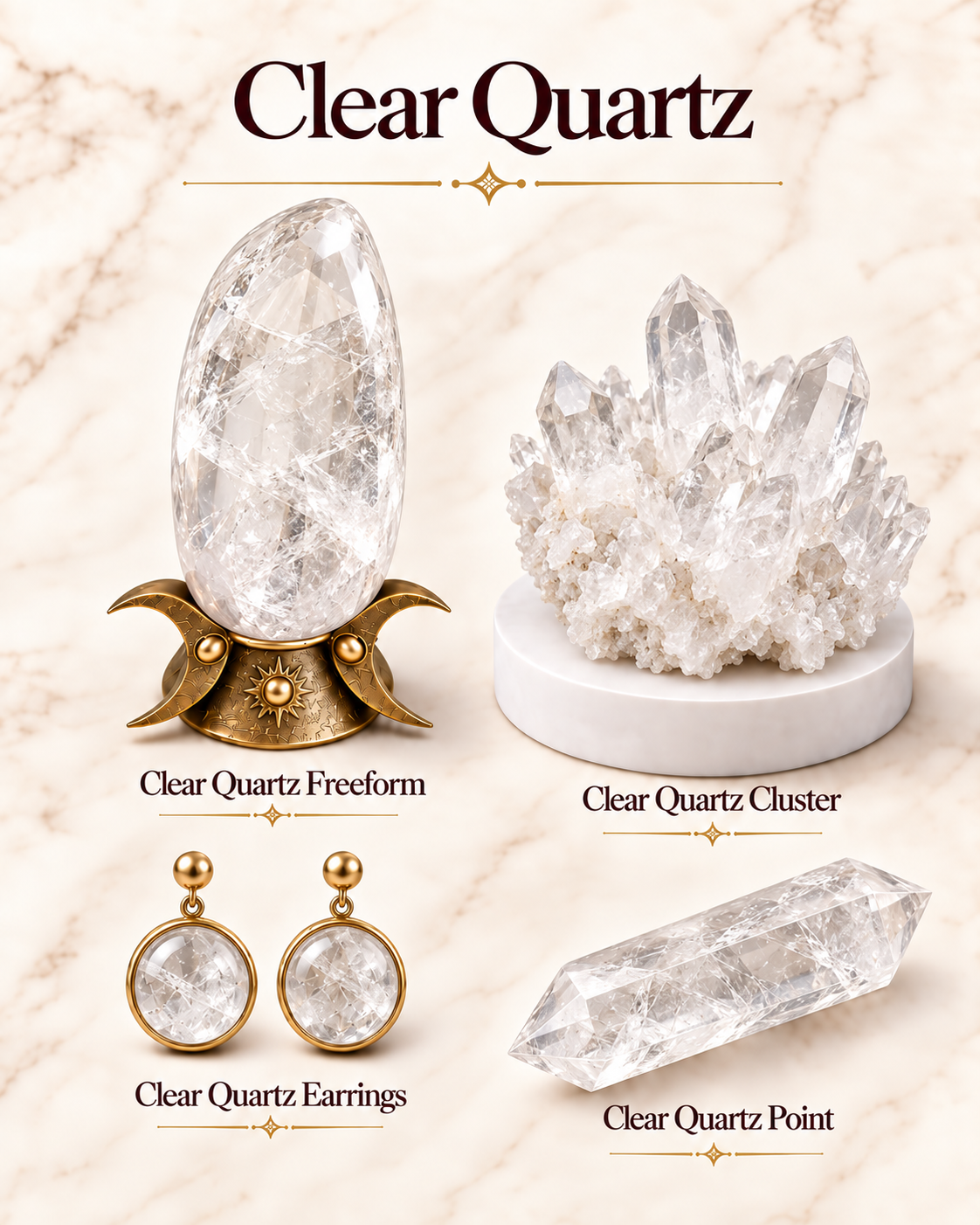
Clear Quartz is the colourless, transparent variety of quartz, prized for its glass-like clarity, distinctive crystal shapes and remarkable durability. From perfectly clear points to crystals filled with natural veils and inclusions, it is one of the most recognisable and widespread minerals on Earth.
CWExplore this passport
Showing Science & Formation
Scientific passport
The mineral facts
Observable and measurable properties used to describe and identify this mineral.
- Chemical formula
- SiO₂
- Mineral class
- Oxide — Silica; structurally a framework silicate (tectosilicate)
- Crystal system
- Trigonal
- Mohs hardness
- 7
- Lustre
- Vitreous
- Streak
- White
- Specific gravity
- 2.65–2.66
- Transparency
- Transparent to translucent
Common colours
Colourless and water-clear; may contain white or cloudy zones caused by microscopic inclusions, fractures or internal features
Cleavage and fracture
Poor to indistinct cleavage; typically conchoidal fracture
From the Earth
How it forms
The geological processes that create this crystal over time.
Formation
Its geological story
Quartz forms in many geological environments. Clear, well-formed crystals commonly grow when silica-rich fluids circulate through fractures and cavities in rocks and gradually cool, depositing quartz onto the cavity walls. Large crystals may also develop within granitic pegmatites, where slowly cooling magma and mineral-rich fluids provide space for crystal growth. Quartz is additionally common in igneous, metamorphic and sedimentary rocks and can survive weathering because of its hardness and chemical resistance. The familiar pointed Clear Quartz crystals form when the mineral has enough open space to develop its natural crystal faces rather than growing as an interlocking mass.
A closer look
Scientific notes
Quartz is crystalline silicon dioxide and one of the most widespread minerals in Earth's crust. Pure quartz is colourless; the many coloured quartz varieties arise from trace elements, structural defects or microscopic mineral inclusions. At normal surface temperatures, quartz occurs as alpha-quartz, which has trigonal symmetry. Although well-formed crystals frequently appear six-sided, this external habit reflects the arrangement of crystal faces rather than quartz being genuinely hexagonal in its room-temperature crystal structure. Quartz is optically uniaxial positive, with refractive indices of approximately 1.544 and 1.553 and birefringence of around 0.009. Quartz is also piezoelectric, meaning mechanical stress can generate an electrical charge within appropriately oriented crystals, while an applied electrical field can cause controlled vibration. This behaviour is why manufactured quartz components are widely used for precise timing and frequency control in electronics.
Passport stamps
Where in the world?
Important countries, regions and mineral localities connected with this crystal.
Brazil
Corinto and wider Minas Gerais quartz localities
Minas Gerais
Minas Gerais is one of the world’s best-known quartz-producing regions and has produced huge numbers of clear quartz crystals ranging from small points to impressive collector specimens. The region is especially important because Brazil helped establish quartz as one of the classic minerals of both the gem and specimen world.
United States
Ouachita Mountains
Arkansas
Arkansas is internationally famous for exceptionally clear quartz crystals, especially those found in the Ouachita Mountains. It is one of the best-known modern collecting regions for Rock Crystal and has become strongly associated with high-quality clear quartz points and clusters.
Switzerland
Alpine cleft localities
Swiss Alps
The Swiss Alps are a classic historic source of fine quartz crystals formed in alpine fissures. Quartz from these localities helped shape the long European tradition of crystal collecting and is strongly linked with the image of beautifully formed natural Rock Crystal.
United States
Herkimer County
New York
Herkimer County is famous for producing the exceptionally clear, naturally double-terminated quartz crystals commonly known as Herkimer Diamonds. Although they are quartz rather than diamond, they are among the most recognisable clear quartz forms in the world.
Madagascar
Tamboholehibe and other Madagascar quartz localities
Antananarivo Province
Madagascar has produced a wide range of important quartz specimens, including clear quartz crystals and clusters. It is an important modern specimen source and helps show how widespread and geologically varied clear quartz can be.
Crystal Detective
Look closely. Ask better questions.
Safe observations at home are separated from professional laboratory identification. No single home test can prove every specimen's identity or origin.
Safe checks at home
Look for Clear Quartz's glass-like lustre and, on natural well-formed crystals, its characteristic prismatic shape with pointed terminations. Crystal faces may also show fine natural growth lines. Examine the specimen under magnification. Natural Quartz may contain mineral inclusions, internal veils, healed fractures, liquid inclusions and irregular growth features. Completely flawless material is possible, so the absence of inclusions alone does not prove that a specimen is artificial. Quartz has a Mohs hardness of 7 and can scratch ordinary glass, but avoid scratch testing polished, valuable or collectible specimens because testing can damage either the specimen or the surface being tested. Broken Quartz characteristically develops curved, shell-like conchoidal fractures rather than strong cleavage planes. Visual observations are useful indicators but cannot reliably separate every natural crystal from high-quality synthetic Quartz or glass.
Professional methods
Professional identification can use refractive-index testing, specific-gravity measurement and polarised-light microscopy. Quartz has refractive indices around 1.544–1.553, a specific gravity of approximately 2.65 and characteristic optical behaviour that helps distinguish it from many imitations. Raman spectroscopy and X-ray diffraction can confirm crystalline quartz, while infrared spectroscopy, advanced microscopy and inclusion analysis can provide additional information. Natural and hydrothermally grown synthetic Quartz can share essentially the same fundamental chemical and physical properties, so determining natural versus synthetic origin may require specialist examination of internal growth structures, inclusions and other microscopic features.
Imitations and treatments
Clear Quartz may be imitated by glass, lead glass, resin and other transparent manufactured materials. Glass imitations can sometimes contain rounded gas bubbles, flow structures or a more uniform internal appearance than natural Quartz. Synthetic Quartz is also widely manufactured using hydrothermal growth techniques. Because synthetic Quartz has the same basic chemical composition and crystal structure as natural Quartz, simple home tests may not reliably distinguish the two. Some Quartz is deliberately heated and rapidly cooled to create networks of internal fractures and sold as crackle quartz or cracked quartz. These fractures may then be dyed. So-called Aura Quartz is natural or synthetic Quartz that has been given a thin metallic surface coating to create an artificial rainbow or metallic appearance. It should be described as coated material rather than untreated Clear Quartz. Quartz may also undergo irradiation or heating to create or alter colours in other quartz varieties. Any significant treatment should be disclosed when known.
The Mythical Library
Stories carried through time
Folklore can be enjoyed without confusing it with evidence. Where a popular tale is a later retelling, the passport says so.
The Mythical Library
Choose a book to enter the full-screen reader.
Beliefs, traditions and cultural context
What people have believed
Beliefs, traditions and cultural context Clear Quartz has a genuinely long history of human fascination. The ancient Greek word krystallos was associated with ice, and classical tradition held that transparent Quartz was water or ice that had frozen so completely that it could never melt. This ancient idea survives in the modern word crystal and in the traditional name Rock Crystal. Across different periods, transparent Quartz has been carved into ornaments, vessels, beads, seals and decorative objects. Because exceptionally clear material resembles frozen water or glass while remaining a natural stone, it has repeatedly attracted symbolic and mystical interpretations. In contemporary crystal spirituality, Clear Quartz is commonly described as a stone associated with clarity, intention, meditation, energy amplification and spiritual awareness. It is sometimes called a “Master Healer” within modern crystal literature and may be linked with all chakras, particularly the Crown Chakra. Those modern spiritual interpretations are part of contemporary crystal belief and practice. They are not scientifically demonstrated medical or therapeutic properties, and the Forever SnS Crystal Passport should treat them separately from the mineralogical and historical facts.
Handle thoughtfully
Safety notes
Intact Clear Quartz specimens are generally safe for normal handling. The important safety issue arises when Quartz is cut, drilled, ground, sanded or crushed. These activities can create respirable crystalline silica dust. Repeated or significant inhalation of this extremely fine dust can cause serious occupational diseases including silicosis and is associated with increased risks of lung cancer and other respiratory disease. Lapidary work should therefore use wet-working techniques or suitable dust extraction together with appropriate respiratory and eye protection. Broken Quartz can also produce very sharp edges. Small or damaged specimens should be kept away from young children and pets where cuts, choking or ingestion could occur.
Keep it beautiful
Care and cleaning
Clear Quartz is comparatively durable, with a Mohs hardness of 7, and normally requires little special care. Dust can be removed using a soft brush or cloth. For general cleaning, use lukewarm water, mild soap and a soft brush, then rinse thoroughly and dry. Avoid severe impacts because Quartz is brittle and may chip or fracture despite its hardness. Sudden temperature changes should also be avoided, particularly for specimens containing internal fractures or inclusions. Heavily fractured, included, coated or repaired specimens should not automatically be placed in ultrasonic or steam cleaners because vibration or heat may worsen existing weaknesses or damage treatments. Store particularly fine crystal points so their terminations cannot strike harder minerals or surfaces. Quartz itself is chemically stable under ordinary collecting and display conditions.
Follow the evidence
Sources and further reading
We show the references used while researching this passport so visitors can check important claims and continue learning.
- 1
Overview
All Sorts of Quartz
Smithsonian National Museum of Natural History · Smithsonian Institution
Used for the general overview of quartz, including the fact that quartz is one of the most abundant minerals in Earth’s crust, that pure quartz is colourless, that it has many uses, and that the ancient Greeks called quartz “krystallos,” meaning ice.
Checked 11 Sept 2026
- 2
Science
Quartz
John W. Anthony, Richard A. Bideaux, Kenneth W. Bladh and Monte C. Nichols · Mineral Data Publishing / Handbook of Mineralogy · 2001
Primary mineralogical reference used for Clear Quartz chemical formula, crystal system, hardness, specific gravity, transparency, streak, lustre, cleavage, fracture, optical data and geological occurrence.
Checked 11 Sept 2026
- 3
Science
Quartz: Mineral information, data and localities
Mindat.org contributors · Mindat.org / Hudson Institute of Mineralogy
Used to support Quartz classification, nomenclature, occurrence, optical properties, piezoelectric behaviour and general distribution. Also helpful for historical naming context and locality cross-checking.
Checked 11 Sept 2026
- 4
Localities
All Sorts of Quartz
Smithsonian National Museum of Natural History · Smithsonian Institution
Used to support the Arkansas/Ouachita Mountains locality information and the wider discussion of quartz’s importance as a common and highly varied mineral.
Checked 11 Sept 2026
- 5
Localities
Quartz
John W. Anthony, Richard A. Bideaux, Kenneth W. Bladh and Monte C. Nichols · Mineral Data Publishing / Handbook of Mineralogy · 2001
Used for classic quartz locality support, including Switzerland, Austria, Italy, France, Russia, Myanmar, Japan, Madagascar, Brazil and other well-known quartz-producing regions.
Checked 11 Sept 2026
- 6
Home identification
Quartz: Mineral information, data and localities
Mindat.org contributors · Mindat.org / Hudson Institute of Mineralogy
Used for practical identification details such as crystal habit, transparency, conchoidal fracture, hardness and the fact that home observation cannot always distinguish natural quartz from synthetic material.
Checked 11 Sept 2026
- 7
Laboratory identification
Quartz
John W. Anthony, Richard A. Bideaux, Kenneth W. Bladh and Monte C. Nichols · Mineral Data Publishing / Handbook of Mineralogy · 2001
Used for lab-style mineral data including refractive index, optical class, density, structural information and other technical quartz properties that support the more scientific side of the passport.
Checked 11 Sept 2026
- 8
Fakes and treatments
An Introduction to Gem Treatments
Robert Weldon · Gemological Institute of America
Used for the general treatment and disclosure section. Supports the point that gemstones may be treated to alter appearance and that such treatments should be disclosed. Relevant for coated “aura quartz,” dyed crackle quartz and other altered quartz material.
Checked 11 Sept 2026
- 9
Myths and folklore
Forever SnS Mythical Library — Original Clear Quartz Folklore
Forever SnS · Forever SnS Ltd · 2026
The Stone That Was Once Ice and The Heart of the Mountain Window are original contemporary folklore created for the Forever SnS Mythical Library. They are inspired by real historical ideas about quartz and by its natural formation, but they are not presented as genuine ancient legends or documented traditional folklore.
Checked 11 Sept 2026
- 10
Beliefs and traditions
The Crystal Bible Volume 1
Judy Hall · Godsfield Press / Hachette UK · 2003
Used only as a source for contemporary crystal spirituality and modern metaphysical interpretations of Clear Quartz. It documents beliefs and traditions rather than providing scientific or medical evidence.
Checked 11 Sept 2026
- 11
Safety and care
Crystalline Silica
Occupational Safety and Health Administration · U.S. Department of Labor — OSHA
Used specifically for the warning that cutting, drilling, grinding or crushing quartz can create respirable crystalline silica dust, which is hazardous when inhaled. This source supports the safety warning section rather than ordinary handling of intact specimens.
Checked 11 Sept 2026
From the Forever SnS collection
Shop products featuring Clear Quartz
Each listing shows the actual product details, photographs and current availability.
Passport complete