Meet the crystal

Forever SnS Crystal Passport
Celestite
Pronounced: SELL-uh-styte
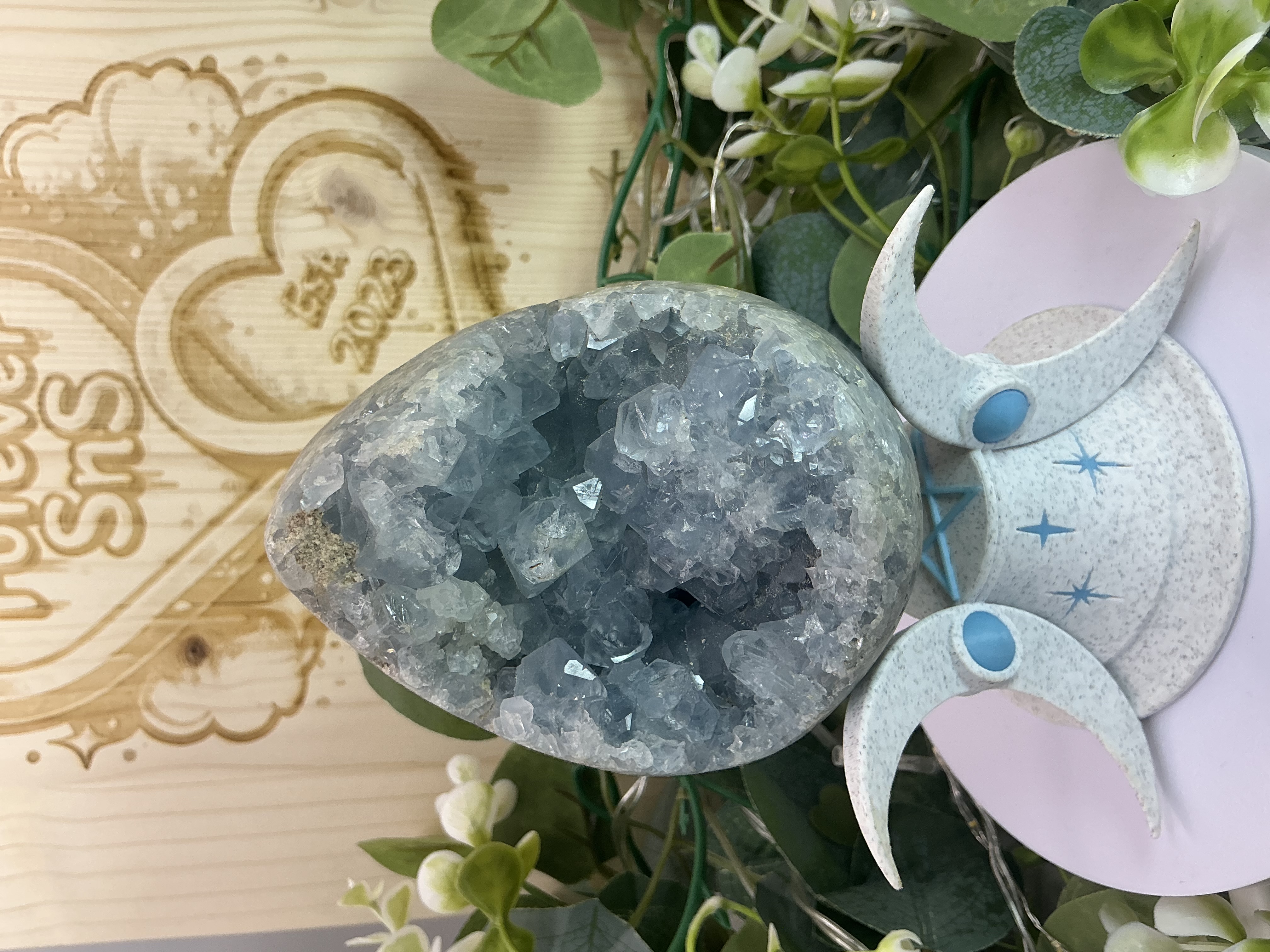
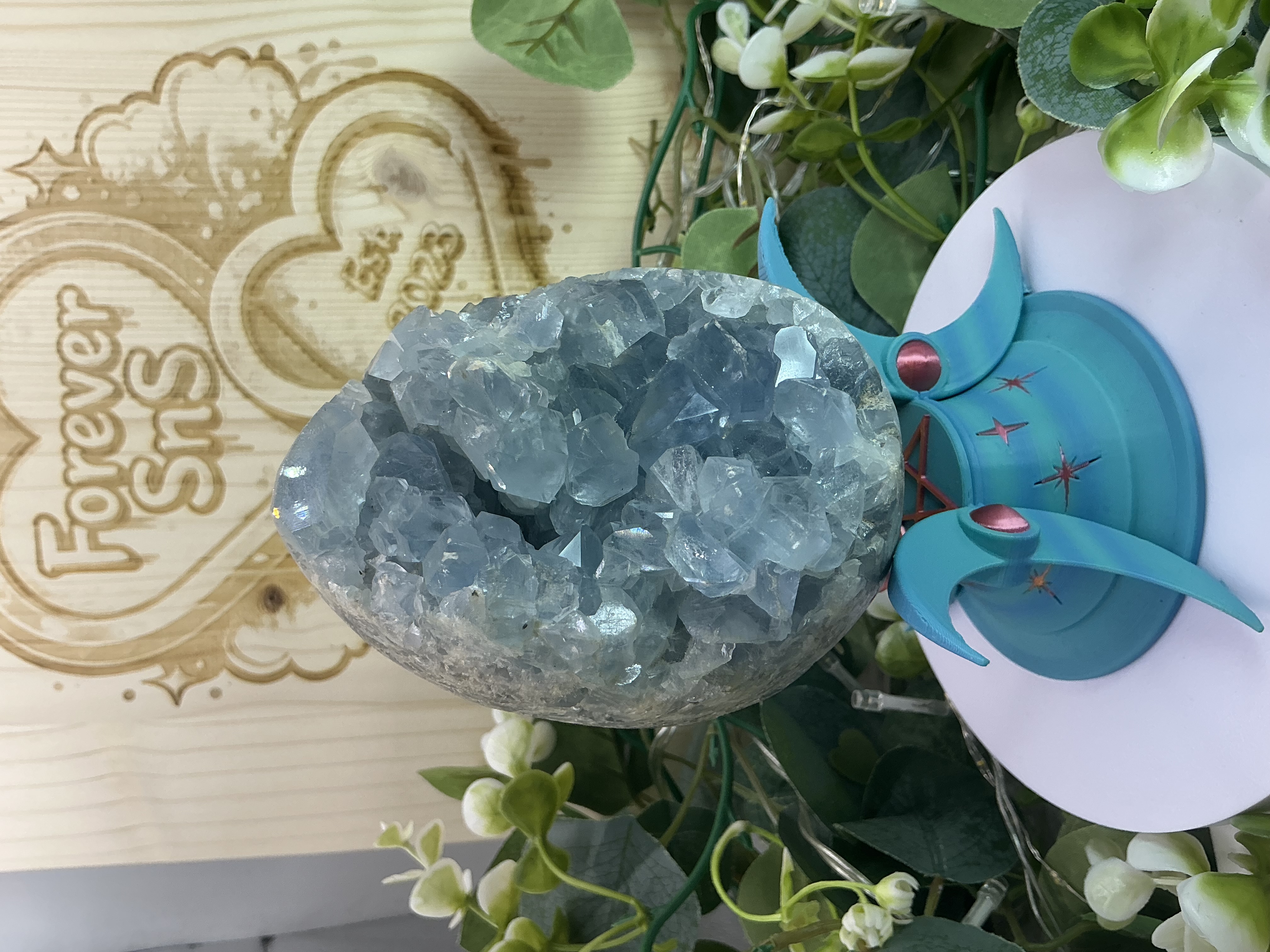
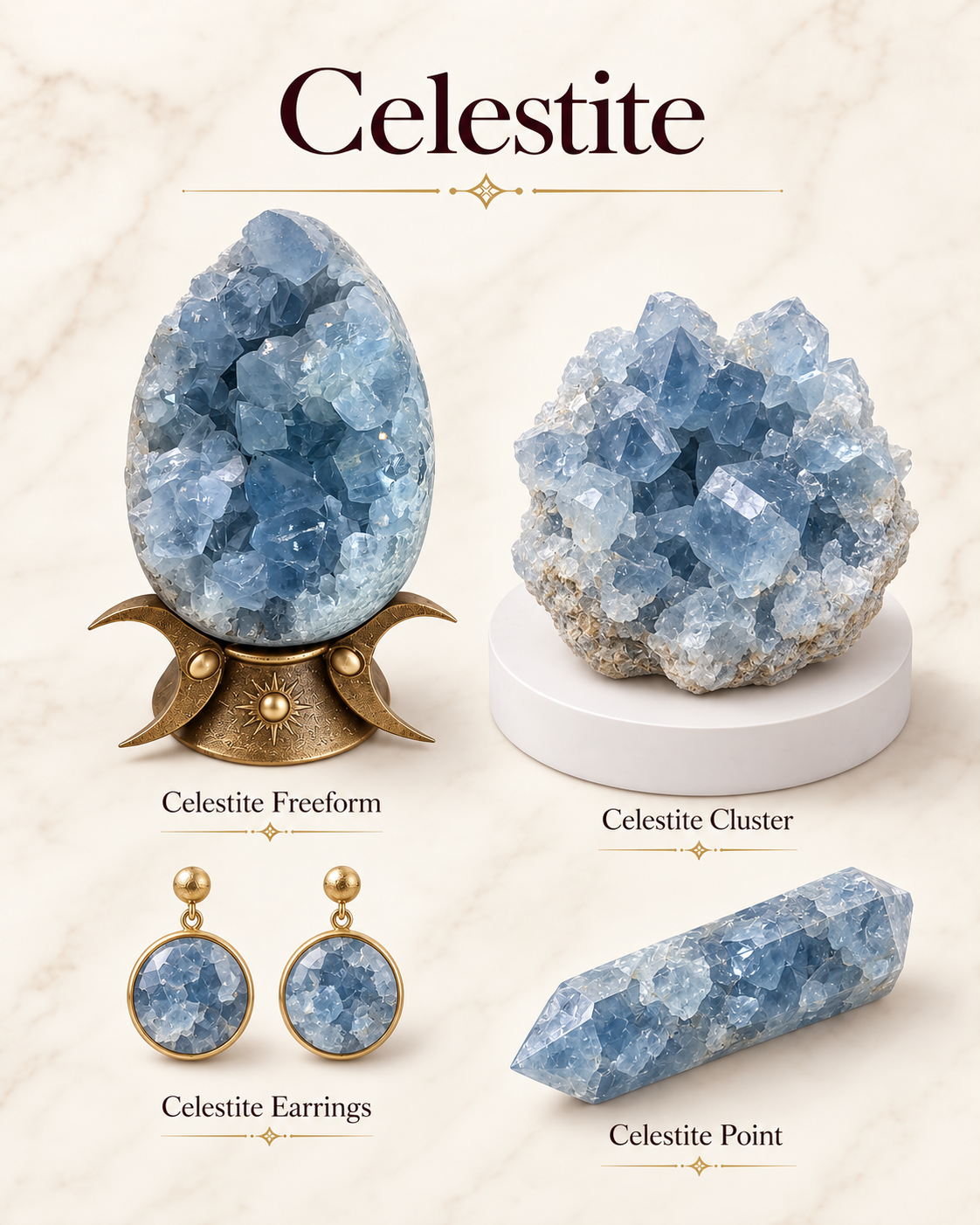
Celestite is a beautiful, delicate mineral best known for its soft sky-blue crystals and striking crystal clusters. Its heavenly colouring and elegant formations make it a popular choice with collectors and crystal enthusiasts.
CWExplore this passport
Showing Science & Formation
Scientific passport
The mineral facts
Observable and measurable properties used to describe and identify this mineral.
- Chemical formula
- SrSO₄
- Mineral class
- Sulfate
- Crystal system
- Orthorhombic
- Mohs hardness
- 3–3.5
- Lustre
- Vitreous to pearly
- Streak
- White
- Specific gravity
- 3.96–3.98
- Transparency
- Transparent to translucent
Common colours
Pale blue, colourless, white, grey, greenish, reddish, brownish
Cleavage and fracture
Perfect cleavage in one direction, good cleavage in another; uneven to irregular fracture
From the Earth
How it forms
The geological processes that create this crystal over time.
Formation
Its geological story
Celestite most commonly forms in sedimentary environments, especially in limestone, dolostone and evaporite deposits. Strontium-rich groundwater or mineral-bearing fluids react with sulfate-rich waters, allowing Celestite crystals to grow within cavities, veins, geodes and nodules. It may also occur as a secondary mineral where existing rocks have been altered by mineral-rich fluids.
A closer look
Scientific notes
Celestite is a strontium sulfate mineral with the chemical formula SrSO₄ and belongs to the baryte mineral group. Its characteristic pale-blue colour can vary considerably, with specimens also occurring colourless, white, grey, greenish, reddish or brownish. Celestite has a relatively high specific gravity for a light-coloured mineral because of its strontium content. It is comparatively soft and brittle, with strong cleavage, meaning well-formed crystals can be easily damaged. Celestite is also an important natural source of strontium, which has a range of industrial uses.
Passport stamps
Where in the world?
Important countries, regions and mineral localities connected with this crystal.
Madagascar
Sakoany Deposit
Boeny Region
Sakoany is one of the world’s best-known sources of Celestite, famous for producing spectacular pale-blue crystal clusters and geodes with excellent colour and clarity.
United States
Crystal Cave, South Bass Island
Ohio
Crystal Cave is famous for an enormous Celestite-lined cavity discovered during limestone quarrying, making it one of the most notable Celestite localities in North America.
United States
Bell’s Mill, Blair County
Pennsylvania
This is historically significant because Celestite was first described from material associated with this locality, making it important in the mineral’s scientific history.
Italy
Sicilian sulfur-mining districts
Sicily
Sicily has produced notable Celestite specimens from sulfur-bearing sedimentary deposits and is an important classic European locality for the mineral.
Spain
Various sedimentary deposits
Andalusia
Spain contains several significant Celestite-bearing sedimentary deposits and has historically contributed both collector specimens and strontium ore.
Crystal Detective
Look closely. Ask better questions.
Safe observations at home are separated from professional laboratory identification. No single home test can prove every specimen's identity or origin.
Safe checks at home
Look for Celestite’s typically pale sky-blue to colourless appearance, transparent to translucent crystals, vitreous to pearly lustre and relatively heavy feel for its size. Crystals are often tabular or prismatic and may occur in geodes or clusters. Celestite is quite soft and brittle, so avoid scratch tests or any destructive testing. Use a magnifying glass to inspect natural crystal faces, cleavage and inclusions. Colour alone is not enough for a definite identification.
Professional methods
Professional identification may use refractive index measurement, specific gravity testing, polarised-light microscopy and spectroscopy. X-ray diffraction (XRD) can confirm the crystal structure, while X-ray fluorescence (XRF) or similar elemental analysis can detect its high strontium content. Raman spectroscopy may also be used for non-destructive confirmation. Laboratory testing is recommended where positive identification is important or when distinguishing Celestite from visually similar minerals.
Imitations and treatments
Celestite is not commonly treated, although pale specimens may occasionally be confused with or sold alongside other blue minerals such as Blue Calcite, Angelite or dyed material. Artificial glass and dyed quartz may also imitate its colour. Warning signs can include unusually vivid or uniform blue colour, dye collecting in cracks, bubbles within glass, or a hardness and weight that do not match natural Celestite. Positive identification may require laboratory testing.
The Mythical Library
Stories carried through time
Folklore can be enjoyed without confusing it with evidence. Where a popular tale is a later retelling, the passport says so.
The Mythical Library
Choose a book to enter the full-screen reader.
Beliefs, traditions and cultural context
What people have believed
Celestite’s spiritual associations are largely modern rather than ancient. Its name comes from the Latin caelestis, meaning “heavenly” or “celestial”, inspired by its pale sky-blue colour. In contemporary crystal and New Age traditions, Celestite is commonly associated with peace, calm communication, meditation, intuition and celestial or angelic symbolism. It is often linked with the Throat, Third Eye and Crown chakras. These interpretations are part of modern spiritual practice and crystal folklore rather than scientifically established properties or well-documented ancient traditions.
Handle thoughtfully
Safety notes
Celestite is relatively soft and brittle and can chip or break easily, producing sharp fragments. Avoid dropping, crushing, cutting or grinding specimens unnecessarily. Mineral dust should not be inhaled or ingested. Wash hands after handling dusty or damaged material and keep small pieces away from young children and pets.
Keep it beautiful
Care and cleaning
Handle Celestite gently and store it separately from harder minerals to prevent scratching or damage to crystal points. Remove dust with a soft, dry brush or microfiber cloth. Avoid prolonged soaking, harsh chemicals, abrasive cleaners, ultrasonic cleaners and steam cleaning. If light cleaning is necessary, use a slightly damp cloth and dry the specimen carefully afterwards.
Follow the evidence
Sources and further reading
We show the references used while researching this passport so visitors can check important claims and continue learning.
- 1
Overview
Celestine: Mineral information, data and localities
Mindat.org contributors · Mindat.org
Primary mineralogical reference used for Celestine/Celestite identification, chemical formula, colour, lustre, Mohs hardness, specific gravity, crystal system, transparency, streak, cleavage, fracture, mineral group, naming history and type locality. Mindat recognises Celestite as a synonym of the valid mineral species Celestine.
Checked 8 Sept 2026
- 2
Science
Handbook of Mineralogy — Celestine
John W. Anthony, Richard A. Bideaux, Kenneth W. Bladh and Monte C. Nichols · Mineral Data Publishing / Mineralogical Society of America · 2003
Authoritative mineralogical reference used to cross-check Celestine’s composition, crystallography and physical properties. Celestine appears in Volume 5, Borates, Carbonates, Sulfates, page 122.
Checked 8 Sept 2026
- 3
Science
Strontium Statistics and Information
National Minerals Information Center · U.S. Geological Survey
Used for geological and economic context. The USGS identifies Celestite as strontium sulfate and one of the principal naturally occurring minerals from which strontium can be economically recovered. It also notes that economically significant Celestite commonly occurs in sedimentary deposits.
Checked 8 Sept 2026
- 4
Localities
Sakoany deposit, Katsepy Commune, Mitsinjo District, Boeny, Madagascar
Mindat.org contributors · Mindat.org
Used for the Madagascar locality information. Sakoany is a famous Celestine locality known for producing large quantities of high-quality blue crystal clusters and geodes. The source also documents the geology of the Celestine-bearing layer and the history of extraction at the deposit.
- 5
Localities
Crystal Cave, South Bass Island, Put-In-Bay Township, Ohio, USA
Mindat.org contributors · Mindat.org
Supports the Crystal Cave locality entry and confirms Celestine as one of the minerals occurring there. Historical geological sources describe the cave as an exceptional Celestite occurrence on South Bass Island, with large blue crystals lining the cavity.
Checked 8 Sept 2026
- 6
Fakes and treatments
Strontium sulfate — PubChem Compound Summary
National Center for Biotechnology Information · U.S. National Library of Medicine / PubChem
Used to verify the chemistry and safety information relating to strontium sulfate, including formula, density, very low water solubility and hazard information. PubChem reports that strontium sulfate is generally not classified under GHS hazard criteria, while also recommending prevention of mineral dust inhalation and noting potential mechanical irritation from airborne particles.
Checked 8 Sept 2026
- 7
Myths and folklore
Forever SnS Mythical Library — Original Celestite Folklore
Forever SnS · Forever SnS Ltd · 2026
The Stone That Held the Morning Sky and The Bell Beneath the Earth are original contemporary folklore stories created for the Forever SnS Mythical Library. They are inspired by Celestite’s appearance, name and natural formation but are not presented as historical legends, ancient traditions or documented cultural folklore.
Checked 8 Sept 2026
- 8
Beliefs and traditions
The Crystal Bible Volume 1
Judy Hall · Godsfield Press / Hachette UK · 2003
Reference for contemporary crystal lore and metaphysical interpretations only. Used to document beliefs associated with Celestite rather than to support scientific or medical claims. The publisher describes the work as covering both practical and esoteric properties and contemporary crystal lore.
Checked 8 Sept 2026
From the Forever SnS collection
Shop products featuring Celestite
Each listing shows the actual product details, photographs and current availability.
Passport complete