Meet the crystal

Forever SnS Crystal Passport
Black Moonstone
Pronounced: BLAK MOON-stohn
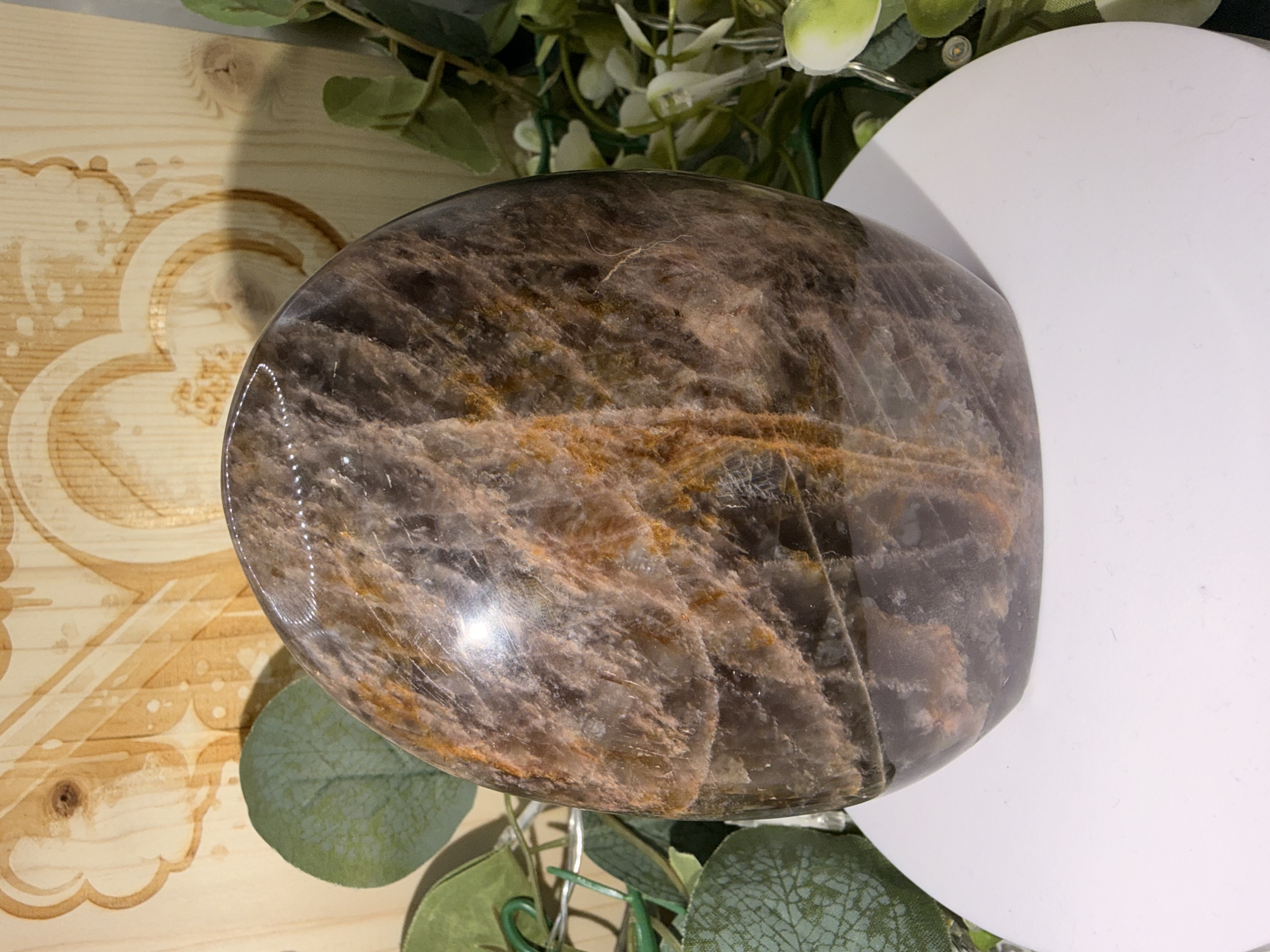
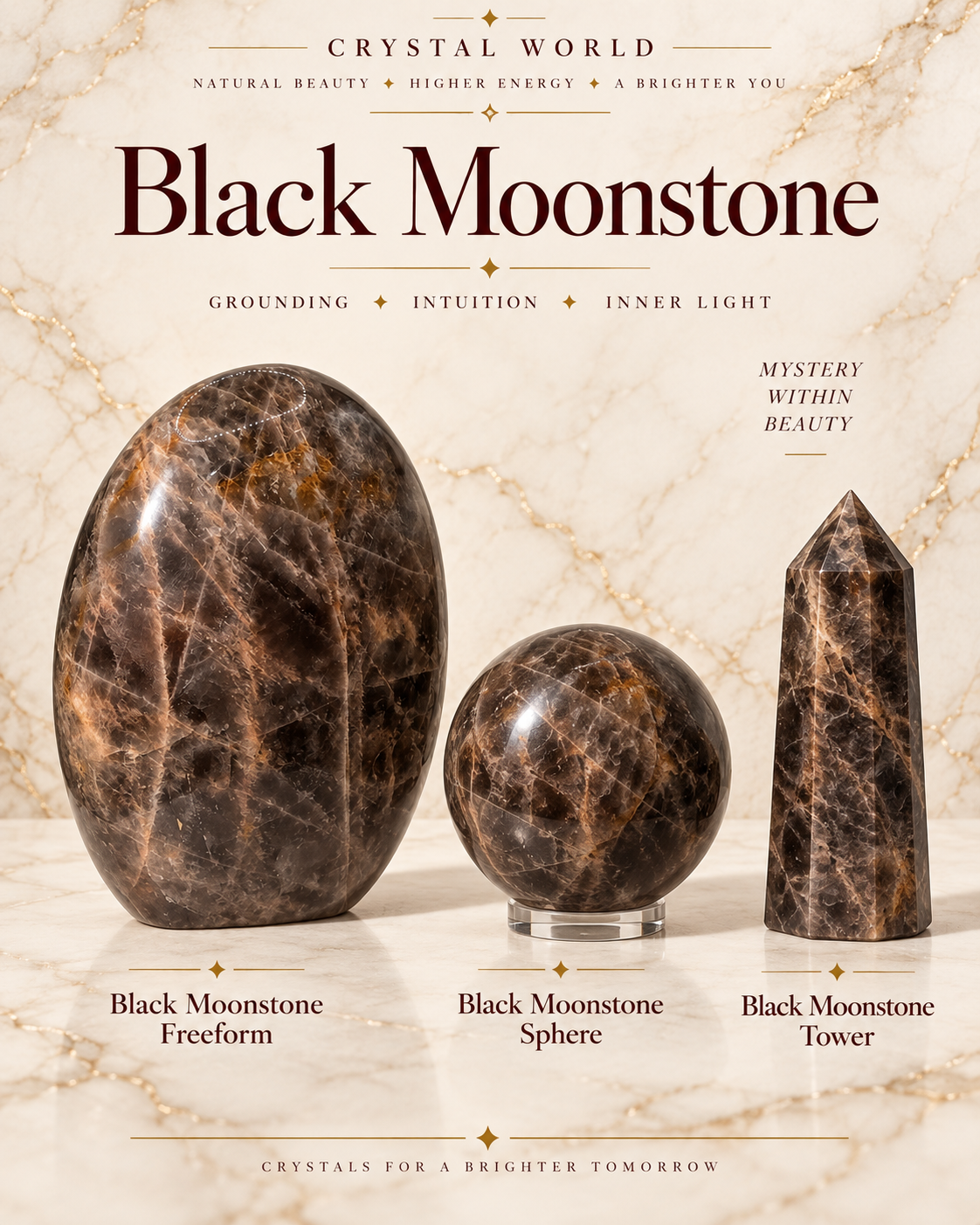
Black Moonstone is a dark-coloured feldspar material valued for its soft silvery, blue, peach or cream flashes of adularescence. Its dramatic contrast between a dark body colour and floating internal sheen gives it a distinctive appearance among moonstone varieties.
CWExplore this passport
Showing Science & Formation
Scientific passport
The mineral facts
Observable and measurable properties used to describe and identify this mineral.
- Chemical formula
- Approximately (K,Na)AlSi₃O₈ — feldspar composition varies between specimens
- Mineral class
- Silicate — Feldspar
- Crystal system
- Typically monoclinic in orthoclase/adularia-rich material; microscopic albite components may be tric
- Mohs hardness
- 6–6.5
- Lustre
- Vitreous to pearly
- Streak
- White
- Specific gravity
- Approximately 2.56–2.63
- Transparency
- Translucent to opaque, occasionally transparent in thin areas
Common colours
Black, charcoal grey, dark grey, brownish grey and smoky brown, often displaying silver, white, blue, cream or peach adularescence
Cleavage and fracture
Perfect cleavage in two directions meeting at approximately 90°; uneven to subconchoidal fracture
From the Earth
How it forms
The geological processes that create this crystal over time.
Formation
Its geological story
Black Moonstone forms as feldspar crystallises from silica-rich magma, particularly in granitic and pegmatitic geological environments. During slow cooling, different feldspar components can separate on a microscopic scale into extremely fine internal layers or lamellae. When these layers are sufficiently fine and properly oriented, incoming light is scattered between them and produces the characteristic floating sheen known as adularescence. The dark body colour may result from the specimen’s mineral composition, microscopic inclusions and internal structural features.
A closer look
Scientific notes
Black Moonstone is a trade variety of feldspar, not an officially recognised mineral species. Traditional moonstone is generally associated with feldspar containing intergrown potassium-rich and sodium-rich phases. As the material cools, microscopic exsolution layers form between feldspar components. Light interacting with these layers produces adularescence — the soft, mobile glow that appears to float beneath the surface as the stone is moved. The exact composition of material sold as Black Moonstone can vary, which means it is safer scientifically to describe it as dark adularescent feldspar rather than assign every specimen to one precise mineral species without laboratory analysis. This is also why Black Moonstone should not automatically be confused with Rainbow Moonstone, which is commonly a white variety of labradorite rather than traditional orthoclase-type moonstone.
Passport stamps
Where in the world?
Important countries, regions and mineral localities connected with this crystal.
Madagascar
Commercial feldspar deposits — exact mine often unrecorded in the retail trade
Central and southern Madagascar
Madagascar is the principal modern commercial source associated with material sold as Black Moonstone. Dark feldspar from the island can show silver, blue or pale internal flashes and is widely cut into freeforms, towers, spheres and palm stones. Because “Black Moonstone” is a trade name rather than a formally defined mineral species, the precise feldspar composition may vary between deposits and individual specimens. One analysed Madagascar specimen sold under this name was identified by X-ray diffraction and EDS as microcline, illustrating the importance of treating the name as commercial rather than chemically exact.
Tanzania
Commercial feldspar deposits
Various feldspar-producing areas
Tanzania produces several unusual adularescent and iridescent feldspars. Dark feldspar containing reflective inclusions has sometimes entered the gemstone trade under names such as Black Moonstone or Black Rainbow Moonstone. This material should not automatically be assumed to be identical to Madagascar Black Moonstone, making Tanzania a useful example of why trade names require careful mineral identification. Tanzania also has documented commercial production of moonstone-type feldspar.
India
Commercial moonstone deposits
Various feldspar-producing regions
India is an important historic and modern source of moonstone and other adularescent feldspars. Grey and dark feldspar material may sometimes be marketed as Black Moonstone, although the precise composition and terminology can vary considerably between sellers. India is therefore relevant to the wider moonstone trade, but individual Black Moonstone specimens should not be assigned an Indian origin without reliable supplier documentation. GIA records moonstone occurring in several body colours including grey and brown.
Sri Lanka
Traditional moonstone and feldspar deposits
Gem-bearing districts
Sri Lanka has a long-established reputation for high-quality moonstone and gem feldspar. Although the country is much better known for pale and blue-sheen moonstone than the modern commercial material called Black Moonstone, dark and grey feldspars occur within the broader moonstone trade. Sri Lanka is therefore best presented as a historically significant moonstone source rather than a definitive source of all material sold specifically as Black Moonstone.
Crystal Detective
Look closely. Ask better questions.
Safe observations at home are separated from professional laboratory identification. No single home test can prove every specimen's identity or origin.
Safe checks at home
Move the stone slowly beneath a bright single light source. Genuine Black Moonstone should show an internal-looking sheen that appears, disappears or moves as the viewing angle changes. Look for natural feldspar features such as colour zoning, internal fractures, mineral inclusions and variations in opacity. The flash should normally appear to originate from within the material rather than behaving like a rainbow coating sitting directly on the surface. Black Moonstone commonly has a dark grey, brownish or charcoal body colour rather than perfectly uniform jet black. Avoid scratch testing finished specimens because feldspar has good cleavage and may chip even though its Mohs hardness is around 6–6.5.
Professional methods
Professional identification may include refractive-index measurement, specific-gravity testing, polarised-light microscopy and microscopic examination of feldspar structures. X-ray diffraction can determine which feldspar minerals are present, while Raman spectroscopy can help identify mineral phases non-destructively. Electron microscopy or chemical analysis such as SEM-EDS or electron microprobe analysis can examine sodium, potassium, calcium and other elemental components and help determine the specimen’s position within the feldspar family. Optical microscopy can also reveal twinning, exsolution lamellae and other internal structures responsible for adularescence.
Imitations and treatments
Black Moonstone may be confused with Labradorite, Larvikite, dark feldspar, dyed stones, coated material or manufactured glass. Glass imitations may contain rounded gas bubbles, flow marks or unusually uniform colour and may lack the natural internal structures expected in feldspar. Some marketed material may be artificially darkened, dyed or coated to increase contrast or produce a stronger visual effect. A surface coating tends to produce colour directly at the exterior of the stone, whereas genuine adularescence appears to move beneath the surface. Because “Black Moonstone” is a trade term rather than a mineral species, incorrect labelling is also possible. Laboratory testing is the most reliable way to determine the exact feldspar composition.
The Mythical Library
Stories carried through time
Folklore can be enjoyed without confusing it with evidence. Where a popular tale is a later retelling, the passport says so.
The Mythical Library
Choose a book to enter the full-screen reader.
Beliefs, traditions and cultural context
What people have believed
Moonstone as a broader gemstone has a long history of symbolism connected with the Moon, changing light and lunar cycles. However, Black Moonstone as a specifically named variety is largely a modern commercial and crystal-spiritual category, and claims about ancient cultures using “Black Moonstone” specifically should be treated cautiously. Contemporary crystal traditions commonly associate Black Moonstone with intuition, new beginnings, reflection, protection, emotional awareness and working through periods of change. Modern spiritual practitioners may connect it with the Crown, Third Eye or Root chakras, depending on the tradition, and sometimes use it symbolically during meditation or lunar practices. Its dark body colour combined with a shifting internal glow has also encouraged modern symbolism involving hidden potential, inner knowledge and finding light within darkness. These are modern spiritual beliefs and symbolic interpretations, not scientifically established physical, psychological or medical effects.
Handle thoughtfully
Safety notes
Finished Black Moonstone is generally safe for normal handling. Feldspar is brittle and possesses strong cleavage, so pieces can chip or split if struck or dropped. Cutting, grinding or drilling feldspar can generate fine mineral and silicate dust. Avoid inhaling this dust and use appropriate respiratory protection, eye protection, wet-working methods and dust extraction during lapidary work. Broken pieces may develop sharp edges, and small specimens should be kept away from young children and pets where choking or ingestion could occur.
Keep it beautiful
Care and cleaning
Clean Black Moonstone gently using lukewarm water, mild soap and a soft cloth or brush, then dry thoroughly. Avoid harsh chemicals, abrasive cleaners and sudden temperature changes. Ultrasonic and steam cleaners are best avoided because natural fractures and feldspar cleavage can make specimens vulnerable to damage. Store separately from harder minerals such as quartz, topaz and corundum to prevent scratching. Avoid hard knocks, especially around carved points, towers and thin edges.
Follow the evidence
Sources and further reading
We show the references used while researching this passport so visitors can check important claims and continue learning.
- 1
Overview
Black Moonstone
Mindat.org contributors · Mindat.org / Hudson Institute of Mineralogy
Used to clarify the mineralogical naming issue surrounding Black Moonstone. Mindat treats Black Moonstone as a synonym associated with Labradorite rather than recognising it as a separate mineral species. This supports the Passport’s decision to describe Black Moonstone as a trade name and avoid assigning every specimen one universal chemical composition.
Checked 13 Sept 2026
- 2
Science
Moonstone
Gemological Institute of America · Gemological Institute of America (GIA)
Primary gemological reference for moonstone and adularescent feldspar. Used for feldspar classification, hardness, specific gravity, common body colours and the optical phenomenon of adularescence. GIA explains that traditional moonstone involves microscopic feldspar layers and also notes that feldspars other than orthoclase can show the same phenomenon.
Checked 13 Sept 2026
- 3
Localities
Analysis Black Moonstone
Stapel van Stenen · Stapel van Stenen mineral analysis project · 2025
Supports Madagascar as a documented source for material specifically sold under the Black Moonstone trade name. The analysed rough specimen was explicitly recorded as originating from Madagascar.
Checked 13 Sept 2026
- 4
Home identification
Moonstone Buyer's Guide
Gemological Institute of America · Gemological Institute of America (GIA)
Used for visual identification principles including body colour, clarity and moving adularescence. GIA records moonstone in grey and brown as well as pale colours and explains that the sheen should move as the viewing angle changes.
Checked 13 Sept 2026
- 5
Laboratory identification
Moonstone Description
Gemological Institute of America · Gemological Institute of America (GIA)
Used for the scientific explanation of adularescence and the complexities of the moonstone trade name. GIA explains that light scattering through microscopic feldspar structures creates the moving glow and confirms that labradorite and sanidine can also produce moonstone-like adularescence.
Checked 13 Sept 2026
- 6
Laboratory identification
Analysis Black Moonstone
Stapel van Stenen · Stapel van Stenen mineral analysis project · 2025
Useful case study of a specimen sold as Black Moonstone from Madagascar. Testing included Raman spectroscopy, EDX/EDS and X-ray diffraction, with the analysed sample identified as microcline feldspar. This does not prove that every Black Moonstone is microcline; instead, it demonstrates why the commercial name cannot safely be treated as one precisely defined mineral species.
Checked 13 Sept 2026
- 7
Fakes and treatments
Imitation Rainbow Moonstone Assemblage
Amy Cooper, Nathan Renfro and Tara Allen · Gems & Gemology / Gemological Institute of America · 2013
Used to demonstrate that convincing moonstone imitations and assembled materials exist. GIA documented an imitation constructed from quartz, gypsum, coatings, cement and plastic that visually reproduced an iridescent moonstone appearance. This supports the Passport’s recommendation to rely on professional testing where authenticity is important.
Checked 13 Sept 2026
- 8
Myths and folklore
Forever SnS Mythical Library — Original Black Moonstone Folklore
Forever SnS · Forever SnS Ltd · 2026
The Moon That Hid Its Light and The Door Between Two Nights are original contemporary folklore created for the Forever SnS Mythical Library. They draw inspiration from Black Moonstone's dark appearance, feldspar optical phenomena and modern lunar symbolism but are not presented as ancient mythology, inherited cultural tradition or historical folklore.
Checked 13 Sept 2026
- 9
Beliefs and traditions
The Crystal Bible Volume 1
Judy Hall · Godsfield Press / Hachette UK · 2003
Used only as background for contemporary crystal spirituality and modern metaphysical traditions surrounding moonstone and related crystal practices. These beliefs are documented as cultural or spiritual interpretations rather than scientific, psychological or medical effects.
Checked 13 Sept 2026
- 10
Safety and care
Moonstone Care and Cleaning Guide
Gemological Institute of America · Gemological Institute of America (GIA)
Used for hardness, durability and cleaning guidance. GIA gives moonstone a Mohs hardness of 6–6.5, notes its two cleavage directions and poor toughness, warns against high heat and sudden temperature change, and recommends warm soapy water rather than ultrasonic or steam cleaning.
Checked 13 Sept 2026
From the Forever SnS collection
Shop products featuring Black Moonstone
Each listing shows the actual product details, photographs and current availability.
Passport complete