Meet the crystal

Forever SnS Crystal Passport
Aragonite
Pronounced: uh-RAG-uh-night
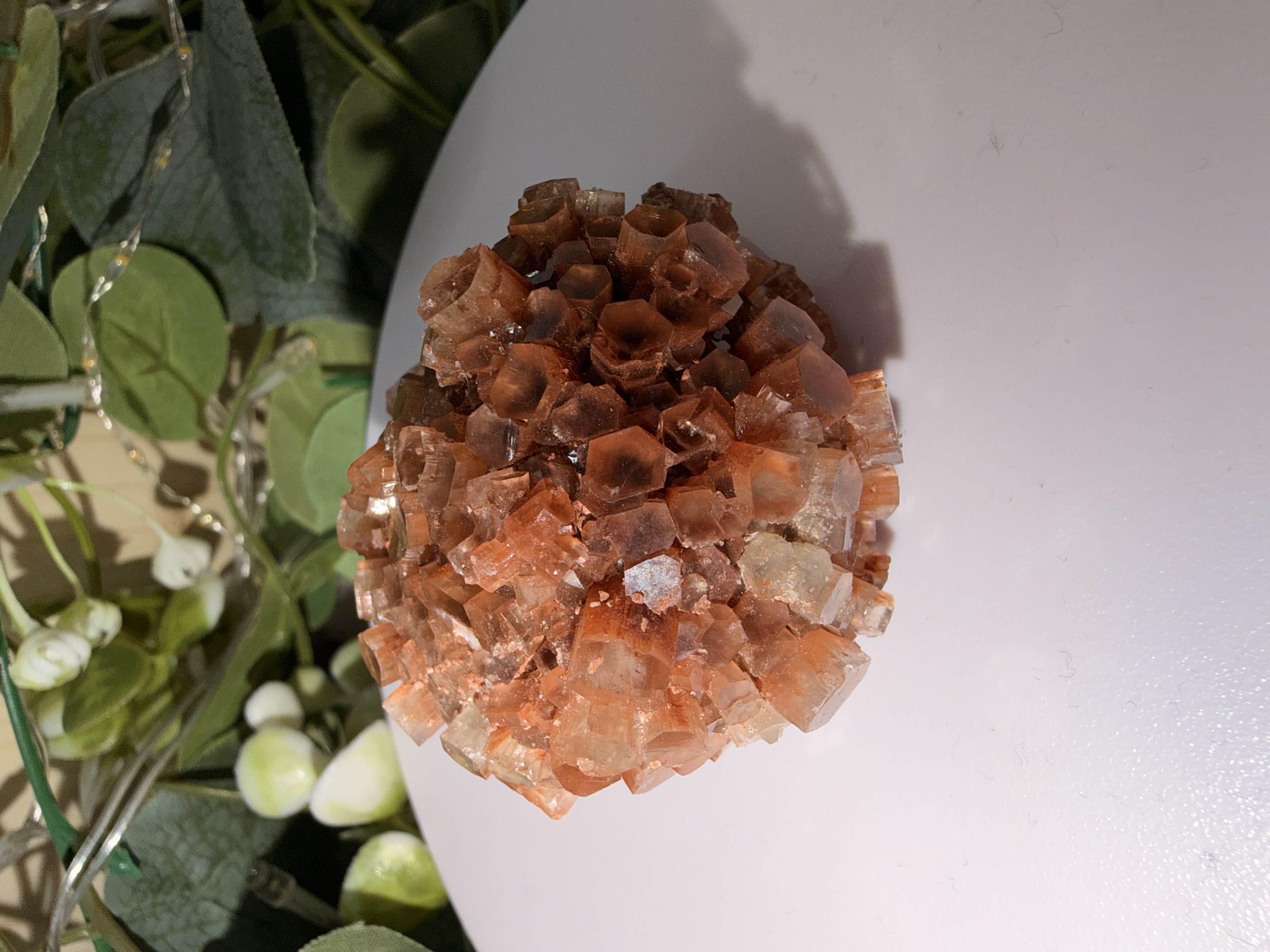
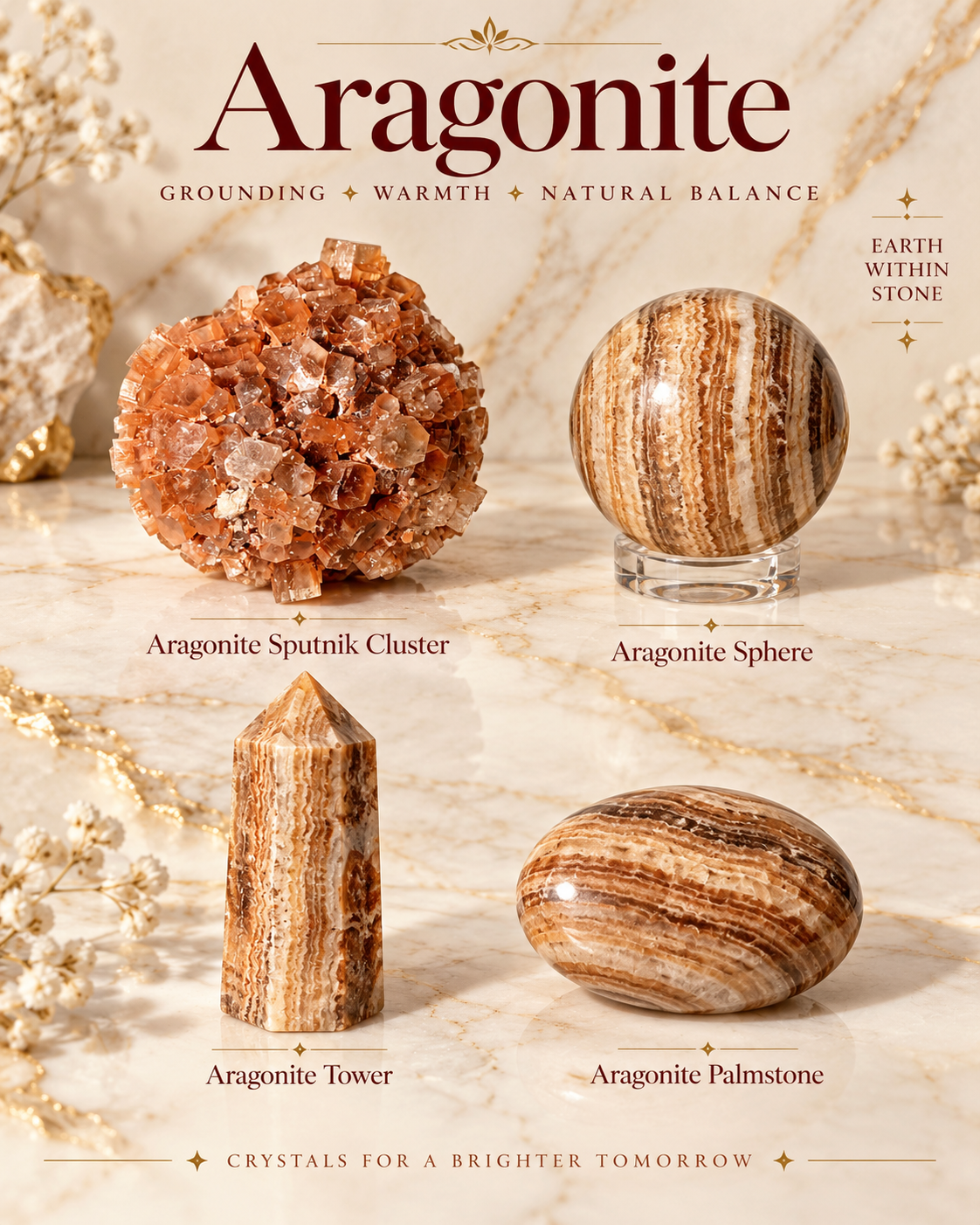
Aragonite is a calcium carbonate mineral best known for its delicate needles, radiating clusters and pseudo-hexagonal twinned crystals. It shares the same chemical formula as Calcite but has a different internal crystal structure, making it a distinct mineral species.
CWExplore this passport
Showing Science & Formation
Scientific passport
The mineral facts
Observable and measurable properties used to describe and identify this mineral.
- Chemical formula
- CaCO₃
- Mineral class
- Carbonate — Aragonite Group
- Crystal system
- Orthorhombic
- Mohs hardness
- 3.5–4
- Lustre
- Vitreous to resinous
- Streak
- White
- Specific gravity
- Approximately 2.94–2.95
- Transparency
- Transparent to translucent
Common colours
Colourless, white, grey, cream, yellow, brown, reddish, orange, green, blue and violet depending on impurities and inclusions
Cleavage and fracture
Distinct cleavage on one plane, with other cleavage directions much less pronounced; typically sub-conchoidal to uneven fracture
From the Earth
How it forms
The geological processes that create this crystal over time.
Formation
Its geological story
Aragonite commonly forms in low-temperature, near-surface environments where calcium-rich fluids precipitate calcium carbonate. It can develop in caves as stalactites and other speleothems, around hot springs, in marine sediments, in evaporitic environments and in mineral veins. Aragonite also forms biologically. Many marine organisms build shells or skeletal structures from Aragonite, including corals and numerous molluscs. The mineral can form under conditions where Aragonite is initially favoured over Calcite even though Calcite is generally the more stable form of calcium carbonate at ordinary surface conditions. Over geological time, Aragonite may therefore transform into Calcite. Mindat describes Aragonite as metastable relative to Calcite and notes that environmental changes can promote this conversion.
A closer look
Scientific notes
Aragonite is a genuine mineral species and the principal member of the Aragonite Group. Its most important scientific relationship is with Calcite. Both minerals are: CaCO₃ But: Aragonite = orthorhombic Calcite = trigonal This difference in atomic structure causes them to have different crystal shapes, densities and physical behaviour despite their identical chemical composition. Aragonite is denser than Calcite, with a specific gravity around 2.95 compared with approximately 2.71 for Calcite. Cyclic twinning is extremely common in Aragonite. Several orthorhombic crystals can intergrow in repeated orientations, creating pseudo-hexagonal prisms or radiating forms.
Passport stamps
Where in the world?
Important countries, regions and mineral localities connected with this crystal.
Spain
Gallo River, Molina de Aragón, Guadalajara
Castile-La Mancha
Molina de Aragón is the type locality of Aragonite and the place from which the mineral ultimately received its name. The Gallo River locality is specifically recorded as the type locality, making it historically one of the most important Aragonite locations in the world.
Morocco
Tazouta diggings, Sefrou Province
Fès-Meknès
Tazouta is one of the best-known modern sources of the radiating brown and reddish Aragonite clusters often sold as Sputnik Aragonite. Mindat notes that the locality has sometimes incorrectly been called the “Tazouta Mine”; it is more accurately described as a collecting or digging area because there was no conventional mine there.
Austria
Styrian Erzberg, Eisenerz
Styria
The Styrian Erzberg is historically important for the extraordinary Aragonite variety Flos Ferri, meaning “flowers of iron”. This form develops as delicate, branching, coral-like or helictitic growths and was originally reported from the Erzberg area.
Italy
Agrigento Province and historic sulphur-mining districts
Sicily
Sicily contains numerous documented Aragonite localities, particularly around Agrigento and historic sulphur deposits. Aragonite there may occur with native sulphur, Celestine, Calcite and Gypsum, demonstrating another geological setting in which calcium carbonate crystallises as Aragonite rather than Calcite.
Italy
Poggio Balate, Termini Imerese, Palermo
Sicily
Poggio Balate is another documented Sicilian Aragonite locality and has produced collectible crystal specimens. Including it helps show how widespread and varied Aragonite occurrences can be even within one island.
Crystal Detective
Look closely. Ask better questions.
Safe observations at home are separated from professional laboratory identification. No single home test can prove every specimen's identity or origin.
Safe checks at home
Look first at the crystal habit. Aragonite commonly forms as: - radiating needle clusters - starburst or “Sputnik” formations - long prismatic crystals - pseudo-hexagonal twinned crystals - fibrous or columnar masses The radiating Sputnik habit is particularly characteristic. Aragonite is softer than Quartz, so avoid scratch testing valuable specimens. Because Aragonite is calcium carbonate, it can react with acids. However, I would not recommend acid testing a collectible piece, because the test can permanently damage the surface. Aragonite and Calcite can look very similar, so crystal shape and density are often more useful than colour.
Professional methods
X-ray diffraction is one of the clearest ways to distinguish Aragonite from Calcite because their crystal structures produce different diffraction patterns. Raman spectroscopy and infrared spectroscopy can also identify the calcium carbonate polymorph. Polarised-light microscopy can distinguish Aragonite based on its optical behaviour. Specific gravity measurement is useful because Aragonite is noticeably denser than Calcite. SEM imaging may be used to examine crystal morphology, while elemental analysis will confirm calcium carbonate chemistry but cannot by itself distinguish Aragonite from Calcite because both have the same elemental composition.
Imitations and treatments
Aragonite may be confused with Calcite, especially when both occur as pale, cream or brown carbonate material. Radiating Aragonite clusters can also be mistaken for similar needle-like mineral aggregates. Some Aragonite sold in bright colours may be dyed, particularly very vivid blue, pink, green or purple material. Dyed specimens may show unnaturally intense colour concentrated in cracks or porous areas. Some polished commercial material sold simply as Aragonite may actually contain mixtures of Aragonite, Calcite or other carbonate minerals. Natural Sputnik Aragonite should normally display irregular crystal growth rather than perfectly uniform artificial-looking spikes.
The Mythical Library
Stories carried through time
Folklore can be enjoyed without confusing it with evidence. Where a popular tale is a later retelling, the passport says so.
The Mythical Library
Choose a book to enter the full-screen reader.
Beliefs, traditions and cultural context
What people have believed
Aragonite has a documented mineralogical history dating back centuries, but many of the spiritual meanings attached to it today are modern crystal traditions rather than ancient beliefs associated specifically with the mineral name Aragonite. Contemporary crystal spirituality commonly associates Aragonite with grounding, patience, stability, discipline and connection with the Earth. Radiating Sputnik Aragonite is sometimes symbolically associated with expanding outward from a stable centre, because its crystals grow in many directions around one core. Brown and orange Aragonite are often linked in modern crystal practices with the Root and Sacral chakras, while lighter specimens may be given different associations depending on colour. These spiritual interpretations are contemporary symbolic beliefs and are not scientifically demonstrated medical, psychological or physical effects. Its scientifically established importance lies instead in its unusual crystal structure, its relationship with Calcite, its role in caves and marine environments and its occurrence in biological shells and skeletons.
Handle thoughtfully
Safety notes
Finished Aragonite specimens are generally safe for normal handling. Because it is relatively soft and brittle, the main everyday risk is physical damage to the specimen rather than toxicity. Radiating clusters can have sharp needle-like crystal tips, so handle them carefully. Grinding, cutting or polishing Aragonite creates mineral dust that should not be inhaled. Use wet-working methods, eye protection and appropriate respiratory protection during lapidary work. Avoid ingesting mineral powders or placing untreated specimens in drinking water.
Keep it beautiful
Care and cleaning
Aragonite is relatively soft and fragile. Clean it gently with a soft dry brush or slightly damp cloth. Avoid prolonged soaking, aggressive scrubbing or high-pressure water on delicate needle clusters. Do not use acidic cleaners such as vinegar because calcium carbonate minerals react with acids. Avoid ultrasonic and steam cleaners, particularly for radiating or fractured specimens. Keep Aragonite away from harder minerals such as Quartz, which can easily scratch it. Store delicate Sputnik clusters where the projecting crystals cannot be knocked or crushed.
Follow the evidence
Sources and further reading
We show the references used while researching this passport so visitors can check important claims and continue learning.
- 1
Overview
Aragonite: Mineral information, data and localities
Mindat.org contributors · Mindat.org / Hudson Institute of Mineralogy · Continuously updated database
Primary mineralogical reference for Aragonite, including its CaCO₃ composition, orthorhombic crystal system, physical properties, polymorphic relationship with Calcite, crystal habits and worldwide occurrences.
Checked 26 Sept 2026
- 2
Localities
Molina de Aragón, Guadalajara, Spain
Mindat.org contributors · Mindat.org / Hudson Institute of Mineralogy · Continuously updated database
Used to document the Gallo River locality at Molina de Aragón as the type locality of Aragonite and to support the historic geographic origin of the mineral name.
Checked 26 Sept 2026
- 3
Localities
Tazouta Diggings, Sefrou Province, Morocco
Mindat.org contributors; locality references include Steffen Jahn, Rainer Bode, Peter Lyckberg, Olaf Medenbach and Hans-Jürgen Lierl · Mindat.org / Hudson Institute of Mineralogy · Continuously updated database
Important reference for Moroccan Aragonite clusters. Also confirms that the locality is more accurately described as Tazouta diggings rather than the frequently used but misleading “Tazouta Mine”.
Checked 26 Sept 2026
- 4
Localities
Flos Ferri
Mindat.org contributors · Mindat.org / Hudson Institute of Mineralogy · Continuously updated database
Used for the unusual branching Aragonite variety Flos Ferri. The name means “flowers of iron”, and the variety was originally reported from the Styrian Erzberg at Eisenerz, Austria.
Checked 26 Sept 2026
- 5
Localities
Aragonite from Styrian Erzberg, Eisenerz, Austria
Mindat.org contributors · Mindat.org / Hudson Institute of Mineralogy · Continuously updated database
Supports the Styrian Erzberg locality and documents both ordinary Aragonite and the Flos Ferri variety from the historic iron-mining district.
Checked 26 Sept 2026
- 6
Localities
Aragonite from Sicily, Italy
Mindat.org contributors · Mindat.org / Hudson Institute of Mineralogy · Continuously updated database
Documents numerous Sicilian Aragonite occurrences, particularly within Agrigento Province and historic sulphur-mining districts, together with associated minerals such as native sulphur, Celestine, Calcite and Gypsum.
Checked 26 Sept 2026
- 7
Home identification
Aragonite: Mineral information, data and localities
Mindat.org contributors · Mindat.org / Hudson Institute of Mineralogy · Continuously updated database
Used for diagnostic properties including orthorhombic symmetry, characteristic cyclic twinning, pseudo-hexagonal crystals, radiating habits, hardness, density and comparison with other carbonate minerals.
Checked 26 Sept 2026
- 8
Laboratory identification
Aragonite: Mineral information, data and localities
Mindat.org contributors · Mindat.org / Hudson Institute of Mineralogy · Continuously updated database
Used for Aragonite's structural relationship with Calcite and other CaCO₃ polymorphs. Laboratory techniques such as X-ray diffraction and Raman spectroscopy can distinguish the different crystal structures even though their basic chemical composition is identical.
Checked 26 Sept 2026
- 9
Fakes and treatments
Aragonite: Mineral information, data and localities
Mindat.org contributors · Mindat.org / Hudson Institute of Mineralogy · Continuously updated database
Used as the baseline mineralogical reference for distinguishing genuine Aragonite from Calcite and other lookalike carbonate specimens. Brightly coloured commercial specimens should be assessed separately for possible dyeing or treatment.
Checked 26 Sept 2026
- 10
Myths and folklore
Forever SnS Mythical Library — Original Aragonite Folklore
Forever SnS · Forever SnS Ltd · 2026
The Star That Grew Beneath the Earth and The Two Stones With the Same Name are original contemporary Forever SnS folklore. They are inspired by genuine Aragonite crystal habits and its polymorphic relationship with Calcite but are not presented as Spanish, Moroccan, Austrian or other traditional cultural legends.
Checked 26 Sept 2026
- 11
Beliefs and traditions
The Crystal Bible Volume 1
Judy Hall · Godsfield Press / Hachette UK · 2003
Used only to document contemporary crystal-spiritual associations surrounding Aragonite. These interpretations are treated as modern beliefs and symbolism rather than scientific or medical evidence.
Checked 26 Sept 2026
From the Forever SnS collection
Shop products featuring Aragonite
Each listing shows the actual product details, photographs and current availability.
Passport complete