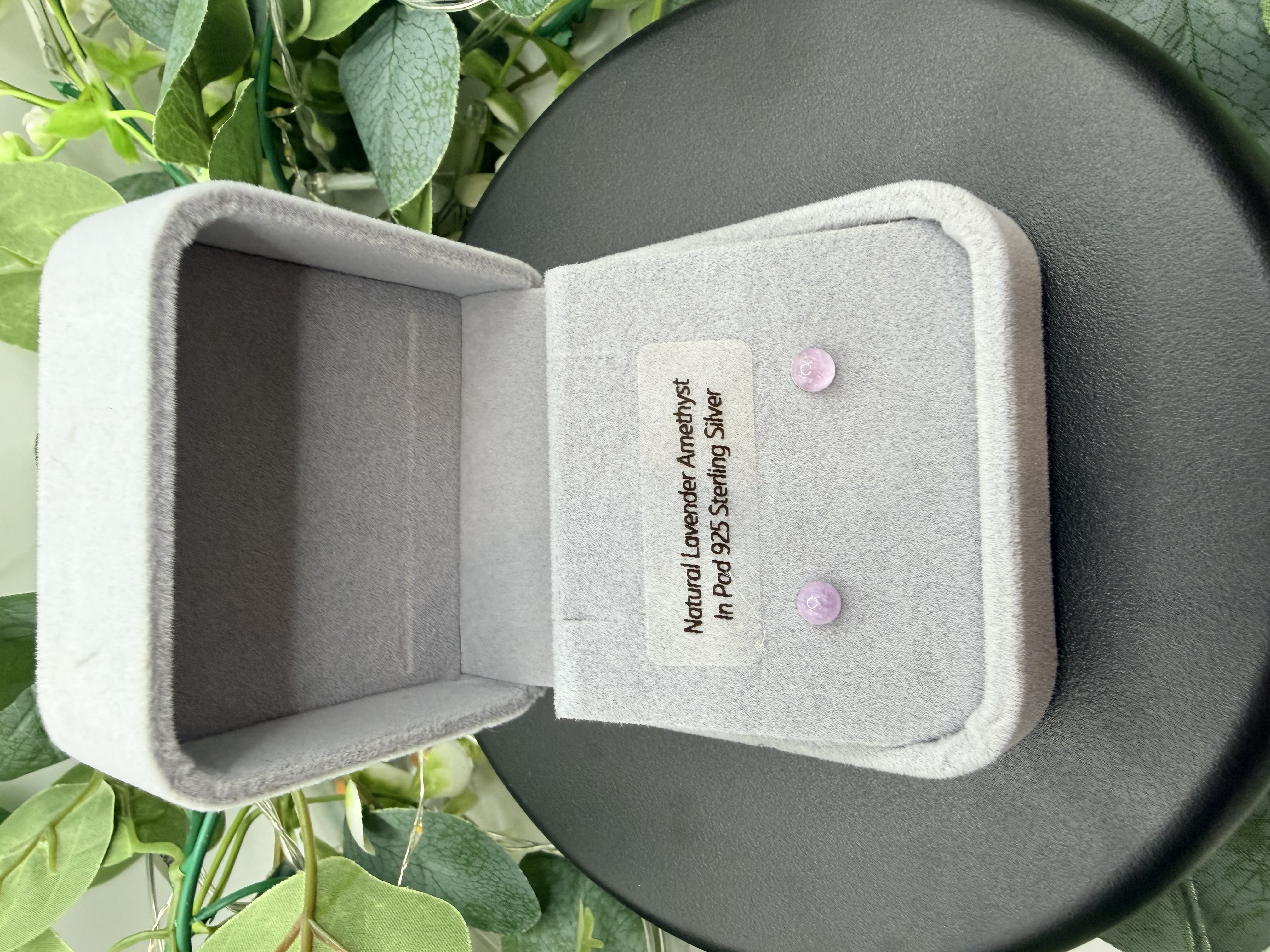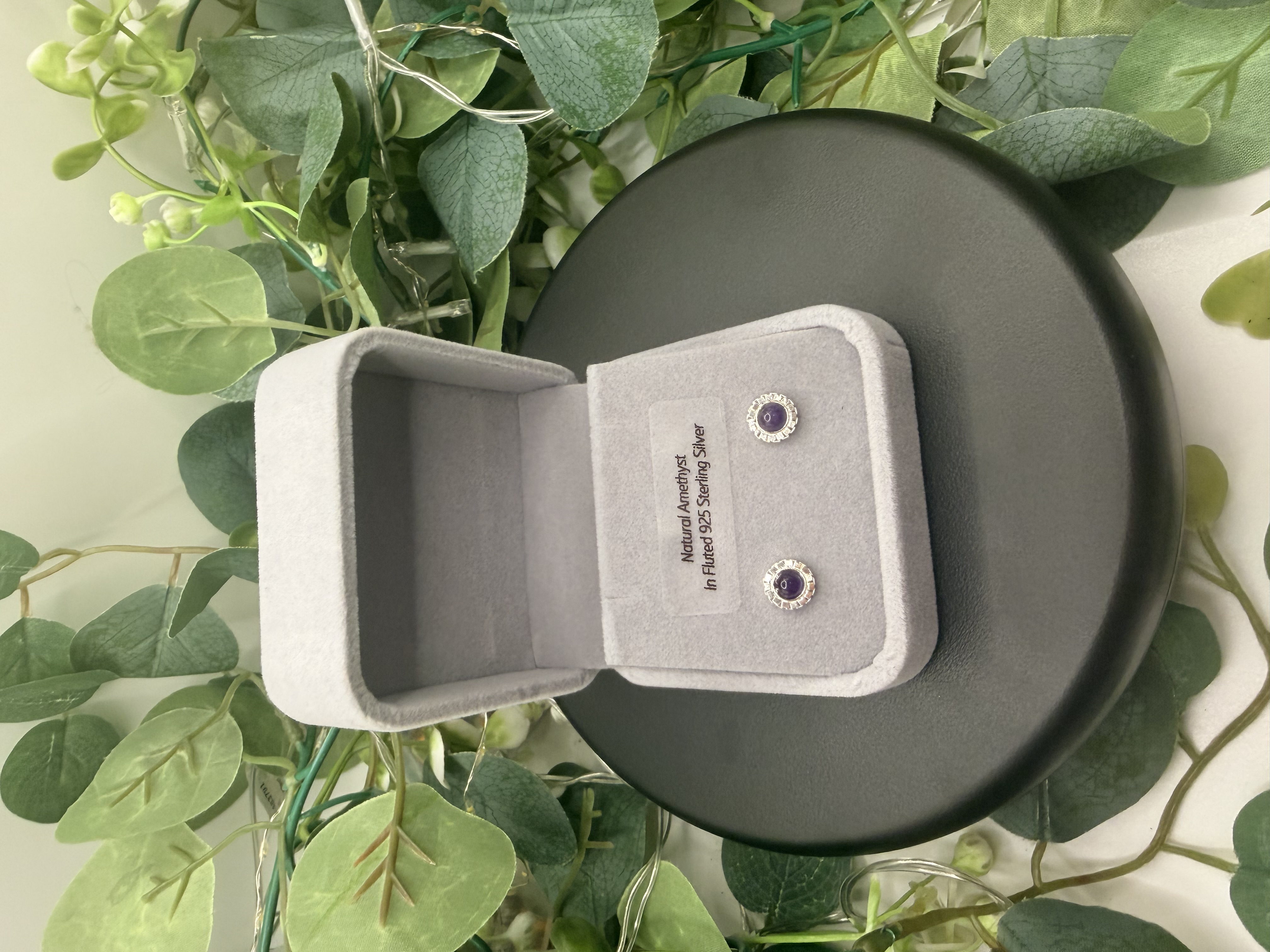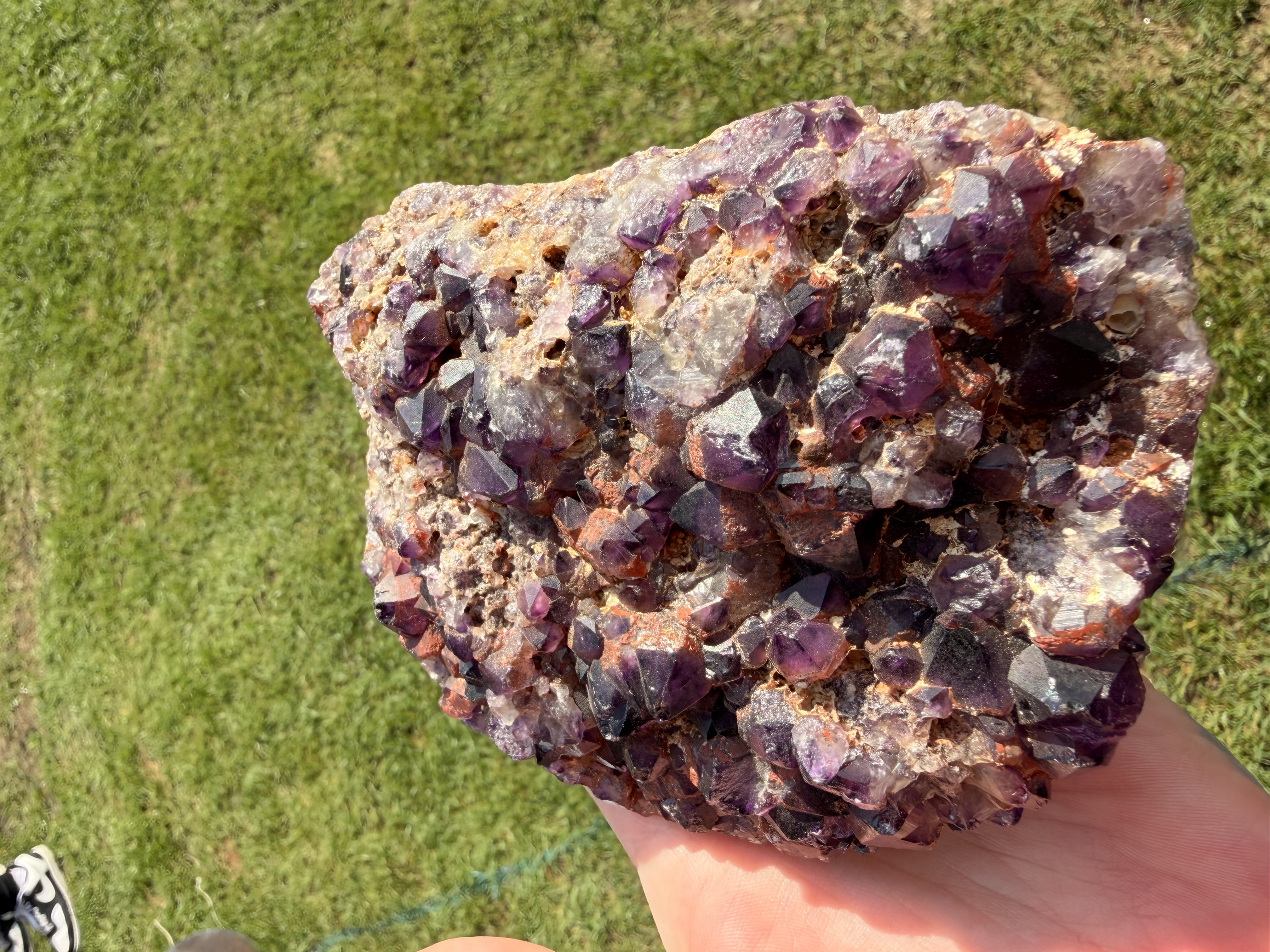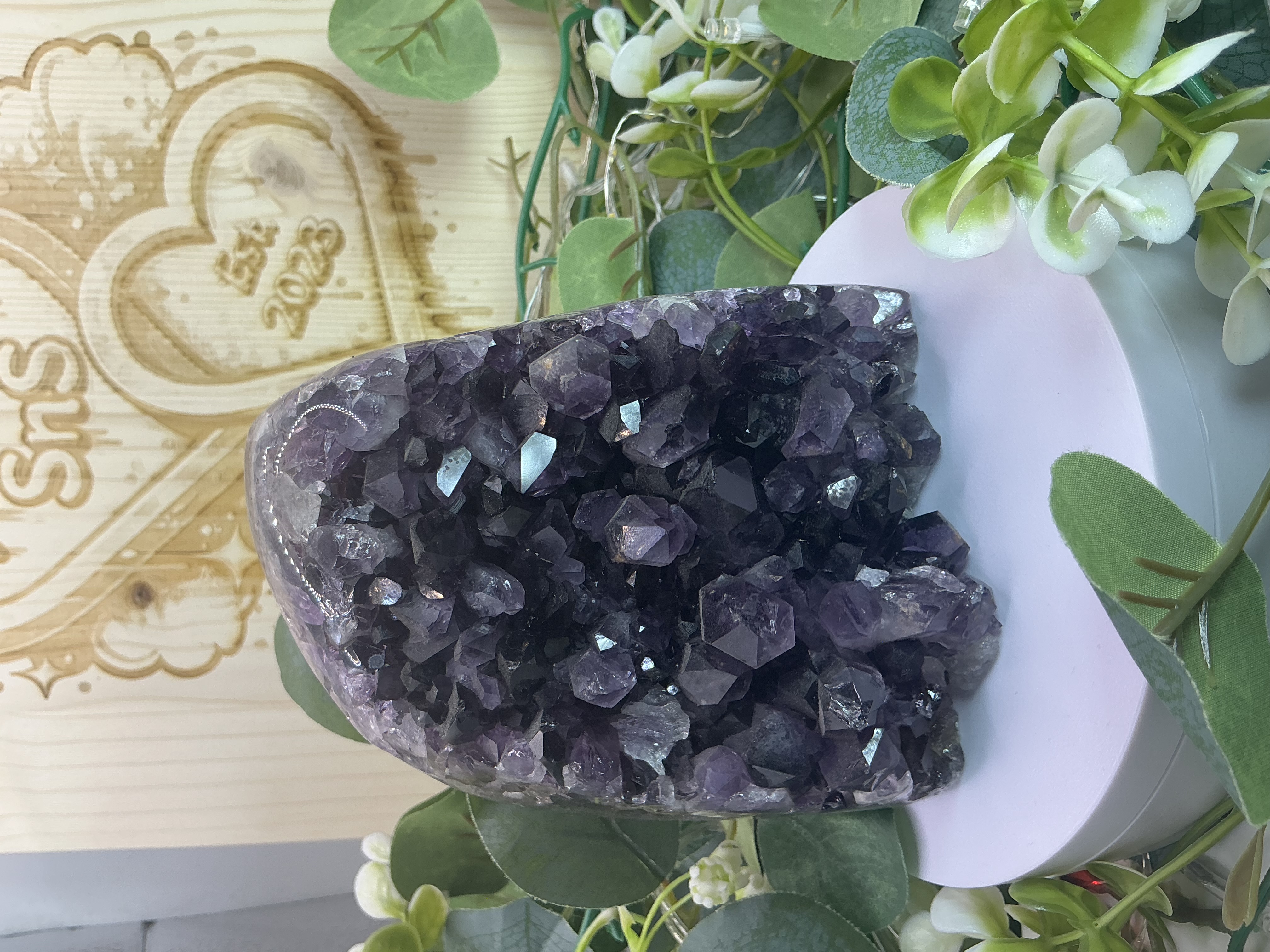
Meet the crystal

Forever SnS Crystal Passport
Amethyst
Pronounced: a - muh - thist
Amethyst is the purple variety of quartz, coloured by iron-related defects and natural irradiation within the crystal. With a Mohs hardness of 7, it forms in geodes and mineral veins and is found worldwide, notably in Brazil, Uruguay and Zambia.
CWExplore this passport
Showing Science & Formation
Scientific passport
The mineral facts
Observable and measurable properties used to describe and identify this mineral.
- Chemical formula
- SiO₂
- Mineral class
- Silicate (tectosilicate); quartz group
- Crystal system
- Trigonal
- Mohs hardness
- 7
- Lustre
- Vitreous
- Streak
- White
- Specific gravity
- 2.65
- Transparency
- transparent to translucent
Common colours
Pale violet, lilac, lavender purple, violet, bluish purple, reddish purple and deep royal purple. Colour zoning from pale to dark purple is also common.
Cleavage and fracture
Amethyst has no true cleavage. It is brittle and normally displays a conchoidal to uneven fracture, which can produce smooth, curved, glass-like broken surfaces.
From the Earth
How it forms
The geological processes that create this crystal over time.
Formation
Its geological story
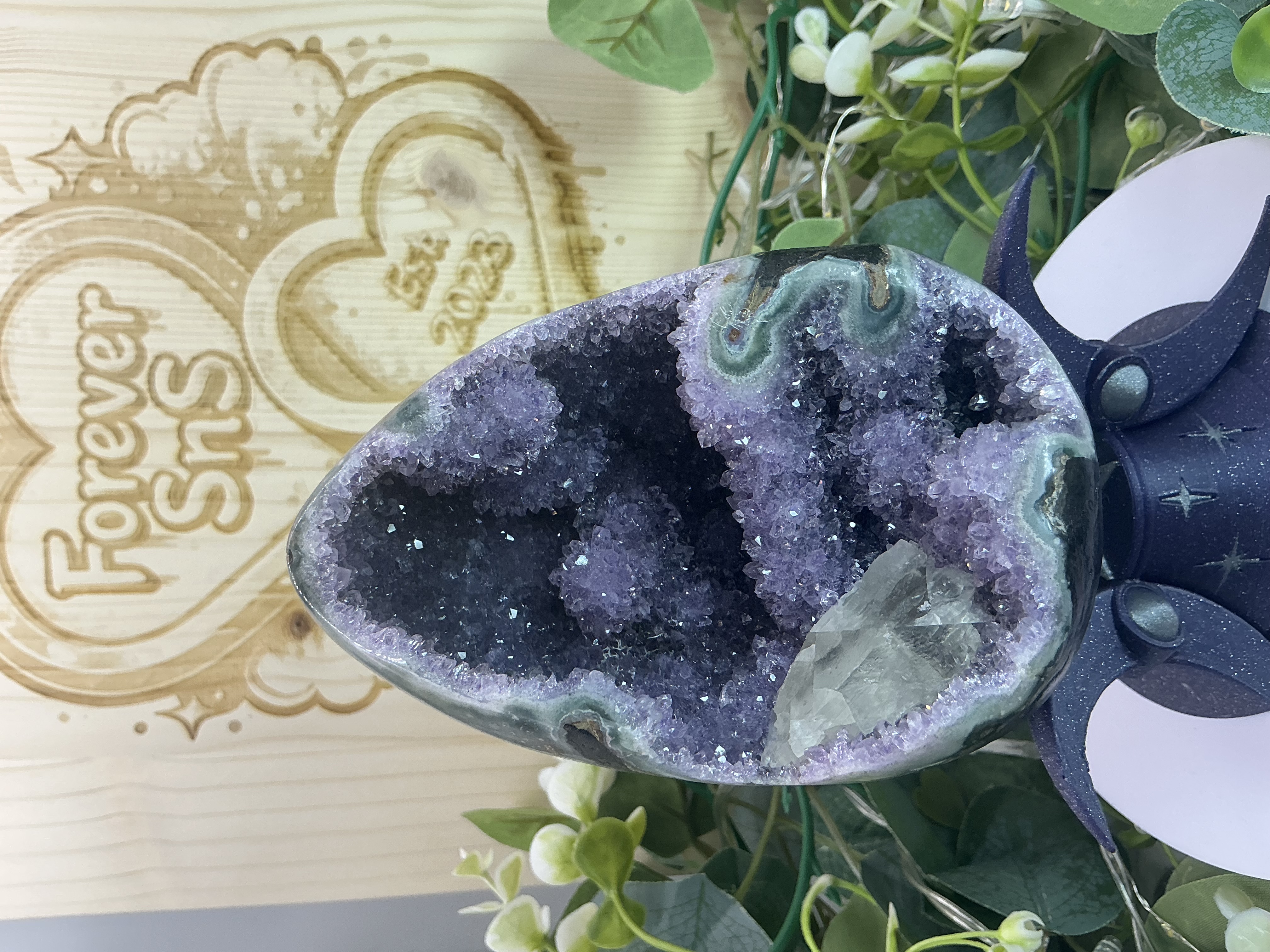
Amethyst grows when silica-rich fluids crystallise inside cavities, fractures and mineral veins. It is especially well known for lining geodes within volcanic basalt. Small amounts of iron become incorporated into the growing quartz, and natural irradiation over geological time creates the colour centres responsible for its purple appearance. Some geodes contain outer layers of chalcedony and colourless quartz before developing amethyst crystals towards the centre.
A closer look
Scientific notes
Amethyst is macrocrystalline quartz composed of silicon dioxide. Its purple colour is produced by iron-related defects in the crystal structure that are activated by natural ionising radiation. Natural specimens may display uneven colour zoning and slightly different bluish-purple and reddish-purple colours when viewed in different directions. Heating amethyst can change it to yellow, orange, brown, colourless or, in some cases, green. Hydrothermal synthetic amethyst has the same basic composition and many of the same physical properties as natural amethyst, so difficult specimens may require professional laboratory testing.
Passport stamps
Where in the world?
Important countries, regions and mineral localities connected with this crystal.
Brazil
Ametista do Sul
Rio Grande do Sul
One of the world’s major amethyst-producing areas. Large crystal-lined geodes occur within basalt and may contain outer layers of chalcedony and colourless quartz.
Uruguay
Artigas mining district
Artigas Department
An important source of basalt-hosted amethyst geodes, often recognised for their small crystals and richly saturated purple colour.
Zambia
Kariba Mine
Zambia is an important commercial source of strongly saturated, high-quality amethyst that is frequently used in jewellery.
Bolivia
Anahí Mine
Santa Cruz Department
This mine produces both amethyst and natural ametrine, in which purple amethyst and yellow citrine occur together within the same crystal.
Crystal Detective
Look closely. Ask better questions.
Safe observations at home are separated from professional laboratory identification. No single home test can prove every specimen's identity or origin.
Safe checks at home
Examine the specimen under bright, neutral lighting and, if available, with a 10× magnifying loupe. Amethyst should have a glassy lustre. Intact crystals may show the familiar six-sided form of quartz, while natural specimens can contain uneven colour zoning, veil-like inclusions and healed fractures. Perfectly round gas bubbles or obvious curved flow lines can suggest purple glass. Purple fluorite is softer than amethyst, commonly forms cubic crystals and has distinct cleavage. Do not scratch a finished crystal or piece of jewellery. Avoid unreliable temperature, water, ultraviolet and “energy” tests. Home observations cannot reliably prove whether an amethyst is naturally formed or laboratory-grown.
Professional methods
A qualified gemmologist may test amethyst’s refractive index, normally approximately 1.544–1.553, birefringence of approximately 0.009, specific gravity near 2.65 and uniaxial optical behaviour. Microscopic examination and a polariscope may reveal growth zoning, inclusions and Brazil-law twinning. Infrared spectroscopy can help distinguish some natural and synthetic amethyst, although no single identifying feature works for every specimen. Raman spectroscopy or X-ray diffraction can confirm that the material is quartz, while advanced spectroscopy and trace-element analysis may be needed for difficult cases. A specimen’s geographic origin usually cannot be proven from appearance alone.
Imitations and treatments
Common alternatives include purple glass, dyed or coated quartz, purple fluorite and hydrothermal synthetic amethyst. Glass may contain round gas bubbles or curved flow lines. Purple fluorite is softer, often forms cubic crystals and has strong cleavage. Synthetic amethyst can look extremely convincing and has the same chemical composition as natural amethyst, so laboratory examination may be necessary. Amethyst colour may be enhanced through irradiation. Heating may change it to yellow, orange, brown or colourless, and some material can become green. Treatments should always be disclosed. Green quartz produced from amethyst is called Prasiolite, while naturally combined purple and yellow quartz is known as Ametrine.
The Mythical Library
Stories carried through time
Folklore can be enjoyed without confusing it with evidence. Where a popular tale is a later retelling, the passport says so.
The Mythical Library
Choose a book to enter the full-screen reader.
Beliefs, traditions and cultural context
What people have believed
The name amethyst comes from the Ancient Greek amethystos, meaning “not intoxicated”. Ancient Greek and Roman traditions connected the purple stone with wine, sobriety and clear-headedness, and later stories linked it with Dionysus or Bacchus. Amethyst has also appeared in religious, ceremonial and royal jewellery throughout history. In modern crystal traditions, it is commonly associated with calmness, protection, meditation, sleep, spiritual awareness and mental clarity. These are historical, cultural and spiritual beliefs rather than scientifically proven medical effects. Amethyst should never be presented as a treatment or used as a substitute for qualified medical care.
Handle thoughtfully
Safety notes
Amethyst is generally safe for normal handling, but broken specimens can have sharp edges. Do not ingest crystals, lick them or use them to prepare drinking water or crystal “elixirs”, because treatments, coatings and associated matrix minerals may be unknown. Cutting, drilling, sanding or polishing quartz can create dangerous respirable crystalline silica dust. It should never be dry-processed at home. Professional dust controls and suitable protective equipment are required. Keep small specimens away from young children and pets.
Keep it beautiful
Care and cleaning
Clean amethyst with warm water, mild soap and a soft brush, then rinse and dry it carefully. Avoid steam cleaners, high temperatures, sudden temperature changes, harsh chemicals and prolonged exposure to intense sunlight. Ultrasonic cleaning is generally considered safe for untreated, unfractured amethyst, but it should be avoided for included, dyed, fracture-filled, mounted or otherwise uncertain specimens. Store amethyst separately to prevent its crystal points from chipping and to stop it scratching softer minerals.
Follow the evidence
Sources and further reading
We show the references used while researching this passport so visitors can check important claims and continue learning.
- 1
Overview
Amethyst Description
Gemological Institute of America (GIA)
Supports the identification of amethyst as purple quartz and its bluish-purple to reddish-purple colour range.
Checked 23 Aug 2026
- 2
Science
Quartz | Common Minerals
University of Minnesota
Supports the chemical formula, hardness, specific gravity, lustre, streak and fracture information for quartz.
Checked 23 Aug 2026
- 3
Science
Quartz (var. amethyst)
Smithsonian National Museum of Natural History
Supports the chemical composition of amethyst and the role of iron and natural radiation in producing its purple colour.
- 4
Localities
February Birthstone: Amethyst
Gemological Institute of America (GIA)
Supports information about important amethyst sources, including Brazil, Bolivia and Zambia.
Checked 23 Aug 2026
- 5
Fakes and treatments
Infrared Spectroscopy of Natural vs. Synthetic Amethyst: An Update
S. Karampelas and colleagues · Gems & Gemology, GIA · 2011
Explains the use and limitations of infrared spectroscopy when separating natural and synthetic amethyst.
Checked 23 Aug 2026
- 6
Myths and folklore
Amethyst History and Lore
Gemological Institute of America (GIA)
Supports the historical association between amethyst, wine, sobriety and Dionysus or Bacchus.
Checked 23 Aug 2026
- 7
Safety and care
Amethyst Care and Cleaning Guide
Gemological Institute of America (GIA)
Supports the advice concerning cleaning, heat, sudden temperature changes and prolonged exposure to strong light.
Checked 23 Aug 2026
- 8
Safety and care
Silica Dust
Health and Safety Executive (HSE)
Supports the warning about respirable crystalline silica dust produced when silica-containing materials are cut, ground or polished.
Checked 23 Aug 2026
From the Forever SnS collection
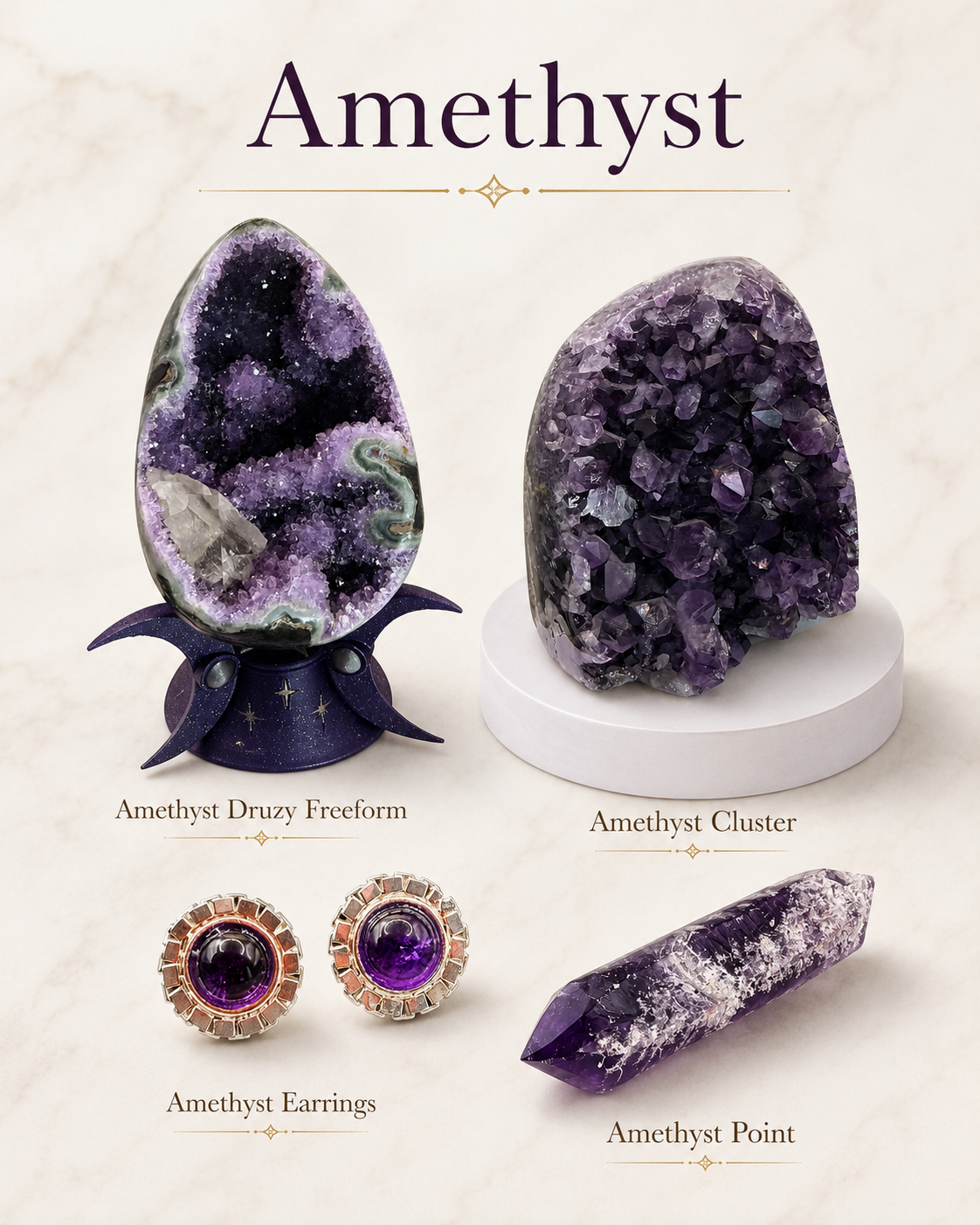
Shop products featuring Amethyst
Each listing shows the actual product details, photographs and current availability.
Passport complete