Meet the crystal

Forever SnS Crystal Passport
Amazonite
Pronounced: AM-uh-zon-ite
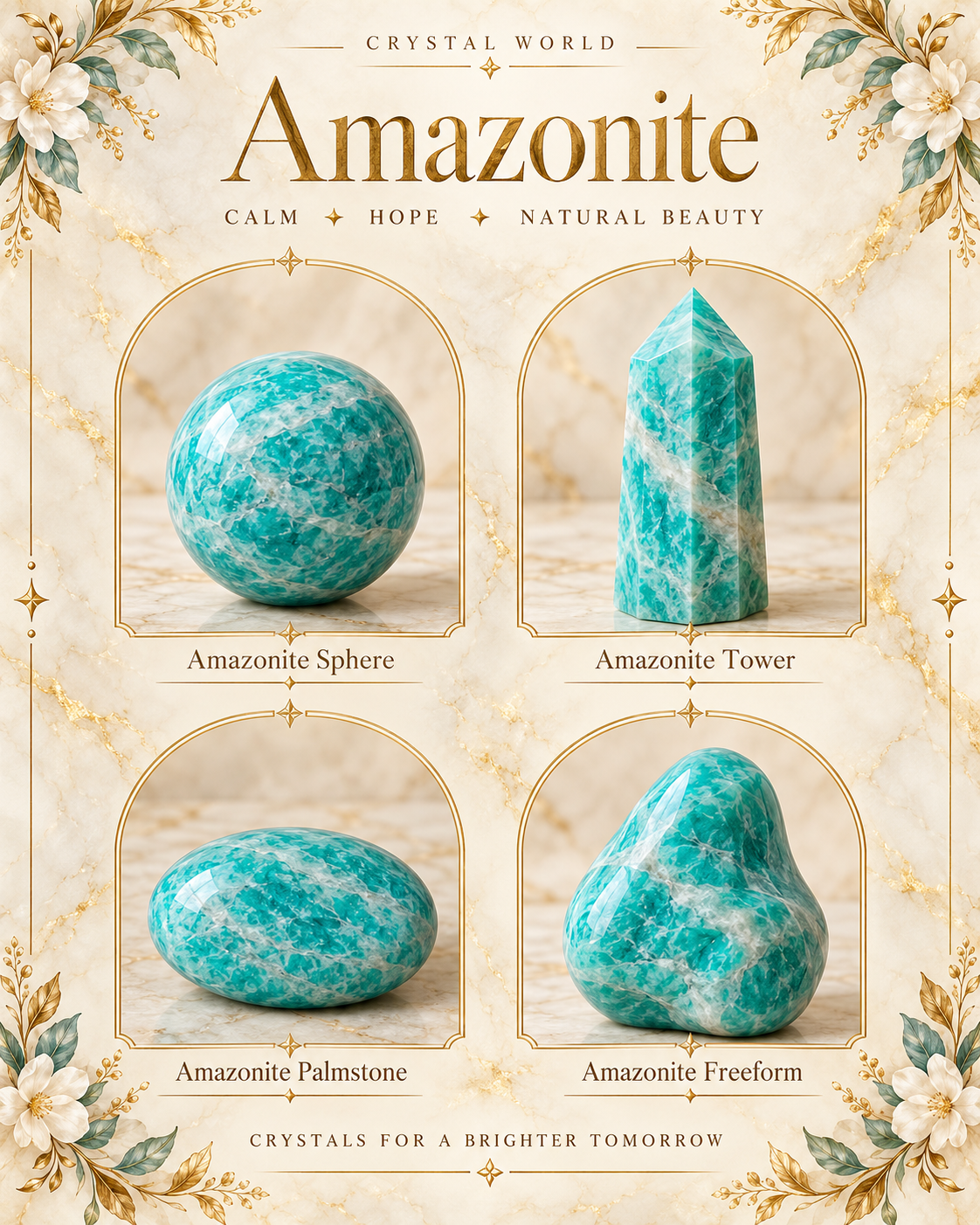
Amazonite is a green to blue-green variety of microcline feldspar valued for its distinctive colour, blocky crystal habit and occasional white streaking or perthitic patterning.
CWExplore this passport
Showing Science & Formation
Scientific passport
The mineral facts
Observable and measurable properties used to describe and identify this mineral.
- Chemical formula
- KAlSi₃O₈
- Mineral class
- Silicate — Feldspar Group
- Crystal system
- Triclinic
- Mohs hardness
- 6–6.5
- Lustre
- Vitreous to pearly
- Streak
- White
- Specific gravity
- Approximately 2.55–2.63
- Transparency
- Transparent to opaque
Common colours
Mint green, blue-green, turquoise-green, pale green and greenish-blue
Cleavage and fracture
Perfect cleavage in two directions; uneven to conchoidal fracture.
From the Earth
How it forms
The geological processes that create this crystal over time.
Formation
Its geological story
Amazonite forms as microcline feldspar in potassium-rich igneous rocks, especially granitic pegmatites. Pegmatites cool slowly and can produce unusually large feldspar crystals. During crystallisation and later structural ordering, microcline develops its characteristic feldspar framework. Trace amounts of lead together with water- or hydroxyl-related structural defects are believed to contribute to the green and blue-green colour seen in Amazonite.
A closer look
Scientific notes
Amazonite is a colour variety of microcline rather than a separate mineral species. Microcline is a potassium feldspar with the composition KAlSi₃O₈. The green to blue-green colour has historically been attributed to several possible causes, but modern research supports a connection involving trace lead and water-related structural defects. Amazonite may show white streaks or perthitic textures caused by fine intergrowths of different feldspar compositions. The name Amazonite is geographically misleading because classic Amazonite deposits are not centred on the Amazon River region.
Passport stamps
Where in the world?
Important countries, regions and mineral localities connected with this crystal.
United States
Pikes Peak Batholith
Colorado
The Pikes Peak Batholith is one of the world’s classic Amazonite-producing regions. Pegmatites and miarolitic cavities throughout the area have produced exceptional blue-green microcline crystals, often associated with Smoky Quartz, Albite and Hematite. Colorado Amazonite is especially famous for strong colour, sharp crystal form and highly collectible Amazonite-Smoked Quartz combinations.
Russia
Ilmen Mountains
Chelyabinsk Oblast
The Ilmen Mountains are one of the classic historic Amazonite-producing regions of Russia. Bright green and blue-green microcline from granitic pegmatites in this area became famous among early European mineral collectors and helped establish Amazonite as a recognised ornamental feldspar variety.
Madagascar
Sahatany Valley
Vakinankaratra
The Sahatany Valley is an important Madagascan pegmatite district that has produced attractive Amazonite alongside many other rare and gem-quality pegmatite minerals. Amazonite is documented from several localities within the valley, including Maharitra, Estatoby, Ambatomalaza and Vohidahy.
Ethiopia
Konso
Southern Ethiopia
Konso is a significant modern Amazonite locality known for exceptionally well-formed green to blue-green microcline crystals. Some crystals reach large sizes and occur with Albite and Smoky Quartz, making the locality particularly important to mineral collectors.
Namibia
Klein Spitzkoppe
Erongo Region
Klein Spitzkoppe is a classic Namibian pegmatite locality famous for excellent feldspar, Topaz, Quartz and other pegmatite minerals. Amazonite occurs here as attractive blue-green areas within well-formed microcline crystals, sometimes showing sharp Carlsbad twinning.
Crystal Detective
Look closely. Ask better questions.
Safe observations at home are separated from professional laboratory identification. No single home test can prove every specimen's identity or origin.
Safe checks at home
Look for green to blue-green feldspar with a slightly blocky appearance and possible white streaks, patches or fine perthitic patterns. Natural colour is usually softer and less perfectly uniform than dyed material. Amazonite commonly shows feldspar cleavage and may display pale white lines or patches. Avoid destructive scratch testing on polished or valuable pieces.
Professional methods
X-ray diffraction can confirm microcline and distinguish it from other feldspars. Raman spectroscopy can identify the feldspar structure. Refractive index and specific gravity testing can support gemological identification. Microscopy can reveal perthitic intergrowths, cleavage and natural internal features. Chemical analysis can detect trace lead and other elements associated with Amazonite colour.
Imitations and treatments
Amazonite may be confused with Turquoise, Chrysoprase, Jade, dyed Quartz, dyed Howlite, glass and other green ornamental stones. Some lower-quality feldspar may be dyed to strengthen its colour. Dyed material may show unusually intense colour concentrated in cracks or porous areas. Glass imitations may appear too uniform and may contain bubbles or an artificial surface sheen.
The Mythical Library
Stories carried through time
Folklore can be enjoyed without confusing it with evidence. Where a popular tale is a later retelling, the passport says so.
The Mythical Library
Choose a book to enter the full-screen reader.
Beliefs, traditions and cultural context
What people have believed
Amazonite has been used as an ornamental and decorative stone for centuries, although historical material described as Amazonite should be treated carefully because older names were not always applied to confirmed microcline. In contemporary crystal spirituality, Amazonite is commonly associated with communication, calm, confidence, balance and self-expression. Its blue-green colour has led modern practitioners to connect it with both the Heart and Throat chakras. Some modern traditions also associate Amazonite with truth, boundaries and emotional balance. These interpretations belong to contemporary crystal spirituality and symbolism and are not scientifically demonstrated medical, psychological or physical effects. Its genuine scientific interest lies in its feldspar structure, trace-element colour mechanism and occurrence in granitic pegmatites.
Handle thoughtfully
Safety notes
Finished Amazonite is generally safe for normal handling. Cutting, grinding or drilling can create fine feldspar and silica-bearing dust that should not be inhaled. Use wet-working methods, suitable respiratory protection and eye protection during lapidary work. Do not ingest powdered mineral material.
Keep it beautiful
Care and cleaning
Clean Amazonite with lukewarm water, mild soap and a soft cloth. Avoid harsh chemical cleaners and sudden temperature changes. Avoid steam and prolonged ultrasonic cleaning because feldspar has good cleavage and may contain fractures. Protect from sharp knocks and drops. Store separately from harder gemstones such as Quartz, Sapphire and Diamond to reduce scratching.
Follow the evidence
Sources and further reading
We show the references used while researching this passport so visitors can check important claims and continue learning.
- 1
Overview
Amazonite
Mindat.org contributors · Mindat.org / Hudson Institute of Mineralogy
Primary mineralogical reference for Amazonite as a green to blue-green variety of potassium feldspar, usually Microcline, including its formula, colour chemistry, naming history and worldwide localities.
Checked 21 Oct 2026
- 2
Localities
Amazonite from Pikes Peak, Colorado, USA
Mindat.org contributors · Mindat.org / Hudson Institute of Mineralogy
Documents Microcline and Amazonite from Pikes Peak, including associations with Smoky Quartz, Goethite, Hematite and Albite.
Checked 21 Oct 2026
- 3
Localities
Amazonite from Pit No. 50, Ilmen Mountains, Russia
Mindat.org contributors · Mindat.org / Hudson Institute of Mineralogy
Documents Amazonite from the historic Ilmen Mountains pegmatite district in Chelyabinsk Oblast, Russia.
Checked 21 Oct 2026
- 4
Localities
Amazonite from Maharitra, Sahatany Valley, Madagascar
Mindat.org contributors · Mindat.org / Hudson Institute of Mineralogy
Documents Amazonite from the Maharitra pegmatite in the Sahatany Valley, one of Madagascar’s important gem and rare-mineral pegmatite districts.
Checked 21 Oct 2026
- 5
Localities
Amazonite from Konso, Ethiopia
Mindat.org contributors · Mindat.org / Hudson Institute of Mineralogy
Documents world-class Amazonite crystals from Konso, including large green crystals associated with Albite and Smoky Quartz.
Checked 21 Oct 2026
- 6
Localities
Amazonite from Klein Spitzkoppe, Namibia
Mindat.org contributors · Mindat.org / Hudson Institute of Mineralogy
Documents Amazonite-bearing Microcline from Klein Spitzkoppe, associated with Quartz, Topaz, Schorl, Phenakite and other pegmatite minerals.
Checked 21 Oct 2026
- 7
Laboratory identification
A Spectroscopic Study of Irradiation Coloring of Amazonite: Structurally Hydrous, Pb-Bearing Feldspar
Anne M. Hofmeister and George R. Rossman · Mineralogical Society of America · 1985
Important spectroscopic study showing a strong relationship between lead, structural water and irradiation in the formation of Amazonite colour centres.
Checked 21 Oct 2026
- 8
Myths and folklore
Forever SnS Mythical Library — Original Amazonite Folklore
Forever SnS · Forever SnS Ltd
The Stone Named for a River That Never Knew It and The Colour Hidden in the Feldspar are original contemporary Forever SnS stories inspired by Amazonite’s unusual naming history and genuine colour chemistry. They are not presented as ancient or traditional folklore.
Checked 21 Oct 2026
- 9
Beliefs and traditions
Forever SnS — Modern Amazonite symbolism context
Forever SnS · Forever SnS Ltd · 22026
Used to separate contemporary crystal symbolism from mineralogical and historical fact. Associations with communication, calm, confidence, balance and self-expression are presented only as modern beliefs.
Checked 21 Oct 2026
Passport complete
